I started serious Investing Journey in Jan 2000 to create wealth through long-term investing and short-term trading; but as from April 2013 my Journey in Investing has changed to create Retirement Income for Life till 85 years old in 2041 for two persons over market cycles of Bull and Bear.

Since 2017 after retiring from full-time job as employee; I am moving towards Investing Nirvana - Freehold Investment Income for Life investing strategy where 100% of investment income from portfolio investment is cashed out to support household expenses i.e. not a single cent of re-investing!

It is 57% (2017 to Aug 2022) to the Land of Investing Nirvana - Freehold Income for Life!


Click to email CW8888 or Email ID : jacobng1@gmail.com


Welcome to Ministry of Wealth!

This blog is authored by an old multi-bagger blue chips stock picker uncle from HDB heartland!

"The market is not your mother. It consists of tough men and women who look for ways to take money away from you instead of pouring milk into your mouth." - Dr. Alexander Elder

"For the things we have to learn before we can do them, we learn by doing them." - Aristotle

It is here where I share with you how I did it! FREE Education in stock market wisdom.

Think Investing as Tug of War - Read more? Click and scroll down


Important Notice and Attention: If you are looking for such ideas; here is the wrong blog to visit.

Value Investing
Dividend/Income Investing
Technical Analysis and Charting
Stock Tips

Showing posts sorted by date for query serious investing. Sort by relevance Show all posts

Sunday, 26 June 2022

Timing Is Everything. Yes?

 Read? Timing Is Everything. No?

Really true even in investment training space. Timing is everything and when timing turned sour or bad then trouble begins!

Those days when Uncle8888 started serious attentions into into Market - Option trading for passive income was so hot! Big option trading booths especially Freely School Of Options Trading at investment seminars giving out door gifts at the main entrance. Shiok! 

Read? Smart Money Grabbers over dummy investors (9) - Mai siao siao. Course conducted by Dr.

Read? MAS: Don't trade in binary options on unregulated platforms

Read? Smart Money Grabbers over dummy investors - III

Actually; Uncle8888 likes to attend these free previews if they provide free makan. Why not when he has plenty of free time and no additional transport cost to these venues as he is on monthly pass.

Read? No selling free investment webinar

Timing is everything even in investment training space. 

Right timing to sell hot courses. 

From option trading to value/growth investing, passive income/from S-REITs, not enough capital to build retirement income from S-REITs? Don't worry. Just leverage up!

Then S-Reits to Crypto and soon back to pivoting to growth investing?

Timing Is Everything. Yes or No?


Friday, 20 August 2021

Singapore Stock Market Is Crap! Can Panda/Koala Investors Still Survive On Scraps???

 Singapore stocks: Once bitten, twice shy

Why retail investors are shifting away from the local bourse, and how SGX plans to stay ahead

UMA DEVI

umadevi@sph.com.sg@UmaDeviBT

AS a seasoned stock market investor since the 1990s, Ken is no stranger to market fluctuations and paper losses. As of today, the 56-year-old has lost some S$300,000 in the Singapore stock market, while his investments in the United States and Hong Kong have given him sizeable profits. "Retail investors don't have much confidence here, they're getting toasted," he tells The Business Times. "I've lost so much money that I'm scared."

While Singapore continues to be lauded as a financial hub, drawing big business and billions in foreign investment, the local stock market appears to have lost some of its appeal to retail, or non-professional, investors like Ken. Concerns like regulatory lapses and lack of liquidity, he says, have diminished confidence.

"I would generally avoid the Singapore market unless there are sound stocks like the blue-chips," he says, "but I have allocated less for Singapore unless we see a marked improvement in the supervisory environment here".

Some of Ken's biggest losses in the local market to date include S$20,000 in embattled commodities trading company Noble Group, and about S$200,000 in entertainment production company Spackman Entertainment Group which has incurred the ire of regulator Singapore Exchange Regulation (SGX RegCo) for issues related to its management and certain acquisitions, and is currently trading at about 0.5 Singapore cent. The counter's high was 50.5 cents back in July 2014.

It is a similar situation for 65-year-old retiree CK Law. He has been investing since 2000, and has been more active in the stock market since his retirement last year. (Same time investing as Uncle8888 and same age some more)

The Covid-19 pandemic made things worse. Mr Law, who invests only in Singapore, is now staring at a "six-figure paper loss" while his friends are reaping gains from rallies in other markets around the world.

Since the end of March 2020 when the Covid-19 pandemic decimated most stock markets around the world, the benchmark Straits Times Index is up about 24.4 per cent. In comparison, the Shanghai and Hong Kong markets are up 26 per cent and 7.3 per cent respectively, while the Malaysia market is up 12.1 per cent. Key Wall Street indices are also up. The Dow Jones Industrial Average has risen 59.1 per cent, the Nasdaq has added 88.9 per cent, while the S&P 500 is up 70.5 per cent.

Declining investor confidence

Although the Singapore market is known for its stability, some have identified shortcomings that could threaten its ability to attract investor interest. Younger investors also appear to be shying away from the local bourse.

Investment analyst Jennifer Franslay says her current portfolio allocations are 60 per cent in the US, 30 per cent in the rest of Asia, and 5 per cent each in Singapore and cryptocurrencies. The 25-year-old says that her US holdings have recovered to pre-Covid levels, while most of her Singapore holdings are still in the red.

"When someone invests in the Singapore market, they're losing out on all the gains they can get from overseas markets, which is why I find it quite unattractive," she says.

Financial adviser Liu Minghao says the market movement of the Singapore market is "way too small" compared to that of the US. The types of counters listed in Singapore also have limited appeal, he suggests.

"In Singapore, we all know about Walmart and probably invest in it, but I doubt there is anyone in the US looking to buy Sheng Siong shares," says the 25-year-old.

In order to shore up retail activity, the Singapore stock market needs to urgently improve on two things - liquidity and attracting "good quality companies", says S Nallakaruppan, president of the Society of Remisiers.

Homegrown unicorns like Grab and SEA are venturing abroad for listings. MyRepublic plans a Hong Kong IPO, while Olam opted for London for the primary listing of its unit Olam Food Ingredients with a concurrent listing on SGX.

A rising number of companies have also come under investigation or have been voluntarily suspended from trading for long periods of time, which he says is the stock market equivalent of a "black hole". Investors are left in the lurch holding "zombie companies".

According to a report from SGX, 56 stocks have been suspended from trading for 12 months or longer as at May this year, while another 9 stocks are set to be delisted in due course. This translates to about 10 per cent of counters currently listed on the bourse. In 2016 when SGX first started giving half-yearly updates of such stocks, there were only 20 stocks on this list.

Mr Nallakaruppan recalls his own experience with railway parts maker Midas Holdings, which shocked shareholders with litigation suits and enforcement orders. The stock has been suspended from trading since February 2018, but remains listed on SGX.

"It's sad when you see all your money wiped out like this, and all these affect investors' confidence overtime," he says. "This isn't like Monopoly money, it's real money that people are losing."

Delistings have also been on the rise, notes Maybank Kim Eng's (MBKE) chief executive Aditya Laroia. "Since 2012, delistings on SGX have outpaced new listings by 40 per cent," he notes. "This is largely driven by the limited niche, specialised sectors offered on SGX compared to other regional exchanges. Notable valuation discounts have been the result, encouraging delistings."

A lack of liquidity has prompted listed companies to head for privatisation, including BreadTalk, Fragrance Group and SK Jewellery.

SGX's latest financial results released on Aug 5 reflect some of these sentiments. SGX posted net profit of S$205.6 million for the second half of FY2021 ended June, down from S$258.6 million in the year-ago period. The group's H2 operating revenue fell 6.8 per cent year-on-year to S$535.1 million, with the decline coming from its equities segment, amid a fall in treasury and other revenue as well as trading and clearing revenue.

For the full FY2021, SGX's largest business segment, equities, saw operating revenue decline 7.7 per cent to S$701.1 million.

SGX market strategist Geoff Howie notes that STI constituent stocks typically "dominate" the inflows and outflows of the Singapore market in terms of market value. However, in July this year, only six out of the 30 stocks that saw the highest net institutional inflows were constituent stocks.

The health of the stock market is largely dependent on the authorities and regulators here, argues Mak Yuen Teen, a corporate governance advocate and associate professor at the National University of Singapore.

Prof Mak notes that 10 years ago, Singapore was home to more than 150 "S-chip" companies, or Chinese companies listed on SGX. This number is down to just 71 today, and could drop even further, he warns.

"Just over the first six months of this year, another six S-chips have disappeared. I am not saying they are all going to collapse, but I think we will continue to see more doing so," he says.

What was once an "S-chip problem" has spread to the rest of the market over the past few years. Big companies like Hyflux and Noble, Singapore-based companies like Best World and Trek 2000, and Eagle Hospitality Trust are some of the names that have collapsed, wiping out investors' money along with them.

Mom-and-pop investors also have limited protection in the market, notes Prof Mak, and may not have the resources to make up for losses. As such, the bourse regulator needs to do more to protect the interests of these investors in terms of holding relevant parties responsible for stock market scandals. These include the likes of company directors, issue managers, sponsors and auditors.

"While SGX Regco has strengthened certain rules and improved its surveillance, and there are signs of them and other regulators stepping up, we have yet to see results," says Prof Mak.

"We should aim for a market with good quality companies, not aim to increase the number of listings regardless of quality."

Changing investment landscape

Over the years, more people have piled into capital markets as they realise the importance of alternative sources of income. Financial literacy too has increased, and with it, awareness of the need to diversify portfolios.

"Singapore investors have become more aware - not just of opportunities but more importantly, risks," says Thomas Rupf, head of VP Bank Singapore.

Financial institutions and brokerages report similar trends. MBKE's Mr Laroia says that in the past, opportunities on the SGX could represent as much as 80 per cent of the bank's retail business.

"One would expect that to be reflective of many firms in Singapore," says Mr Laroia. But investors became "more informed holistically about opportunities globally".

Without commenting on exact proportions, Mr Laroia says the Singapore market is "still a significant portion" of MBKE's retail business, but interest in the US and Hong Kong markets have seen "significant increases" over recent years, and continue to grow.

Samuel Rhee, chairman and chief investment officer of Endowus, says that the firm offers several "ready-made investment portfolios" that are designed to serve different investment objectives. "Most portfolios are globally diversified and Singapore's representation in the global allocation is very small," he says.

"Endowus' clients are generally more interested in global markets which have provided consistently better returns over time than being just exposed to a single market, but most will maintain some small exposure to Singapore."

Exposure to Singapore securities in Endowus's Cash Smart portfolios - which have shorter-term goals - currently range from 16.4 per cent to 30.2 per cent. The Selected General Investing portfolios for cash and Supplementary Retirement Scheme (SRS) funds have allocations of 0.11 per cent to 0.63 per cent.

Digital wealth manager Syfe's chief executive Dhruv Arora notes that Singaporeans "already have a lot of exposure to the Singaporean market by working and owning property in Singapore".

"The most attractive and popular overseas markets for our clients are definitely the US and China."

While Syfe's core portfolio, which offers "global diversification", has a "negligible" allocation to Singapore, its real-estate, income-focused portfolio is fully made up of Singapore-listed real estate investment trusts and Singapore government bonds. Its cash management solution, Cash+, has about 50 per cent of its holdings in Singapore through government bonds and investment grade corporate bonds.

Stashaway says: "In general, we try to build portfolios that give our clients as much global exposure as possible for diversification."

A majority of clients at Tiger Brokers have holdings in equities directly, says chief executive Eng Thiam Choon. US holdings are the most popular, with a notional value of about 68 per cent. Hong Kong's stands at 24 per cent, while Singapore has just 5 per cent.

"Today, there is a huge interest in technology and digitalisation due to the pandemic, and the US stock markets are getting more interesting with theirs reputation for attracting big technology companies," says Mr Eng.

Staying ahead of the curve

SGX is ramping up its efforts to provide a diversified experience for investors, and has been increasing its focus on derivatives. The result? An ability to offer investors "two forms of economic participation", says Michael Syn, head of equities at SGX. Mr Syn used to look after SGX's currency and commodity derivatives before he assumed his current position.

"One is ownership, which you do through shares. But the other one is really through the economic ripple effects through the economy," he says, which makes the market "both horizontally and vertically integrated".

SGX had long ago noticed that most customers wanted things that exist both in the stock market and in the futures market, and the exchange has had to adapt accordingly in order to secure a "bigger share of (customers') wallets.

"If I don't do it, someone else will do it, and then they will be number one in Asia," says Mr Syn. He recalls how, a decade ago, investors were interested in China commodities and currency. Three to five years ago, SGX offered access to different countries and themes through launching more currencies and commodities.

Today, the exchange has broadened its range of ESG derivatives even further. In January this year, SGX launched four new derivatives which have been certified by the Commodity Futures Trading Commission, enabling market participants to trade them directly from the US. These include the SGX FTSE Blossom Japan Index Futures and the SGX FTSE Emerging ESG Index Futures.

SGX has also increased its focus on foreign exchange. In June 2020, the exchange fully acquired BidFX - a cloud-based foreign exchange (FX) trading platform for institutional investors. In July 2021, it also acquired global multi-asset execution and order management systems provider MaxxTrader.

But competition is on the rise. SGX is looking to grow its non-equities business, which constitutes commodities, derivatives and FX. This segment has also seen the largest increase in liquidity, says Mr Syn.

"The largest increase in liquidity that we've seen reflects very much Singapore's increasing role in commodities, derivatives, and FX... that's why we derive so much of our revenue and growth from derivatives."

SGX is also actively looking into allowing special purpose acquisition companies (SPACs) to list in Singapore, and is said to be considering lowering the minimum value for SPAC listings, DealStreetAsia reported on Thursday.

Robson Lee, a Singapore-based partner of US law firm Gibson Dunn, says that while there could be some initial interest by promoters and cornerstone investors to set up SPACs in Singapore when this is allowed, sustained demand will depend on the market's ability to attract potential unicorns or serious businesses to list here.

He says: "While finalising the regulatory requirements for SPAC listings, SGX should concurrently address the fundamentals to promote Singapore as a holistic market for high liquidity and sustainably high valuation securities listings in Asia."

For equities, meanwhile, the historical challenge for Singapore is that its market "matures and grows very early", says SGX's Mr Syn. For instance, domestic names such as Singtel and DBS were listed in the 1990s. Today, the exchange is a 50:50 between domestic and international companies, but newer platforms and companies are emerging. And SGX will have to continue to take heavy bets to keep its attractiveness to investors.

Staying ahead of the curve has been the focus of SGX, says Mr Syn.

"I often tell my guys this, it's not because we're smarter. It's because we have to be. Otherwise, there's nothing left for us... Because if we don't anticipate and build in advance of demand, by the time the demand comes, it's very hard for us to compete for attention and for credibility.


Sunday, 18 July 2021

I Am With Earn More Camp - My Own Data Points Proved It! Investing To Win More Than Earned Income Is Not Easy!

Uncle8888 started serious investing on Jan 2000 and after 22 years of days and nights watching financial news and actively monitoring his portfolio; his investment performance is rather flat across market cycles!

Read? Mind Flip (5)

How come?

Never pay for investment training courses to turn $100K to $1M?


Thursday, 4 February 2021

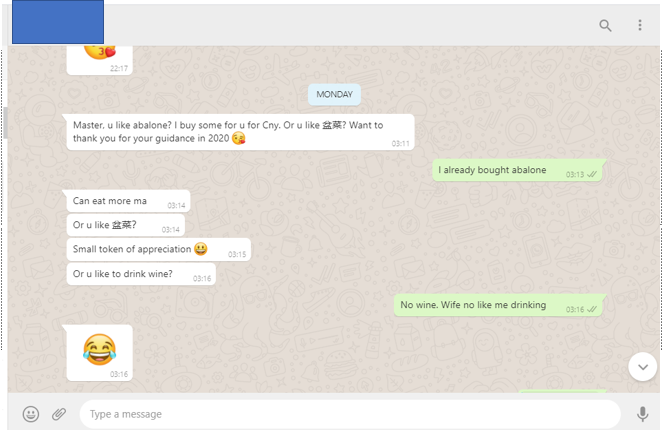
Unexpected Token Of Appreciation From Follower (Ex-colleague)!

CW8888, Uncle8888, or Master8888 LOL!

He has spare $300K as capital to invest as NEWBIE, continue to save under low interest rate or reduce his outstanding housing loan. 

At last CNY makan session (End Jan 2020, STI was falling down like London Bridge) gathering with few other ex-colleagues; he was discussing and exploring options. He already has two investment properties in overseas but he has never in stock market. 

He didn't want more investment into properties so he is considering stock investment.  But as newbie he has no confidence in investing so he wanted to seek guidance from lao jiao who has made it! 

Same same as Uncle8888. Actually; our colleagues or ex-colleagues who are serious lao jiao investors among us are the most practical role model for NEWBIES to seek guidance or investing experience of DO and DO NOT ! 3Ms - Method, Mind and Money Management!

Read? Who influence you into investing?


Monday, 14 October 2019

Can Dividend Investing Support AVERAGE Retirees Over Decades Of Inflation In Their Retirement Lifetime?


Uncle8888 has serious doubt as AVERAGE retiree; he can just depend on dividend investing to support his lifetime household expenses with yearly inflation.

Certainly; he needs more than just dividend investing strategy to be sustainable!

So you believe when you build an investment portfolio to generate the required dividend income to support your household expenses you can FIRE or retire?

Sure?

In long-term investing, your account size really matters - CW8888


Friday, 9 August 2019

Market Timing, Cash Drag And Past Performance

Cash: "Cash drag" is a common source of performance drag in a portfolio. It refers to holding a portion of a portfolio in cash rather than investing this portion in the market.

How bad is cash drag?


Should he be guided by his past performance to look forward?

 Best  : 12% CAGR
 Worse : 1.6% CAGR

Does cash drag and market timing a serious hit in his performance over the next 10 years?

Current with cash drag : 6% CAGR

Let see what happened when he looks back few years down the road.

Let the data and the Maths do the talking!


Friday, 3 May 2019

The Art Of Becoming Millionaire From The Stock Market: The Do and Don't (3)


Read? The Art Of Becoming Millionaire From The Stock Market: The Do and Don't (2)

Is large war chest in your investment portfolio a damn serious drag on cash flow and performance?

But; Uncle8888's experience is somehow not the same feeling. Hmm ...


His current war chest is 1.4 times his initial investing capital on Jan 2000 and since then he has never injected a single cent as capital for last 19 years.


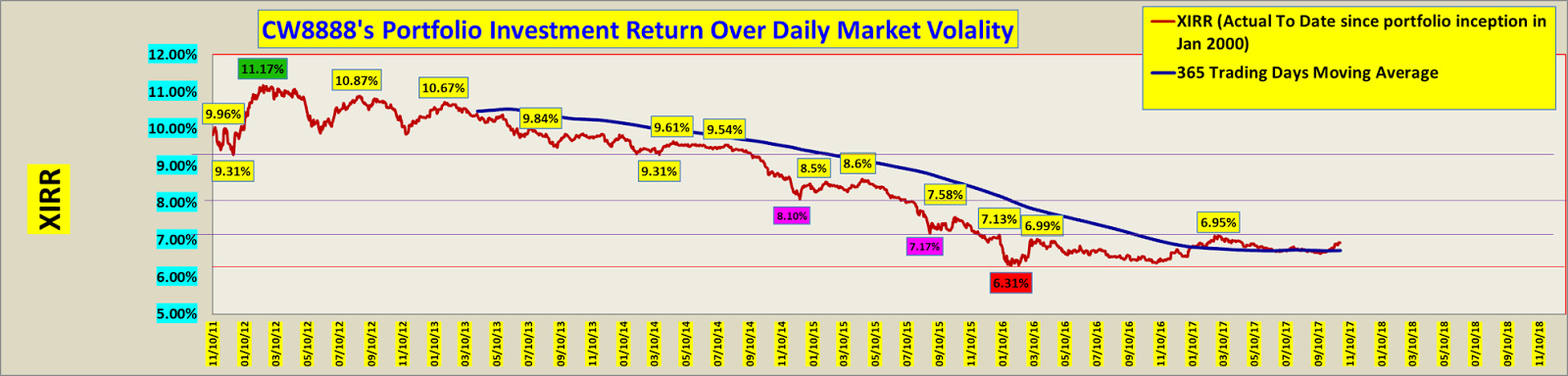
Current YTD yield on capital is 6.5% and long term average yearly yield is 10.3% as of 3 May 2019


Performance over past market cycles of Bulls and Bears as of 3 May 2019, CAGR/XIRR is 6.4% 


How bad is cash drag?


Updated for Warren Buffet for 2018


Sunday, 7 April 2019

The Stocks Manage Themselves


Read? The Stocks Manage Themselves

Uncle8888 really likes these ...


It doesn’t matter if you self-identify as an active or passive investor, the stocks don’t care about you either way. It’s a completely one-sided relationship.


When Ibbotson said it’s “much harder to manage people than it is to manage stocks” he was speaking in terms of running a business but the hardest person to manage is yourself when we’re talking about investing.

Research shows investors who are overconfident in their abilities and assume they’re above average investors trade more frequently. There’s an embedded illusion of control in that we assume doing more will lead to a better result. Of course, the research also shows that those investors who trade more end up with below average results.

We’re all taught at an early age that working harder and giving it 110% will lead to better results. This is true in some endeavors but rarely when it comes to the markets. Trying harder typically leads to worse results because when you press you tend to make mistakes.


There are no extra points awarded for effort or degree of difficulty when investing.


CW8888

Know ourselves and manage ourselves according to our historical investment outcome and performance across past market cycles; refine, revise, or adjust investing strategies to move forward to next market cycles to build wealth or generate cash flow from the stock market according to our investing goals.

Back testing his own past 19 years of data points; he is now more blur.

Is holding too much cash as war chest a serious drag on his investment portfolio performance?

Hmm ...


Monday, 18 March 2019

My Life Journey So Far At One Quick Glance On Mar 2019


My Family 


My Human Asset : Self and career development and dead wood!


My path to pursue financial independence and having option to retire @ 60 from full-time job as employee


My current Net Worth as presented in Three Taps Model solution model. It covers basic retirement planning issues on liquidity, longevity and legacy.

Liquidity : Two years cash reserve in bank for 2019/2020

Longevity : Tap 1 and Tap 2 which are non market volatile fixed assets.

Legacy : Tap 3 which is investment portfolio which is very volatile across future market cycles. 


My current cash flow to fund annual household expenses


Is money enough?


STI since the day I have started serious learning and investing on Jan 2000 to pursue financial independence through short-term trading and long-term investing.

Alamak!

Started investing at the peak of Dotcom Bubble. Wrong market timing!

More capital into the market. More paper losses. Dividends are just Panadols!


My Investment portfolio performance across market cycles since Jan 2000


Any paper gains are an illusion of wealth in the market; but any paper losses can be real losses!

Paper losses become real losses when your losing stocks are suspended, bankrupted and de-listed. You lost 100% of your invested capital. In the other case; your losing stocks are taken private and de-listed; your paper losses become realized losses!

Beware!

Your money management skill through market cycles is the one that can save you from wealth destruction and chop fingers!

So far since Jan 2000, I have three zero baggers which lost 100% of invested capital! 

Why? No stop loss!


Top winners to top losers


Lynch provides insight on how to achieve exceptional results

In an interview he gave to PBS, Peter Lynch discussed what is needed to achieve a track record similar to his. Even though the answer seems simple on the surface, it has many insights that are worth commenting on.

Q: Was that your secret?

A: Well, I think the secret is, if you have a lot of stocks, some will do mediocre, some will do OK, and if one or two of 'em go up big time, you produce a fabulous result. And I think that's the promise to some people. Some stocks go up 20% to 30%, and they get rid of it, and they hold on to the dogs. And it's sort of like watering the weeds and cutting out the flowers. You want to let the winners run. 

When the fun ones get better, add to 'em, and that one winner, you basically see a few stocks in your lifetime, that's all you need. I mean stocks are out there. When I ran Magellan, I wrote a book. I think I listed over 100 stocks that went up over tenfold when I ran Magellan, and I owned thousands of stocks. I owned none of these stocks. I missed every one of these stocks that went up over tenfold. I didn't own a share of them. And I still managed to do well with Magellan. So there's lots of stocks out there and all you need is a few of 'em. So that's been my philosophy. You have to let the big ones make up for your mistakes.

All you need for a lifetime of successful investing is a few big winners, and the pluses from those will overwhelm the minuses from the stocks that don’t work out. - Peter Lynch

No of winning stock pick : 30

No of losing stock pick     : 26

Winners/ Losers ratio = 30 / 26 = 1.2

Such lousy stock picker! How come didn't lose money?

Total Winning $ / Total Losing $ ratio = 2.1


Saturday, 5 May 2018

We Can Learn To Invest Like Warren Buffet In Value Investing???


Of course. We can!

There are quite a number of trainers in Singapore can train you in value investing and then you on your way to become nano value investor like Warren Buffet.

Since Jan 2000 when Uncle8888 became interested and serious in long -term investing and short-term trading; he has been following financial news day and nights and definitely news on Warren Buffet is a must read.

One thing for sure on Warren Buffet that catches his eyes!

Warren Buffet can talk UP the market and talk DOWN the market!

You can meh?

What did you read on Warren Buffet on his latest talk on his investment?


Sunday, 21 January 2018

You Invest What You Can Afford To Lose? Right Or Wrong???


Often we hear this saying in the investment cyberspace or social media : You invest what you can afford to lose and more often this is the general advice to newbies. 


The truth on the ground practice by serious retail investors is  ...

You speculate what you can afford to lose. It is speculating and NOT investing!

You look carefully at many serious retail investors and investment bloggers on what they are doing with their investment portfolio and SINGLE stock positioning and portfolio management. 

It is NOT uncommon for these retail investors to build on single stock position up to X% or investment portfolio up to XX% of their net worth!

X% or XX% of their net worth is NOT something they can afford to lose. Right?


Newbies haven't earn their right to call themselves as investors so they are in fact just speculators. Right?

So the advice is actually : You speculate on what you can afford to lose!


Saturday, 21 October 2017

Is Too Much Cash As War Chest A Stabilizer Or Serious Drag In Our Investment Portfolio Performance???


Is waiting for GSS by Mr. Market good investing idea without sacrificing too much on investment portfortlio peformance?

How many measure their investment performance down to fine detail to know the real impact or we just accept the myth of rotting cash theory?


Sunday, 24 September 2017

One Uncommon Way To Top Up CPF OA Through CPFIS


Read? CPF Contribution and Allocation Rates

Read? 2016 : Key Fact of Household Income In Singapore

Read? Government to review CPF Investment Scheme: DPM Tharman

Read? The Dilemma Of Young Personal Financial Investment Influencers


Few points to take note:

1. The CPFIS was set up to offer CPF members a way to earn higher returns on their savings but it is "not fit for purpose", Mr Tharman told an audience at the Economic Society of Singapore's annual dinner. 

Over the past 10 years, more than 80 per cent of the CPF members who put their savings into an investment product via the CPFIS would have been better off just leaving their money in the Ordinary Account, which earns a guaranteed 2.5 per cent each year, Mr Tharman noted.

Some 45 per cent of those who made use of the CPFIS even made losses over the same period.

2. Maximum CPF allocation to CPF OA is 23% of wage

3. The Ordinary Wage (OW) Ceiling limits the amount of OW that would attract CPF contributions. The OW Ceiling is capped at $6,000 currently. (Before 1 Jan 2016, OW Ceiling was $5,000)

4. Assuming 3 months year end bonus.

5. Median gross monthly income in 2016 is $4,056 and i.e. 68% of OW Ceiling of $6,000


How much can we possibly have in our CPFIS as war chest?

By simplifying the Maths

Maximum mandatory contribution to CPF OA as employees at OW Ceiling = 23% x $6,000 x 15 = $20,700 per year

For 10 years : $207,000 in CPFOA or  35% for CPFIS = $72, 450

For 20 years : $414,000 in CFP OA or 35% for CPFIS = $144,900


For many of us, if not most of us as employees will not have large CPFIS as war chest. Right?


So how to win this CPFIS war game?

Understand their wise words

"It's not whether you're right or wrong that's important, but how much money you make when you're right and how much you lose when you're wrong." ~ George Soros

In the famous book entitled Reminiscences of a Stock Operator, Jessie Livermore said: “After spending many years in Wall Street and after making and losing millions of dollars I want to tell you this: It never was my thinking that made the big money for me. It always was my sitting. Got that? My sitting tight! 

It is no trick at all to be right on the market. You always find lots of early bulls in bull markets and early bears in bear markets. I've known many men who were right at exactly the right time, and began buying or selling stocks when prices were at the very level, which should show the greatest profit. 

And their experience invariably matched mine -- that is, they made no real money out of it. 

I found it one of the hardest things to learn. But it is only after a stock operator has firmly grasped this that he can make big money. It is literally true that millions come easier to a trader after he knows how to trade than hundreds did in the days of his ignorance.”


Men who can both be right and sit tight are uncommon. 

----------------------------------------------------------------

Many financial investment writers out there in the cyber world like to share on theories and concepts so it is about time for Uncle8888 to share with you the story of Coca Cola - The Real Thing!

Hmm .. may be too young to know this past long running advertisement of Coca Cola.

It is harder to tune to the whisper of lone voice among the loud Pipers' call in the social media of investing circus  showing amazing acts with CPF accounts for retirement; but finally we still have to choose our own poison to act!


That is equivalent of $17.8K top up to his CPF OA per year for 17 years since Uncle8888 started as serious retail investor from Jan 2000 to 2017.

On top of $303K, each refund back to CPF OA will continue to earn 2.5% compound interests for X to 1X years.

Total investment gains will include another $XX,XXX interests and the best part is that counting of investment gains is not ending soon. 

For how many more good years to count? Don't know!


PS: The current CPF Annual Limit is $37,740 since 2016.

Hmm ..

Effective top up to his CPF OA = $20,700 + 17,836 = $38,536.

Whoa!

CPF OA has exceeded CPF Annual Limit of $37,740 for voluntary CPF Top up!


Friday, 9 December 2016

How Come You Don't Need To Watch The Market???


One ex-colleague knew that Uncle8888 was busy running here and there and asked him : How come you don't need to watch the market?

Hmm .. First thing first!

Uncle8888 is not a day trader trading for a living. 

With his investing strategy of (1) No stop-loss and (2) Make hay while Sun shines and not pulling out winter weeds; so there is no serious need for him to watch the market closely. 

He sows his seeds!

His harvest will take days, weeks, months, years or never. 

So why need to watch the market so closely? 

For what? 


Sunday, 25 September 2016

You Are Stupid To Lose Money In Your O & G Investment! Blame Yourself For Stupidity!


The past few weeks or months in the investment blogosphere; some smart Alec bloggers have began to write more on their hindsight wisdom to teach others in the cyberspace "valuable" investing lessons of Do and Don't and What to avoid!

After reading these impressive hindsight wisdom investing lessons; they made you look like idiots. Some in the cyberspace couldn't take it anymore and also began to seek second opinions and confirmation from other investment bloggers. Who is the prime candidate to check arh?


What is behind investing over decades to become successful long-term retail investors?


One "Guru" defined in his investing strategy as three years.

But, Uncle8888 defined long-term investing as the day till you reach your investing goals e.g. reaching the edge of your financial independence or sustainable retirement income for life. So long-term investing may over one or more decades over market cycles, economic cycles, commodity cycles, wars and crisis.

Every crisis that emerged in the past and the present; there are NO shortage of hindsight wisdom writers and including those branded and better known writers. They are the smart Alec telling what to do. What not to do and What to avoid.

Do they have their own money on the table to show us their game plan? Writing is cheap!

Luckily for him; there is NO investment blogosphere when he seriously took whatever money available in cash and CPF as his war chest and began his long-term investing journey to reach financial independence near the peak of STI for the next market crash.

!@#$ unlucky fellow!

So blame Rich Dad. Poor Dad? He is the one who inspired him to take action to get out of rat race!

Blame his stupidity in reading a book and believe?


Luck matters!

Agreed!

When Uncle8888 seriously began his long-term investing; there was NO investment blogosphere so NO reading from smart Alec in the blogosphere teaching "valuable" investing lessons; otherwise he might be the one seeking second opinions and confirmation from other investment bloggers who have their skin on it.

Some hindsight wisdom reading really made us depressive and lose confidence and made us look like idiots.

Get it?

Watch out for hindsight wisdom writing; and especially those smart Alec who don't place their own money on the table and write about it!


So what is behind investing over decades to become successful long-term retail investors?

Uncle8888's thought after more than 16 years of serious investing.

Days and nights with both eyes on financial news and investment blogosphere reading useful and useless stuff. It is no different like reading newspapers.

The Past. The Present and The Future!

When investing over decades in the stock market; our Present is the outcome of our Past. The Present is NOT our Future. We have to keep learning, revising and refining our investing strategies.

Up till now, Uncle8888 still doesn't believe in passive investing unless you are super savers and then can afford to be more passive.

The Future is the outcome of the Present. Have we put in enough time and effort in our Present so that Future is the outcome of the Present. How Future Me Thank You?


O & G is facing the worst crisis ever as told by many insiders in O & G industry.

So?

This is the Present. But for long-term investors; our Present is the outcome of our Past. Worst ever? Not necessary true!

We better understand the long-term investing over one or more decades. It is about The Good. The Bad and The Ugly! The Past. The Present and The Future!

Over decades; investing is like Pokémon Go. Catch Them All - The Good. The Bad and the Ugly.

Learn to look your investment performance at Investment Portfolio level and not at single stocks. Power up your Level!

Read? More on Portfolio Management?


Precisely; it about 3Ms - Method, Mind and Money Management.

That is Art and Science of Position sizing and Diversification.

This can be learned in less than one hour with a few pieces of blank papers and a pen. It is so simple! You recall the TV Ads - It is so simple!

You have $10 to spare for set meal at Toast Box or Ya Kun?


Uncle8888's Top Three positions in his investment portfolio are all in news over the past months.

Bang his head and si liao?

Really?


Saturday, 20 August 2016

Pokemon Go (10)


Read? Pokemon Go (9)


Let see who is the next investment blogger who still has the cheek to say that passive investors can use Pokémon Go method of investing.

Novice catching is of course NO sweat!

But, Catch Them All with serious Goal and Target is damn hard work. It is not much different from retail investors who are very determined to achieve their investment goals and targets over market cycles. It will require lots of hard work with some element of good luck at the right place and the right time to catch them all!

This is universal true for anything that we don't have control and absolutely have no idea when it will happen. But; when we have spent more than enough time and with some luck we can achieve.


Uncle8888 has spin more than 2,000 PokeStops!


Tuesday, 9 August 2016

What Is Long-Term Investing And Short-Term Trading???


When Uncle8888 started this blog on Sunday, 19 November 2006; he named the title of his blog to his investing and trading strategies which he has been revising and executing since Jan 2000 when he became serious and convinced that the stock market (Investment quadrant) is the way to go after reading Rich Dad, Poor Dad in Dec 1999.


Read? The journal begins ...


After more than 16 years in Singapore's local stock market, one picture shows it all. What is long-term investing and short-trading?

Look carefully at the picture; the current yield on investment cost on his top 3 holding is coming back to full circle. It looked like a Normal Bell Curve; the two extreme points are resting at the same level; but they are way far apart.

The difference is how we are done with long-investing and short-term along this long journey across market cycles at the end. Are we richer than we began?

It was full of nerves and guts to STOP listening to those "smarter" ones from time to time coming to him to advise or telling him that he should to do this or do that according to classic market wisdoms which they have known or practiced. But; this picture tells a different story after more than 16 years across market cycles.

Believe who now?


Related Posts with Thumbnails