I started serious Investing Journey in Jan 2000 to create wealth through long-term investing and short-term trading; but as from April 2013 my Journey in Investing has changed to create Retirement Income for Life till 85 years old in 2041 for two persons over market cycles of Bull and Bear.

Since 2017 after retiring from full-time job as employee; I am moving towards Investing Nirvana - Freehold Investment Income for Life investing strategy where 100% of investment income from portfolio investment is cashed out to support household expenses i.e. not a single cent of re-investing!

It is 57% (2017 to Aug 2022) to the Land of Investing Nirvana - Freehold Income for Life!


Click to email CW8888 or Email ID : jacobng1@gmail.com


Welcome to Ministry of Wealth!

This blog is authored by an old multi-bagger blue chips stock picker uncle from HDB heartland!

"The market is not your mother. It consists of tough men and women who look for ways to take money away from you instead of pouring milk into your mouth." - Dr. Alexander Elder

"For the things we have to learn before we can do them, we learn by doing them." - Aristotle

It is here where I share with you how I did it! FREE Education in stock market wisdom.

Think Investing as Tug of War - Read more? Click and scroll down


Important Notice and Attention: If you are looking for such ideas; here is the wrong blog to visit.

Value Investing
Dividend/Income Investing
Technical Analysis and Charting
Stock Tips

Showing posts with label news - market. Show all posts

Monday, 7 June 2021

Ruffer Turned Bitcoin Investment Into a $1.1B Profit in 5 Months: Report

Read? Ruffer Turned Bitcoin Investment Into a $1.1B Profit in 5 Months: Report

CW8888 : The hopeful millionaires in the Future are providing their dream money to real millionaires now! 

U.K.-based Ruffer Investment Management made a $1.1 billion profit in five months from investing in bitcoin, according to a published report

A Ruffer investment director said the firm sold its bitcoin because younger people would not be spending so much time trading now that the lockdowns are ending, according to The Sunday Times report.

“When the price doubled we took some profits for our clients in December and early January. We actively managed the position and by the time we sold the last tranche in April the total profit was slightly more than $1.1 billion,” Hamish Baillie, the investment director, said.

The firm invested 2.5% of its $27 billion portfolios into bitcoin in November and took profits earlier this year as the cryptocurrency more than doubled to around $40,000.

In February, Duncan MacInnes, the co-manager of Ruffer Investment said the firm had around $700 million left in bitcoin as the company reported a profit of $750 million overall.

Ruffer made its bitcoin purchase via One River Digital and Coinbase.

Madness of the Crowd In The Market???

 Read? Investors can learn a critical lesson from Sir Isaac Newton

Can it happen in SGX; then some of us may huat from this madness!


Saturday, 30 January 2021

MARKETS GameStop short sellers are still not surrendering despite nearly $20 billion in losses this month

 Read? MARKETS GameStop short sellers are still not surrendering despite nearly $20 billion in losses this month


Short-selling hedge funds have suffered a mark-to-market loss of $19.75 billion year to date in the brick-and-mortar video game retailer GameStop, according to data from S3 Partners.

Still, short sellers mostly are holding onto their bearish positions or they are being replaced by new hedge funds willing to bet against the stock.

GameStop shares that have been borrowed and sold short have declined by just about 5 million over the last week, marking an 8% dip in the short interest, according to S3.

Most of the short covering occurred on Thursday, when the stock fell for the first time in six days.


Hmm ... very interesting!

There are sellers to match buyers!

 But only 8% dip in the short interest i.e. no massive short covering! Paper losses only. LOL!

Who are buying bloody high to fight this war?

War hasn't ended yet!

Let see who die first?

Short sellers or late buyers supporting this War?

Heroes always die first?

$5m profits are paid by short sellers and the rest of millionaires' profits are paid by who?

Read? What is the Greater Fool Theory?


Wednesday, 27 January 2021

Huge Army of Fire Ants Can Kill An Elephant

 Read? Melvin Capital, hedge fund targeted by Reddit board, closes out of GameStop short position

Melvin Capital closed out its short position in GameStop on Tuesday afternoon after taking a huge loss, the hedge fund’s manager told CNBC.

CNBC could not confirm the amount of losses the firm took on the short position. Citadel and Point72 have infused close to $3 billion into Melvin Capital to shore up its finances.

Melvin manager Gabe Plotkin told Andrew Ross Sorkin that speculation about a bankruptcy filing is false.


Hmm .. How? Someone in Singapore starts the lead for an army of Fire Ants for SGX's most hated and shorted stocks?


Saturday, 16 January 2021

Properties in Singapore only Go UP!!!

 Valerie Kor

Fri, 15 January 2021, 6:00 am

SINGAPORE (EDGEPROP) - The top loss of the week during the week of Dec 29, 2020, to Jan 5, 2021, was incurred by the seller of a four-bedroom unit on the seventh floor at St Regis Residences Singapore in District 10. The 2,594 sq ft unit was bought in December 2007 for $8 million ($3,084 psf) and sold on Jan 5 for $4.8 million ($1,850 psf). The seller therefore saw a 40% loss of $3.2 million, which is annualised at 3.8% over 13 years.

St Regis Residences Singapore is a 173-unit condominium along Tanglin Road. Developed by City Developments, it is located next to The St Regis Singapore hotel and is a short drive to the Orchard Road shopping belt and Tanglin Mall. The 999-year leasehold project was completed in 2008.

Friday, 1 January 2021

Outperformers in 2020

 Put on record for next year and see how


Monday, 28 December 2020

Analysts project STI to reach between 3,000-3,200 by end-2021


TRADING WINDS DOWN FOR THE YEAR

Analysts project STI to reach between 3,000-3,200 by end-2021 (Put here for record. Chun bo?)

The Business Times on Tuesday reported that local market analysts are forecasting that the STI could reach 3,000-3,200 over the next 12 months.

The newspaper said CGS-CIMB’s Lim Siew Khee was the least bullish of those surveyed, with an STI target of 3,068 whilst RHB Securities set a 3,144 target.

DBS Equity Research’s target is 3,180, the same as UOB-Kay Hian, whilst Phillip Securities is the most bullish at 3,200.

DBS’s Yeo Kee Yan was quoted saying the current vaccine-led recovery optimism should see a return of the traditional sector rotation that accompanies a typical economic cycle.

He noted that banks, consumer discretionary and transportation stocks that are outperformers in the early recovery cycle have led the recent rebound, whilst “pandemic winners’’ like supermarkets, personal protective equipment makers and work-from-home beneficiaries have underperformed.

Paul Chew, Phillip’s research head was quoted saying a reversion-to-the-mean trade is expected in 2021.

“Sectors that suffered the most this year will recover as borders open and activities normalize’’ said Mr. Chew whilst Carmen Lee of OCBC Investment Research pointed out that value stocks tended to narrow the gap with growth stocks and small-cap stocks tended to show better returns historically during an economic recovery.

Friday, 27 November 2020

STI Investing reaches $2b milestone

 STI Investing reaches $2b milestone

“Within the STI, the five stocks DBS, UOB, OCBC, SATS and Ascendas REIT have seen the highest net institutional inflows so far this month, with their average 23% gains driven by $1.4b of net institutional inflows,” said SGX.

“The Assets under Management (AUM) of the two STI ETFs took 17 years to reach the $1b milestone in June 2019, and just 17 months to reach the $2b threshold,” reported SGX. “The SPDR STI ETF crossed the $1b threshold for the first time in its history back in June 2020, and the two STI ETFs have seen approximately $900m of net inflows or net unit creations in 2020 to 24 November.”


Monday, 9 November 2020

Dow rallies more than 5% to a record high as Pfizer says Covid-19 vaccine is more than 90% effective

 Stocks rallied to record levels on Monday as investors cheered trial data from drugmakers Pfizer and BioNTech indicating their Covid-19 vaccine is more than 90% effective.

The Dow Jones Industrial Average traded 1,563 points higher at the open, or 5.5% and hit an all-time high. The S&P 500 also reached a record, popping 3.7%. The Nasdaq Composite was the relative underperformer, trading 1.3% higher. The small-cap Russell 2000 index gained 4.6%.

The announcement was seen on Wall Street as a sign that the pharmaceutical industry may soon have a viable way to control a disease that has derailed the U.S. economy for much of 2020 and has killed more than 230,000 Americans

-----------------------------------

Hmm ... tomorrow morning STI also cheers?


Wednesday, 28 October 2020

DBS Bank Is Planning to Launch a Digital Asset Exchange

Read? DBS Bank Is Planning to Launch a Digital Asset Exchange

Like that; can say Uncle8888 also has one toe in this Bitcoin craze through his long-term 2-bagger DBS holding since 2003???


Thursday, 3 September 2020

Dow surges 450 points in its best day since mid-July, S&P 500 closes at another record

Stocks rose sharply on Wednesday, continuing a strong start to September for the market as traders took profits out of high-flying names like Apple and Tesla and snapped up shares in more beaten-down parts of the market.

The Dow Jones Industrial Average advanced 454.84 points, or 1.6%, to close at 29,100.50. It was the Dow’s first close above 29,000 since February. The S&P 500 gained 1.5% to end the day at 3,580.84 while the Nasdaq Composite was higher by 1% at 12,056.44.

Both the S&P 500 and Nasdaq hit record highs, with the Nasdaq topping 12,000 for the first time. The Dow also posted its biggest one-day move since July 14. The S&P 500 had its best day since July 6.


Saturday, 29 August 2020

Investor bet on Hang Seng Tech ETF goes south


Walau! Anything can happen in the market! FOMO!

Read? Investor bet on Hang Seng Tech ETF goes south

CSOP Hang Seng Tech Index ETF (3033), Hong Kong’s first exchange-traded fund that tracks the  tech index, gained by 1.5 percent on debut to HK$7.615 per unit, while a group of investors lost 60 percent buying the units at HK$20.

The ETF once surged by 1.67 times in the pre-opening session from its offer price of HK$7.5 per unit.

The group of retail investors made their offer on Valuable Capital’s platform under mainland Sina Corporation, local media reported.

The Hang Seng Tech Index hit a record high of 7,745 points before paring the gains to close at 7,580 points today.

A spokesman from CSOP Asset Management denied that there was no mispricing of the ETF and the net asset value of the ETF has not changed a lot, but there could be significant differences between the price and the net asset value in a short period before the market opened, due to the difference between demand and supply during the bidding session.

The investment house reminded investors to pay attention to price fluctuations of newly-listed securities and make investment decisions based on the net asset value. The ETF recorded a turnover of HK$3.05 billion.


Big losses on Day 1

Uncle8888's friend went in to join the Tech Bloom ...


Large volume change hand during the falling off the cliff!


Sunday, 2 August 2020

Bitcoin and Ethereum crash by more than 12% in 6 minutes as more than $1B of positions gets liquidated

Read? Bitcoin and Ethereum crash by more than 12% in 6 minutes as more than $1B of positions gets liquidated

Walan!

About $1.1 billion worth of futures positions of more than 70,000 traders were liquidated across all exchanges, according to market data site Bybt. Nearly $400 million was liquidated on each OKEx and Huobi; followed by BitMEX ($164M) and Binance ($86M).


Tuesday, 21 July 2020

CEO of major Asian bank says ‘a big, big challenge’ is looming for the global economy


Read? CEO of major Asian bank says ‘a big, big challenge’ is looming for the global economy

Banks could experience “far more damage” to their balance sheets when stimulus measures that are keeping many businesses afloat are rolled back, said Piyush Gupta, group CEO of Singaporean lender DBS.

He explained that governments cannot keep supporting the business community financially, so “you’ll start seeing a lot more default, which in turn means that you’ll start seeing the problems spill over to the financial sector.”

But banks globally have also entered the current pandemic-induced crisis on stronger footing and can take on “a lot more pain” compared to the global financial crisis more than a decade ago, he added.

“If a lot of companies are not able to survive ... you’ll have this million-dollar question of how do you deal with these ‘zombie companies,’” said the CEO.

“Do you keep putting money ... using public finances to support companies or do you let creative destruction happen a la Schumpeter? This is going to be a real challenge particularly in the SME space around the world, I suspect this will be a big, big challenge next year,” he added.

Gupta said DBS — the largest bank in Southeast Asia — has taken “some fairly draconian assumptions around the number of SMEs that are likely to be unable to survive” in its internal stress testing. He warned that the ratio of bad loans could be worse than the level seen during the global financial crisis.

“I think you will see more stress on the financial system in the later part of this year and next year without a doubt. And that’s just because the fallout of the macroeconomic shock has still to filter through the financial system at this point in time, I think it will come,” he said.


Saturday, 23 May 2020

The disconnect between stock prices and the economy

Read? The disconnect between stock prices and the economy

LEONARDO DRAGO

Data shows that not only do stocks not follow changes in GDP, it's actually GDP that follows changes in stock prices

Stock markets will often act in ways that are counter to the consensus view of the majority of investors, as we are experiencing at present.

A DEAFENING chorus has emerged since the stock market bottomed in late March and then staged a fast rebound that caught everyone by surprise, even as the pandemic numbers continued to grow:

How can the US stock markets be only down 15 per cent from all-time highs, when we are facing the worst global recession in a century, worse than even 2008?

The conclusion from this train of thought is that current stock prices are 'crazy' in ignoring the dire economic fundamentals, and that another crash is imminent when either a second wave of infections hits, or the mass bankruptcies in the economy come due. Stock markets will often act in ways counter to the consensus view of the majority of investors, as we are experiencing now.

The strongly held view of a second (and even a third) wave of infections coming is based on a historical sample of one: the 1918 Spanish Flu had a second wave which was much worse than the first one. Any statistician will tell you that such a sample size is of zero predictive ability. Sars had minor second waves in isolated locations that were far less lethal than the first wave.


Comparisons to 1918 also throw up all sorts of problems - World War I had just ended, and the world has made massive advances in medicine since then. Initial data is indeed pointing to possible second waves in Wuhan and South Korea, but governments around the world also have much more information compared to two months ago on the lethality of the virus, and are better able to assess the risks of opening the economy even in the face of higher infection rates. The highly feared situation of countries running out of hospital beds to help all the infected, which was considered a 'base case' by some epidemiologists, never came close to occurring, even in countries like Sweden which did not institute an economic lockdown.

Investors with a negative outlook are underestimating the capability of the world's medical research resources, which have been largely redirected towards finding a cure and vaccine for Covid-19.

What about the disparity between stock prices and the economy? Many major economic data points have literally gone off the charts in the negative direction. We have the largest ever monthly unemployment figures and the quickest fall in quarterly GDP. How can stock markets only be off their all-time highs by the equivalent of a mild correction?

We are continually reminded that stock prices follow GDP, but this relationship is wrong. If you could trade the stock market on perfect foresight about next quarter's GDP, you would lose out to the buy-and-hold investor. Quarterly GDP has a near zero correlation to stock market performance. Data actually shows that not only do stocks not follow changes in GDP, it's actually GDP that follows changes in stock prices. The ability of markets to look forward by six to 12 months is often misunderstood. Does the stock market have some kind of crystal ball that foretells the future?

No. It merely aggregates all current knowledge far better than we humans can. It can sometimes overshoot, like at the end of bubbles and during panics, but these large excesses are quickly corrected. Instead of using GDP as an input to forecast future stock markets, current stock trends should be used as one of the inputs to forecast future GDP.

In times of very conflicting signals between the economy, investor consensus, and stock price action, it is useful to remember the following advice:

"The level of stress an investor feels is directly proportional to the amount of time spent agonising about how the stock market should be performing, versus how it actually is performing."

When stock markets perform as we expect, there is no stress. 

When markets do the exact opposite of what we think they should be doing, and continue to do so for what feels like an eternity, we experience enormous stress. 

We do not know if we should be buying more, hold on to what we have, or sell now after the recent rebound, expecting a second crash. 

These questions are magnified for anyone who sold on the way down at levels below where markets are now and is missing out on the rebound.

During such times it is critical to objectively assess how much personal bias is influencing how we think the markets should be acting, as we are bombarded daily with news about the virus, and investment commentaries which are mostly negative or 'cautious'. Instead, since the stock market itself has predictive power and is also the determinant of our investment portfolio's profit and loss, we need to continuously and objectively assess the daily movements in relation to the news.

For example, one of the companies that is in the running for a Covid-19 vaccine is Moderna Inc, listed in the US. On Monday, US equities gained 3.1 per cent on news from Moderna that the tests of its vaccine "couldn't have been better". The next day, a respected medical journal website suggested that the Moderna announcement meant little. US equities promptly fell 1.3 per cent. This kind of market action, when more weight is placed on positive news than negative news, is not bearish and stands in stark contrast to current investor sentiment, which continues to be overwhelmingly bearish.

This daily monitoring and assessing of market action is a full-time job and a big contributor to one's stress levels, which is why most investors would always be better served by not selling in a downturn and remaining invested, or better yet adding more during downturns, at pre-determined prices that match their risk profile.  (CW8888: Unless investors have larger war chest planning to fight more battles ahead of them since nobody will know when the War will end. But, those with no or too little war chest may try to rebuild war chest by recovering whatever they can salvage from the market)

For ones determined to trade the markets, focus more objectively on what the market is doing now, rather than your idea of what it should be doing. If you do this well, you'll see hints of any actual deterioration in stock market action and can act accordingly.

The writer is co-founder of AL Wealth Partners, an independent Singapore-based company providing investment and fund-management services to endowments and family offices, and wealth-advisory services.


Tuesday, 21 April 2020

An oil futures contract expiring Tuesday went negative in bizarre move showing a demand collapse

CW8888: Unprecedented craziness in the market and anything could happen can happen! Never say NEVER in the market.

Read? An oil futures contract expiring Tuesday went negative in bizarre move showing a demand collapse

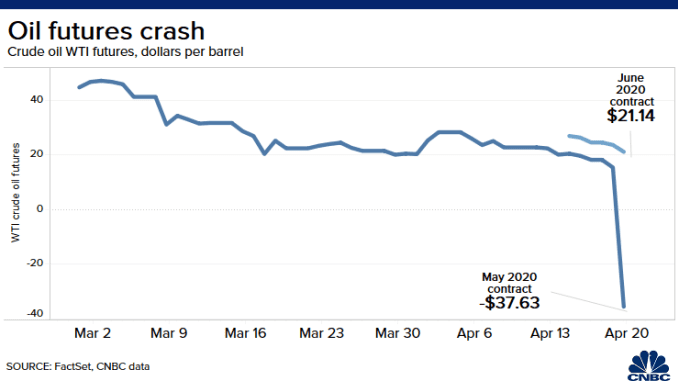
A futures contract for U.S. crude prices dropped more than 100% and turned negative for the first time in history on Monday, showing just how much demand has collapsed due to the coronavirus pandemic.

But traders cautioned that this collapse into negative territory was not reflective of the true reality in the beaten-up oil market. The price of the nearest oil futures contract, which expires Tuesday, detached from later month futures contracts, which continued to trade above $20 per barrel.

West Texas Intermediate crude for May delivery fell more than 100% to settle at negative $37.63 per barrel, meaning producers would pay traders to take the oil off their hands.


This negative price has never happened before for an oil futures contract. Futures contracts trade by the month. The June WTI contract, which expires on May 19, fell about 18% to settle at $20.43 per barrel. This contract, which was more actively traded, is a better reflection of the reality in the oil market. The July contract was roughly 11% lower at $26.18 per barrel.

The international benchmark, Brent crude, which has already rolled to the June contract, settled 8.9% lower at $25.57 per barrel.

20200420 Oil futures crash

Saturday, 18 April 2020

Timeline: How the COVID-19 outbreak has evolved in Singapore so far

Read? Timeline: How the COVID-19 outbreak has evolved in Singapore so far

SINGAPORE: It has been more than 12 weeks since Singapore reported its first COVID-case on Jan 23 – a 66-year-old Chinese national who came to Singapore three days earlier.

Since then, there have been more than 5,000 cases and 11 deaths in Singapore from the disease, which was first detected in Wuhan, China.

This is how the outbreak has evolved in Singapore so far:

Dec 31, 2019: A cluster of severe pneumonia cases in Wuhan, China is reported to the World Health Organization. Doctors do not yet know its cause.

JANUARY

Jan 2, 2020: Singapore’s Ministry of Health (MOH) says it is aware of the cases in Wuhan and will screen all inbound travellers from Wuhan from the evening of Jan 3.

There are no cases in Singapore.

Wednesday, 25 March 2020

Stock futures are flat following a historic rebound as massive stimulus deal nears


Read? Stock futures are flat following a historic rebound as massive stimulus deal nears

CW8888 : Craziness in the market and madness of Fear, Greed, FOMO and In Cash I am relief!

Stock futures were flat in overnight trading, following Tuesday’s historic rally, as investors awaited an unprecedented stimulus package to combat the economic impact of the coronavirus.

Futures on the Dow Jones Industrial Average climbed about 30 points. The S&P 500 futures were little changed.

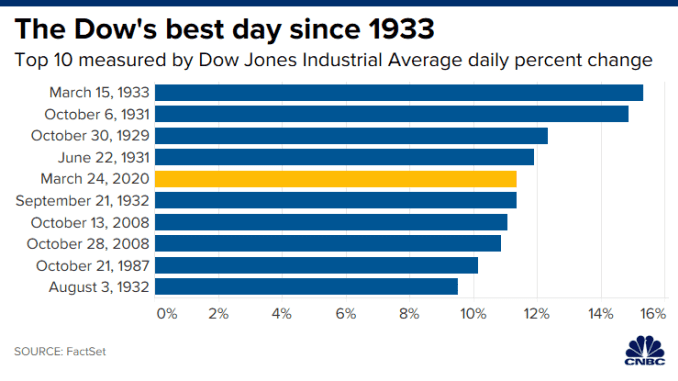
The action in the futures market followed an epic comeback on Wall Street. The Dow soared more than 2,100 points, or more than 11%, notching its biggest one-day percentage gain since 1933 and its best point increase ever. The S&P 500 rallied 9.4% for its best day since October 2008.

CH 20200324_dow_top_10_days.png

Even with Tuesday’s massive rebound, some on Wall Street struggle to see the light at the end of the tunnel, especially without a clear sign that the coronavirus outbreak will be contained soon.

“This was a one-day bull market,” CNBC’s Jim Cramer said on “Closing Bell” on Tuesday. “You had stocks that moved so much they basically moved as if the second half of the year is going to be good. I struggle to find out why the second half of the year should be good ...I hate this kind of rally. This was a machine driven rally, just like the sell-offs … I want to wait to see.”

Lawmakers were closing in on a massive fiscal stimulus bill worth $2 trillion to blunt the economic damage from the pandemic, but talks could stretch into Wednesday morning as the two parties continued to work through the text and hash out final details.

House Speaker Nancy Pelosi told CNBC on Tuesday morning that there is “real optimism” Congress can clinch a pact within a few hours. Senate Majority Leader Mitch McConnell later said the bill is at the “five-yard line.”

Meanwhile, the coronavirus cases in the U.S. and globally still haven’t shown a sign of peaking. More than 400,000 cases have been confirmed worldwide, including over 50,000 in the U.S., according to Johns Hopkins University. So far, more than 600 deaths related to the coronavirus have been confirmed in the U.S. New York City reported nearly 15,000 cases Tuesday and 131 related deaths.

— CNBC’s Jesse Pound contributed reporting.


Tuesday, 17 March 2020

Dow futures jump 200 points after Wall Street suffers worst day since 1987 market crash

Read? Dow futures jump 200 points after Wall Street suffers worst day since 1987 market crash

Stock futures traded higher on Monday night after Wall Street suffered massive losses earlier in the day amid concerns over the economic blow from the coronavirus outbreak.

Dow Jones Industrial Average futures rose by 229 points, or about 1.1%. S&P 500 and Nasdaq 100 futures were also higher. Dow futures briefly traded more than 200 points higher after President Donald Trump tweeted: “The United States will be powerfully supporting those industries, like Airlines and others, that are particularly affected by the Chinese Virus. We will be stronger than ever before!”

The Dow Jones Industrial Average and S&P 500 had their worst day since the “Black Monday” crash of 1987, falling 12.9% and 12%, respectively. It was also the Dow’s third-worst day ever. The Nasdaq Composite had its biggest one-day plunge ever, tumbling 12.3%.

The Cboe Volatility Index — Wall Street’s preferred fear gauge — posted its highest-ever close at 82.69. That tops the financial crisis’ peak of 80.74.

Wall Street’s drop came even after the Federal Reserve slashed interest rates to near-zero on Sunday and announced a $750 billion asset-purchasing program. It also came as the number of coronavirus cases jumped in the U.S.

At least 4,281 cases have been confirmed in the U.S. along with more than 70 deaths, according to data from Johns Hopkins University. President Donald Trump also said the crisis could stretch into August, adding the administration may look at locking down “certain areas.”

“Although the contemporary crisis is loaded with bad news, this has not been its primary problem. It’s the ‘unknown,’” said Jim Paulsen, chief investment strategist at The Leuthold Group, in a note. “Not even health experts understand what this is or where it is headed, and that is the worst possible outcome for investors.”

“Give me bad news any day over complete uncertainty,” he said.

The S&P 500 closed Monday at its lowest level since December 2018. The Dow ended the session at its levels not seen since early 2017.

“For now until there is improvement in the trend … it’s tough to consider being long and it’s right to be in Cash on the sidelines,” Mark Newton, managing member at Newton Advisors, said in a note to clients.
Related Posts with Thumbnails