I started serious Investing Journey in Jan 2000 to create wealth through long-term investing and short-term trading; but as from April 2013 my Journey in Investing has changed to create Retirement Income for Life till 85 years old in 2041 for two persons over market cycles of Bull and Bear.

Since 2017 after retiring from full-time job as employee; I am moving towards Investing Nirvana - Freehold Investment Income for Life investing strategy where 100% of investment income from portfolio investment is cashed out to support household expenses i.e. not a single cent of re-investing!

It is 57% (2017 to Aug 2022) to the Land of Investing Nirvana - Freehold Income for Life!


Click to email CW8888 or Email ID : jacobng1@gmail.com


Welcome to Ministry of Wealth!

This blog is authored by an old multi-bagger blue chips stock picker uncle from HDB heartland!

"The market is not your mother. It consists of tough men and women who look for ways to take money away from you instead of pouring milk into your mouth." - Dr. Alexander Elder

"For the things we have to learn before we can do them, we learn by doing them." - Aristotle

It is here where I share with you how I did it! FREE Education in stock market wisdom.

Think Investing as Tug of War - Read more? Click and scroll down


Important Notice and Attention: If you are looking for such ideas; here is the wrong blog to visit.

Value Investing
Dividend/Income Investing
Technical Analysis and Charting
Stock Tips

Showing posts with label news - markets - Crash. Show all posts

Wednesday, 3 February 2021

Real and Illusion Of Wealth In The Stock Market. It is selling that counts!

Book : It's when you sell that counts

CW8888 : GameStop is great example real and illusion of wealth in the stock market. Uncle8888 truly learnt the truth from this book in Nov 2008! It's when you sell that counts if you happen to buy them at good entries! All are equally critical, entries and exits and holding; but to optimize the profits is NEVER that easy!

Read? Reddit user who helped inspire GameStop mania says he lost $13 million on Tuesday, but is still holding on

Keith Gill, AKA Reddit’s DeepF------Value, apparently lost more than $13 million on Tuesday alone from his GameStop bet as the shares dropped 60%.

Despite the losses, the investor is holding onto 50,000 shares of GameStop as well as 500 call options in the brick-and-mortar video game retailer.

At GameStop’s record high last week, Gill’s total return in the name ballooned more than 2,000% to as much as $33 million, according to his Reddit posts.

Read? MARKETS GameStop short sellers are still not surrendering despite nearly $20 billion in losses this month


Wednesday, 10 June 2020

Semb corp really no hope Liao ?


Sometime, salted fish in the stock market can suddenly flip over!

Instead of cutting losses  and move on; Uncle8888 rather strongly focus on money management and positioning size. Write off financially and take XIRR or CAGR hit on investment performance and move on.


One week ago .... an email from silent reader on 29 May 2020 

Going to die soon now becomes light of hope seen at the end of tunnel. Very bitter Panadols may soon be sweeten although still Panadols to ease heartache!

Existing SCI retail investors like Uncle8888 said heng ah!

New retail so excited to come on board for Panadols and chicken thigh !

90M shares changed hand on 9 Jun 2020!


Monday, 16 March 2020

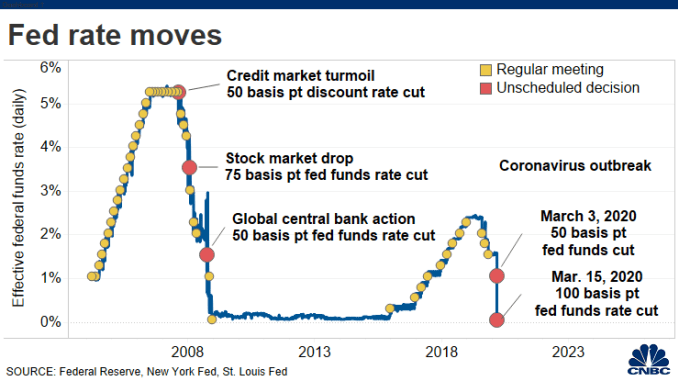
Federal Reserve cuts rates to zero and launches massive $700 billion quantitative easing program


In an emergency move Sunday, the Federal Reserve announced it is dropping its benchmark interest rate to zero and launching a new round of quantitative easing.

The QE program will entail $700 billion worth of asset purchases entailing Treasurys and mortgage-backed securities.

Markets responded negatively, with Dow futures pointing to a drop of 900 points when the market opens Monday morning.


The Federal Reserve, saying “the coronavirus outbreak has harmed communities and disrupted economic activity in many countries, including the United States,” cut interest rates to essentially zero on Sunday and launched a massive $700 billion quantitative easing program to shelter the economy from the effects of the virus.

The new fed funds rate, used as a benchmark both for short-term lending for financial institutions and as a peg to many consumer rates, will now be targeted at 0% to 0.25% down from a previous target range of 1% to 1.25%.

Facing highly disrupted financial markets, the Fed also slashed the rate of emergency lending at the discount window for banks by 125 basis points to 0.25%, and lengthened the term of loans to 90 days.
At a press conference Sunday evening following the decision, Powell said the Fed would be patient before lifting rates again.

“We will maintain the rate at this level until we’re confident that the economy has weathered recent events and is on track to achieve our maximum employment and price stability goals,” Powell said.

“That’s the test ... some things have to happen before we consider ... we’re going to be watching, and willing to be patient, certainly,” he added.

The quantitative easing will take the form of $500 billion of Treasurys and $200 billion of agency-backed mortgage securities. The Fed said the purchases will begin Monday with a $40 billion installment.

Cleveland Fed President Loretta Mester was the lone no vote, preferring to set rates at 0.5% to 0.75%, which would have represented a 50 basis point, of half percentage point, reduction.

The Fed added in its statement that it “is prepared to use its full range of tools to support the flow of credit to households and businesses and thereby promote its maximum employment and price stability goals.”

It appeared, though it was not entirely clear, that the meeting that took place will replace the regularly scheduled meeting of the Federal Open Market Committee.

The move follows several actions by the Fed over the past two weeks in which it enacted a 50 basis point emergency rate cut and expanded the overnight credit offering, or repo, for the financial system up to $1.5 trillion.

—CNBC’s Jeff Cox contributed.


20200303 Fed Rate cuts


Friday, 28 February 2020

Illusion Of Wealth In The Bull Market

CW8888:  Another data point in the history of stock market to prove this illusion of wealth in the stock market!

Read? Stock futures point to more losses after Thursday’s massive tumble amid coronavirus fears

U.S. stock futures pointed Thursday night to more losses after the major indexes suffered a tumble that sent them more than 10% below their record highs.

Dow Jones Industrial Average futures were up 16 points, but indicated a loss of more than 150 points at Friday’s open. S&P 500 and Nasdaq 100 futures also pointed to a lower open on Friday.

The Dow plummeted nearly 1,200 points on Thursday — its biggest one-day point drop ever — as worries over the coronavirus possibly spreading sent stocks spiraling lower. The 30-stock average closed in correction territory along with the S&P 500 and Nasdaq Composite.

The Dow had closed at a record high on Feb. 12. It only took the S&P 500 six days to fall from an all-time high into correction levels, marking the broad index’s fastest drop of that magnitude.

“People have been so preconditioned to buy the dip and to always expect the market to recover that people can get smacked around with moves like this,” said Patrick Hennessy, head trader at IPS Strategic Capital. “No one knows how this thing ends.”

Thursday’s declines also put the Dow and S&P 500 down more than 10.5% each for the week, on pace for their worst weekly performance since 2008.

The sharp drop came after California Gov. Gavin Newsom said the state is monitoring 8,400 people for coronavirus. Meanwhile, the CDC confirmed on Wednesday evening the first U.S. coronavirus case of unknown origin in Northern California, indicating possible “community spread” of the disease.

The number of confirmed coronavirus cases outside of China has also jumped. In South Korea, more than 1,700 cases have been confirmed along with over 600 in Italy.

“The timing of this was just the worst with respect to investor sentiment being elevated,” said Doug Ramsey, chief investment officer at The Leuthold Group. “I’m not sure that the market has really priced in the potential economic impact of this.”

Concerns over the coronavirus have also led several companies to issue earnings and revenue warnings. Microsoft said Wednesday one of its key divisions may not meet the company’s previous revenue guidance. PayPal also warned about its outlook on Thursday.

Goldman Sachs’ David Kostin warned U.S. companies will see no earnings growth this year. “Our reduced profit forecasts reflect the severe decline in Chinese economic activity in 1Q, lower end-demand for US exporters, disruption to the supply chain for many US firms, a slowdown in US economic activity, and elevated business uncertainty,” said Kostin, the bank’s chief U.S. equity strategist.


Friday, 16 January 2015

Forex broker Alpari UK enters insolvency after SNB shock

 CNBC

Foreign exchange broker Alpari UK announced Friday that it had entered insolvency following the Swiss National Bank's (SNB) shock decision to drop its three-year-old peg of 1.20 Swiss francs per euro. 

"The recent move on the Swiss franc caused by the Swiss National Bank's unexpected policy reversal of capping the Swiss franc against the euro has resulted in exceptional volatility and extreme lack of liquidity," Alpari UK said in a statement. 

"This has resulted in the majority of clients sustaining losses which has exceeded their account equity. Where a client cannot cover this loss, it is passed on to us."


The company said that, as a result, it had entered into insolvency, adding that retail client funds would continue to be segregated in accordance with FCA rules. 

This came after New Zealand brokerage Excel Markets also announced that it was unable to resume business following the SNB's move. 

"Both our primary and backup liquidity providers became unresponsive or illiquid for hours after the event," the brokerage said in a statement.

"The majority of clients in a franc position were on the losing side and sustained losses amounting to far greater than their account equity. When a client cannot cover their losses it is passed onto us."


The SNB stunned markets on Thursday, when it scrapped its three-year-old peg of 1.20 Swiss francs per euro. Shortly after the central bank's announcement, the Swiss franc soared by around 30 percent in value against the euro, and by 25 percent against the dollar. 

Currency trading platform Forex.com suspended trading in Swiss francs after the SNB's announcement. On Friday, the company said it hoped to resume trading in the currency soon. 

A number of spread betters, including Forex.com, CMC Markets and ETX Capital, issued statements saying that Thursday's extreme currency movements had not materially affected their companies' financial positions. 

Saturday, 20 August 2011

Crash? You ain't seen nothing yet: analysts

$21 billion wiped off Singapore market - but observers say stocks could fall another 20-30% before hitting bottom


By VEN SREENIVASAN

THE bloodletting which wiped some $21 billion off the Singapore market yesterday could be the beginning of a selldown which could lop another 30 per cent off the value of stocks here.

That seems to be the view of some analysts and strategists following a rampage which dragged the Straits Times Index (STI) down 3.2 per cent or 91.33 points to 2,733.63 points yesterday - its lowest in 15 months.

'What we are seeing is a perfect storm - a confluence of negative factors,' said Prabodh Agrawal, CEO of Singapore-based IIFL Institutional Equities.

'Despite the selldowns we are now seeing, most blue chips and bellwethers here are still trading at just below their long- term price-book levels. During the last recession, they were trading at about two standard deviations below their long-term average. If we assume the same numbers and circumstances, stocks could fall another 20-30 per cent from current levels.'

The selldowns here and across the Asia Pacific region came on the heels of similar overnight savaging of Wall Street and European markets following more disappointing US economic data and intensifying concerns about a potential global economic recession triggered by the European sovereign debt crisis and a sharp US economic slump.

The dive across Asian bourses followed 3-5 per cent plunges in the US and Europe. And the selldown intensified as Wall Street futures remained deep in the red and Europe opened sharply lower again yesterday.

In Tokyo the Nikkei 225 gave up 2.51 per cent to 8,719.24, while Hong Kong's Hang Seng lost 3.08 per cent to 19,399.9 and Sydney's ASX200 dived 3.51 per cent to 4,101.90.

In Singapore, with yesterday's plunge, some $117 billion has been lopped off the value of Singapore equities this month alone.

And technical analysts see more downside. Kim Eng Securities' technical charts suggest a potential low at 2,350 points - a whopping 14 per cent under current levels.

'Based on the weekly chart trends, our chartist sees the STI trading within the 2,600-2,680 area in the short term, which coincides with the 50 per cent Fibonacci level,' it said in a note yesterday. 'The index could further correct downwards to the 2,350-2,420 area if this support area is broken.'

But many analysts also point out that medium-term fundamentals-wise, many stocks are turning attractive and thus providing opportunities for bottom-fishing.

Melvyn Boey, head of research and strategy for Asean, Bank of America/Merrill Lynch, added that although there's a looming crisis in the West, this region's fundamentals are intact.

'Asean, and especially Singapore, remain vulnerable to the impact of a global recession,' Mr Boey said.

'But, that said, South-east Asia's fundamentals are a lot stronger today than five or 10 years ago. Investors should look at stocks of companies with revenue growth, pricing power, cashflow and strong overall fundamentals to ride through the recession.'

Mr Boey added that while a recession seemed imminent, the down-cycles were getting shorter and tighter.

In short, the recovery could be as swift as the slide is brutal. So stick to fundamentals.

On the other hand, Mr Agrawal was more circumspect. 'The 2008/09 crisis lasted only four quarters because governments and central bankers were able to act aggressively and in concert to recapitalise distressed asset markets. Today, government balance sheets are in poor shape, thus diminishing their ability to act as aggressively,' he said.

Mr Agrawal noted that the intervention in 2008/09 had reflated the asset markets, but not the economies concerned. He now sees a potential for several rounds of continuous deleveraging dragging all asset markets - equities, commodities and property - further southwards. In Singapore, he cautions against jumping back into stocks too early.

But then, asset markets - especially equities - could get another reflation if US Federal Reserve chairman Ben Bernanke unveils a new stimulus package or 'QE3' at next Friday's Jackson Hole meeting.


Thursday, 18 August 2011

Stock Volatility to Leave Lasting Scars

By Laura Keeley

Last week’s record volatility in U.S. stocks ended after four days. The anxiety it instilled among mutual-fund investors may linger for years.


Investors pulled a net $23.5 billion from U.S. equity funds in the week ended Aug. 10, the most since October 2008, when markets were reeling from the collapse a month earlier of Lehman Brothers Holdings Inc., the Investment Company Institute said yesterday. The period tracked by the Washington-based trade group included three of the unprecedented four consecutive days in which the Standard & Poor’s 500 Index rose or fell by at least 4 percent.

The roller-coaster ride was unnerving for fund investors who have already endured the bursting of the Internet bubble in 2000, a 57 percent collapse in the S&P 500 Index (SPX) from October 2007 to March 2009 and the one-day plunge in May 2010 that briefly erased $862 billion in value from U.S. shares. The debacles, combined with falling home prices, unemployment above 9 percent and a lack of trust in government to bring down spending, may sour individual investors on domestic stock funds for an additional three to five years, according to Andrew Goldberg, a market strategist at JPMorgan Funds in New York.

“You can’t keep having bombs, so to speak, go off,” Goldberg said in a telephone interview. “If the second you walk outside another one goes off, you’re going to stay inside for longer, and that’s what’s going on.”

History Not Repeating

The $12.2 trillion mutual-fund industry has historically been able to count on investors to come back to stocks after a significant selloff. They did so following “Black Monday” in October 1987, the Asian currency crisis in 1997 and Russia’s debt default in 1998. In the year after the 2000-2002 bear market, U.S. equity funds attracted $130 billion, ICI data show.

Funds that buy domestic stocks lost $98 billion in 33 straight weeks of withdrawals last year after the 20-minute plunge in May, ICI data show. They’ve had redemptions of $74 billion this year. The latest withdrawal streak began in 2007 and didn’t end even as stock surged from their March 2009 lows.

“What we have seen this time is a much slower return to risk-taking,” said Francis Kinniry, principal at Vanguard Group Inc. in Valley Forge, Pennsylvania, the largest U.S. mutual-fund manager. He attributes the difference to falling home prices. In bear markets prior to 2008, residential property values were rising.

“There was significantly more wealth destruction this time around,” Kinniry said.

Index Funds, Bonds

Investors have compensated by shifting some of their money into passively managed index funds and exchange-traded funds that track stock benchmarks, forsaking managers who select the investments they buy and sell.

U.S. stock index funds have posted net deposits every year since 2001, according to Morningstar Inc., a Chicago-based research firm. Investors have similarly poured $851.5 billion into ETFs for all asset classes from 2001 to July 2011. Unlike mutual funds, ETF trade throughout the day like stocks.

Bond funds also have been winners, adding $75 billion in deposits this year, while funds that buy non-U.S. stocks took in $15 billion, according to ICI.

“Over the past couple of years and especially the past couple of weeks, I have heard a large number of clients and acquaintances express fear and dislike for the stock market,” Eitan Tashman, a financial planner in Beverly Hills, California, said in a phone interview. While “many investors are scared of the volatility and seeming instability of the stock market and would even like remove their money from the stock market,” there are few alternatives, he said.

Baby Boomers

The post-World War II generation known as the baby boomers is the largest group of investors in mutual funds, said Geoff Bobroff, an investment-management consultant in East Greenwich, Rhode Island. As they go into retirement, they might not return to equities after two bear markets and the volatility this year, he said.

“They are already thinking now about their retirement years,” Bobroff said. “They may be in fixed-income of different flavors, but equities may no longer be on their horizon.”

The recent volatility makes Mark Beller, 42, a physician in Northridge, California, want to put more of his money into real estate.

“The market is so volatile, 1,400 points in a week? Give me a break,” Beller said in a phone interview. “I have money to invest, and my portfolio is down about 15 to 20 percent, so I’m going to wait for it to come back to where I feel comfortable.”

Cash is King

Younger investors aren’t replacing their retiring counterparts. Cash holdings are at the highest levels since the record in March 2009, according to an Aug. 16 survey by Bank of America Merrill Lynch. Investors from 18 to 30 years old have the highest cash position of any age group at 30 percent of their portfolio, MFS Investment Management said in an Aug. 8 report. Almost three in five investors cite fear about volatility or needing money someday as a reason they hold high or increasing levels of cash.

“Investors are in cash for a reason and, regardless of time horizon, conventional investing wisdom no longer applies,” William Finnegan, senior managing director of retail marketing at the Boston-based firm, said in the report. “The Great Recession of 2008 has had a profound and longer-lasting impact on investors’ confidence than expected.”

The average investor tends to hold large amounts of cash when the markets are at a low and thus miss out on gains, JPMorgan’s Goldberg said. The previous high of cash as a percentage of portfolios was in October 2002, right before the start of a five-year bull market.

Institutions Hold Tight

“Households had become so conservative that they were sitting on all this cash that should’ve been seeking out opportunity,” he said. “To the extent that emotions drive decisions, they’re going to get it wrong.”

Brad Durham, managing director of research at EPFR Global in Cambridge, Massachusetts, said retail investors are exiting funds while institutions are modestly adding to their holdings. Retail investors pulled $26 billion from U.S. equity funds from May 1 to Aug. 10, while institutions added $689 million, he said.

“Institutions are using this period to change their exposures around and they’re not selling as aggressively, while retail investors have just been fleeing,” Durham said.

The return of the S&P 500 during the past 10 years has been about 3 percent including dividends. Investors have experienced “a far greater degree of volatility than one would expect for such meager returns,” Greggory Warren, a Morningstar analyst, wrote in a June 29 research note.

Toll on Managers

“The problem is you don’t really know what to do,” said James Dean, 67, a salesman for an information-services company who lives in Panama City, Florida. “There’s no rhyme or reason for the market to be doing what it’s doing other then the mess our government has gotten us into.”

The investor exodus is taking a toll on publicly traded fund companies. The S&P index of money managers and custody banks has fallen 15 percent since the May 2010 plunge, compared with the 5.8 percent increase by the S&P 500, a benchmark for the largest U.S. companies.

Janus Capital Group Inc. (JNS), which is off 47 percent, led the drop. About 89 percent of the Denver-based company’s assets under management is in stock funds. It has had eight straight quarters of net withdrawals totaling $21.6 billion.

Closely held American Funds and Fidelity Investments are among the big asset managers bearing the brunt of investor defections from U.S. stock funds, according to Morningstar. American, owned by Los Angeles-based Capital Group Cos., had an estimated $43 billion in redemptions this year through July, while Boston-based Fidelity lost $8.8 billion, Morningstar data show.

Best Positioned

Diversified managers such as Invesco Ltd. (IVZ), BlackRock Inc. (BLK) and Franklin Resources Inc. (BEN) are the firms best prepared to capitalize on the environment, Morningstar’s Warren said. Invesco, based in Atlanta, bought Morgan Stanley’s Van Kampen mutual funds last year, giving it a broader domestic base. San Mateo, California-based Franklin has 89 percent of its assets outside of domestic equities. The Templeton Global Bond Fund attracted $10.9 billion through June, the most of any U.S. mutual fund.

BlackRock of New York, the world’s largest asset manager with $3.66 trillion assets under management, owns iShares, the biggest provider of ETFs.

Vanguard, which has about half its mutual-fund assets in index funds, saw net deposits of $30 billion this year through July, according to Morningstar. At Pacific Investment Management Co., the Newport Beach, California-based manager of the world’s biggest bond fund, investors put in $25 billion this year.

Not all investors are panicking or leaving the market.

‘Pleasantly Surprised’

“Generally, they’re holding tight, and I’ve been pleasantly surprised,” Kevin O’Reilly, a financial adviser based in Phoenix, said in a telephone interview. “I haven’t gotten, really, nearly as many calls panicking as I thought I would have.”

Investors may be getting used to the volatility, which isn’t necessarily a good thing, said Lee Ann Knight, a financial adviser in Bedford, Massachusetts.

“They may be immune to worrying about it when they should be,” she said. “What surprised me is that I have had a few phone calls from people wanting to use this opportunity to invest. That’s great, that’s good, but I feel like I had these conversations for 10 years, and people were like, ‘No way, no way.” ‘

Monday, 8 August 2011

Do you think DOW has bottomed out?

A look at the Dow's worst drops since 1899

Bottoms Rarely Look Like Thursday's Rout

by Mark Hulbert

Friday, August 5, 2011

Market declines rarely end with days like Thursday's 513-point drop for the Dow.

So even if you think that we're just suffering a mere correction within an ongoing bull market, you still should be prepared for lower prices in coming sessions.

That at least is the conclusion that emerged from my analysis of past bear market bottoms. The days on which those bear markets actually registered their final lows typically were rather uneventful — nothing like what we saw on Thursday.

Consider March 9, 2009, the day of the closing low of the 2007-2009 bear market, arguably the worst one since the Great Depression. Even though there were many days during that bear market that witnessed panic selling, the day of the final low experienced a drop of just 79.89 points.

It was more than three months earlier than then that the Dow Jones Industrial Average DJIA (^DJI - News) experienced a panic-induced decline that was as bad as Thursday's. That day was Nov. 20, 2008, the day when — not coincidentally — the CBOE's Volatility Index (VIX - News) spiked to its all-time closing high near 81.

Many traders made the same mistake then that I fear that is being made today: Thinking that panic selling signals a low. They were three-and-a-half months early.

Or consider the Crash of 1987, which is the grandaddy of selling panics in U.S. stock market history. On that day, Oct. 19, the Dow dropped 22.6%. And even though the Dow bounced back impressively over the two trading sessions following that Crash — gaining 5.9% on Oct. 20 and another 10.1% on Oct. 21 — the stock market's post-Crash low wasn't registered until Dec. 4, more than six weeks later.

Chances are that the final low of the decline we're experiencing will not be recognized as such until well after the fact. It's most unlikely that, on that day itself, so many traders will be doing what they did on Thursday — falling over themselves announcing that the bottom has been seen.

An old Wall Street saying has it that they don't "ring a bell" at market bottoms. It would appear that this saying contains a lot of wisdom.

Mark Hulbert is the founder of Hulbert Financial Digest in Annandale, Va. He has been tracking the advice of more than 160 financial newsletters since 1980.


Related Posts with Thumbnails