I can. You Can?
Of course, you CAN!
Monkeys or Gorillas in the market. All can! LOL!
Read? Winning The Loser's Game (3)
Read? Peter Lynch on His Secret to Superior Returns (2)
Read? Lost Your Money In Hyflux???


I can. You Can?
Of course, you CAN!
Monkeys or Gorillas in the market. All can! LOL!
Read? Winning The Loser's Game (3)
Read? Peter Lynch on His Secret to Superior Returns (2)
Read? Lost Your Money In Hyflux???
Read? https://www.rainbowonfi.com/2021/12/year-end-reflections-2021.html#comments
I guess you have your "crash got sound" experience on the No.1 reason why most traders lost money - weak money/risk management....
Never let a mistake go to waste. That's how we veterans survived.
Now you may understand why I use Stop-Loss orders despite 70-80% of the time, if I had held on to these losing trades, eventually they will make money one day...
Its to prevent those 20-30% of the time if I didn't get out, they would have wiped out my trading account!!!
But that's my experience. You have to work out your own money/risk management strategies to survive losing trades/investments. And rest assured, we'll have them!
There are lots of other hedging methods if one don't like to use Stop-loss orders - for eg, Peter Lynch don't use Stop-loss orders. He got his 10 baggers to dilute out the losses ;)
Read? Relating to stop-loss!
Risk and Money Management And Absolute Positions Sizing Relative To Capital Base for consistency
Over 22 yrs as Panda retail investor and trader in boring and unaspiring local market!
No stop-loss and yet never blow out his account despites many losses and also 4 Zero-baggers (100% invested capital wipe out)!
We need to find out from ourselves the form of risk and Money management strategy and method that fixed into our money and investing Mind!
3 M's in investing : Method, Money Management and Mind


Probably; the difference in the nature of multi-baggers hold by Panda/Koala retail investors in boring Super Terrible Index is their freehold multi-baggers generating lifelong passive income without fear of losing their money ever.
Free Dividend Fallacy? No lah! It Is Freehold Dividends For Life!!!
Active management and a willingness to take risks with smaller stocks easily trump the Straits Times Index's dull returns
Read? Hunting for multi-baggers in the local market
The Statistics :
1. Total number of different kinds of stocks bought and sold; or still holding : 58
2. What chips? Blue chips, Blue-Black chips, Mid chips, Small chips, Promising chips, Silly chip, and Dead chips. Uncle8888 has done them all!
3. Investment gains/losses : Multi-baggers, Touchstones, Sardines, Salted Fish, and Zero-baggers. All have!
4. Dividends : From Panadols to ease heartache to Funadols!
Read? After Point X In Long Term Investing, Panadols Can Become Funadols (Truly Passive Income)
5 Long-term investing and short-trading over 21 years: What is the outcome?
Read? Peter Lynch on His Secret to Superior Returns (2)


One of the most enduring sayings on Wall Street is "Cut your losses short and let your winners run." Sage advice, but many investors still appear to do the opposite, selling stocks after a small gain only to watch them head higher, or holding a stock with a small loss, only to see it lose even more.
Read? Peter Lynch on His Secret to Superior Returns
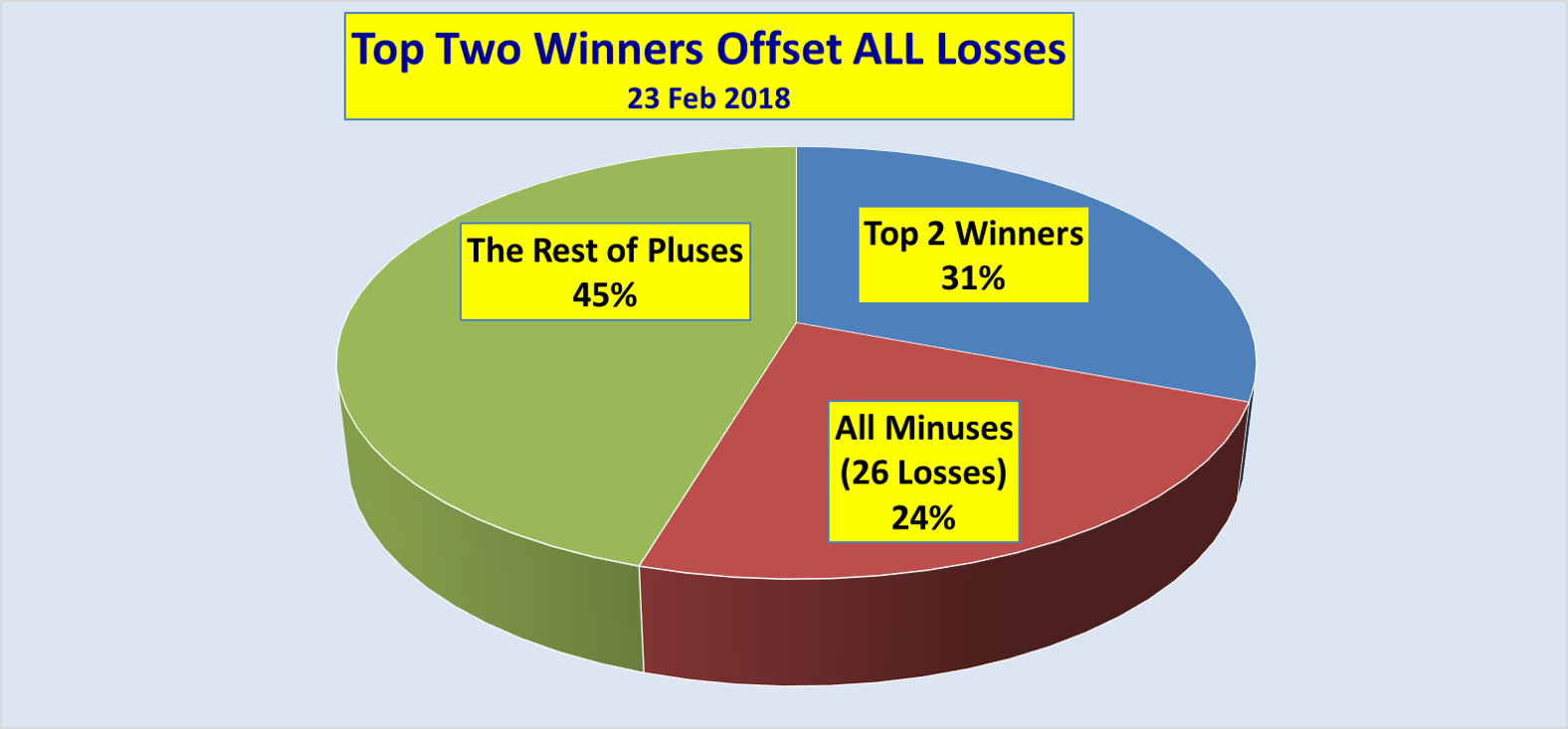
All you need for a lifetime of successful investing is a few big winners, and the pluses from those will overwhelm the minuses from the stocks that don’t work out. - Peter Lynch
How about "Cut your losses short and let your winners run"???
No stop-losses! Die pain pain har?
How about to suit those who by nature who like to believe in "salted fish can turn over" one day or one day salted fishes decay to ashes! Maximum loss is 100% of invested capital! Cry until no tears hor!
Cut your losses short and let your winners run
CAP your losses and take Panadols for Heartache AND let your winners run and play round and round with your winners!
It is actually Short-Term trading or Wrong-Term investing AND Long-Term investing strategy! LOL!
Be OURSELVES since we are investing and trading for ourselves . We should be discovering what really work for us!
21 years from Jan 2000 to Nov 2020 across market cycles of Bulls and Bears


COVID-19 New stocks pick over 8 Months from Feb 2020 to Nov 2020
Finally, when market turns around, this strategy begins to show some truth. LOL!


Real retail investors on DBS.
Time in the market or timing the market? Either one also NOT easy to do!
Investor A
Ex-colleague: Heard you very good at investing?
blah blah
Ex-colleague: How is the market?
CW: Banks and properties are cheonging! DBS at record high!
Ex-colleague: Sianz! I sold my DBS @ $14+
blah blah
CW: I am still holding some DBS bought at $7+ since SARS time.
blah blah
Ex-colleague : When are you going to teach me how to make money?
SGX : The Past is not bad. The Present is lousy! The Future is uncertain?
So how?
What if you have became a free rider from the past SGX and most likely continue to receive yearly and relatively "passive" income? You still go and bang your head against Wall Street?
What is the Secret to become to become Free Rider in SGX?
Hmm ..
Be addicted to continuous doses of Panadols until your heart and brain becoming immune to emotional pains; and then one day you realized OMG, I am a Free Rider now!


Read?The income edge in the stock market
Chances of losing money after a decade is 25%; when dividends are included, it is cut to just 2%
I HAVE a simple rule about investing. I put any cash that I don't need for at least the next five years into the stock market. I don't pay too much attention to pundits who warn about markets being dizzyingly-high or worryingly-low that could drop further. That's because over any rolling five years, the stock market should be higher at the end of the period than at the beginning.
Don't just take my word for it. If you look at the Straits Times Index at any point in time and go back five years, there is a 40 per cent chance that the index would have been lower. That might not seem too alluring. But that's because dividends haven't been accounted for, yet. When the payouts are included, the probability that the investment would be worth more after any rolling five years jumps to 83 per cent.
Is 10 years an eternity?
What is even more remarkable is that the chances of losing money over any ten-year period after including dividends are reduced even further. Some might think of 10 years as an eternity. But it's not, if we plan to invest for decades.
Many of us will need to do that if we are putting money aside for our retirements. If we invest with a 10-year time horizon in mind, the chances of losing money after a decade is 25 per cent. When dividends are included, it is cut to just 2 per cent.
To put that into perspective, if we put our money into shares every month for 10 years, we would be making 120 separate deposits. Of those discrete investments, only two would be lower after a decade. With the odds so overwhelmingly in our favour, why would we want to miss out. Additionally, the more often we invest, the greater could be our chances of success.
A ten-year investing horizon is a convenient period to consider because we generally benchmark investments against risk-free assets such as 10-year Treasuries. This is where investing in shares really comes into its own. The average total return in the stock market over 10 years is 70 per cent, which equates to an annualised rate of 5.5 per cent. That compares favourably with a risk-free return rate of 0.25 per cent.
Comfort and joy
What is undeniable, though, is that it can be uncomfortable (or it could even be exhilarating) over any ten-year period from the moment an investment is made.
If we had invested in 1998, the return after 10 years would be 143 per cent. But if we had done the same in 1999, the return would have been a meagre 52 per cent after a decade. That is part and parcel of investing. But nobody ever buys shares just the once and never goes back into the market ever again.
At least, we shouldn't. We should try to develop a routine of investing regular amounts frequently. We should also take with a pinch of salt what experts might have to say about valuations.
Peter Lynch said the secret of successful investing is to never trust our gut feelings but discipline ourselves to ignore them. We should also learn to stand firm if the fundamental story of the company we invest in hasn't changed.
The market, incidentally, is not a great place to check the fundamentals of a business. But it can be a good place to see if anyone is doing something foolish.
Crystal clear
The alternative to the stock market could be to buy some of those risk-free 10-year Treasuries. That way, we are at least guaranteed to get our money back intact. But with an investment in the stock market, there is a risk that our investment could go down as well as up.
However, the loss is only crystallised if we don't stay the course. If we can hang on through the tough times, the chances of losing money over ten years is almost negligible.
Unfortunately, some people can't tolerate the roller-coaster ride that stock markets can take us on.
Or as Mr Lynch said: "Everyone has the brainpower to make money from stocks. Not everyone has the stomach."
The income edge
This is where income investors have a distinct edge. We focus on the income that a share could produce, rather than its share price. The problem with share prices is that they can be a function of market sentiment. When more people want to buy shares, prices will probably rise. But when there are more sellers than buyers, prices could fall. However, the dividends paid by a company don't change with market sentiment.
Instead, they are a function of the fundamentals of the business. So, market highs, market lows, market corrections and market crashes are irrelevant to income investors. We are guided by how much we pay for every dollar of income a share can deliver.
There can be times when we might have to pay more, and times when we could pay less. But we are continually buying tomorrow's income with today's money because one day that will be the only income that we will have to live off.
The writer is co-founder, The Smart Investor
Read? Why do we often make fair but not excellent investment decisions
9. "All you need for a lifetime of successful investing is a few big winners, and the pluses from those will overwhelm the minuses from the stocks that don't work out."

10. "If you're lucky enough to have been rewarded in life to the degree that I have, there comes a point at which you have to decide whether to become a slave to your net worth by devoting the rest of your life to increasing it or to let what you've accumulated begin to serve you."
Right! Cashing out to serve to me i.e. 100% cash payouts from stock operation to Cash Reservoir.
Read? From Growth To Income Stock Operator in SGX




 Posts
All Comments


