I started serious Investing Journey in Jan 2000 to create wealth through long-term investing and short-term trading; but as from April 2013 my Journey in Investing has changed to create Retirement Income for Life till 85 years old in 2041 for two persons over market cycles of Bull and Bear.

Since 2017 after retiring from full-time job as employee; I am moving towards Investing Nirvana - Freehold Investment Income for Life investing strategy where 100% of investment income from portfolio investment is cashed out to support household expenses i.e. not a single cent of re-investing!

It is 57% (2017 to Aug 2022) to the Land of Investing Nirvana - Freehold Income for Life!


Click to email CW8888 or Email ID : jacobng1@gmail.com


Welcome to Ministry of Wealth!

This blog is authored by an old multi-bagger blue chips stock picker uncle from HDB heartland!

"The market is not your mother. It consists of tough men and women who look for ways to take money away from you instead of pouring milk into your mouth." - Dr. Alexander Elder

"For the things we have to learn before we can do them, we learn by doing them." - Aristotle

It is here where I share with you how I did it! FREE Education in stock market wisdom.

Think Investing as Tug of War - Read more? Click and scroll down


Important Notice and Attention: If you are looking for such ideas; here is the wrong blog to visit.

Value Investing
Dividend/Income Investing
Technical Analysis and Charting
Stock Tips

Saturday, 18 June 2011

Small retail investors so excited over SCB


For the past few weeks, there was so much excitement at Singapore No 1 investment cbox over SCB who is so kind to level the playing field for spider monkeys with no minimum commission brokerage.

Spider monkeys can now swing from tree to tree to pluck coconuts here and there at very low cost. Since these coconuts can be plucked at very low cost why worry whether the coconut is green, yellow or brown. No problem, just try one coconut at a time.

In investing, I have seen many successful investors learning their lesson from their most painful and unforgettable lesson of big losses before they became wiser.

Small losses here and there will not teach the spider monkeys the truth of investing. There will not be enough pain to hit them harder and make them learn from the painful lessons and become wiser in investing.

I think there is some similarity between swinging spider monkey and the boiled frog.

The Boiled Frog
 
They say that if you put a frog into a pot of boiling water, it will leap out right away to escape the danger. 


But, if you put a frog in a kettle that is filled with water that is cool and pleasant,
and then you gradually heat the kettle until it starts boiling, the frog will not become aware of the threat until it is too late.


The moral of the story ..

If you can't feel the great pain immediately and learn from it; you may be killed slowly without even knowing why.

STI vs. DOW since Jan 2009


DOW is still the Big Brother!

Stock Dividends - Sir, how do you want it to be done? Raw, medium or well done?

Read? High Dividend Yield Stocks? (10)

When you received your stock dividends, how do you want it to be done? Raw, medium or well done?

The way you treat it may determine how likely you are going to hold or sell.

Discount

When you received your stock dividend, you mentally discount your holding cost against the dividend received. It lowers your holding cost. So shiok! You may  even tell your wife. "Honey, it is cheaper now."

Every year it will become cheaper after receiving more dividends Why sell? Since it is getting cheaper soon. 

Pain Killer

Wah, so shiok! My dividend is coming in July. What paper losses? Never mind le. Oh ya! SCB account will be ready in end Jun so no problem to reinvest the dividend for compounding "interests" - Eight Wonder of The World.

After receiving so many doses of pain killers, pain no more liao.

Returns on Capital

You add the stock dividend in your portfolio P/L statement as part of the total realized gain. You are more concern on XIRR or CAGR of your portfolio. You could be one of those retail investors who are actively managing their portfolio and trying to optimize their XIRR or CAGR.

Sir, how do you want it to be done? Raw, medium or well done?

Friday, 17 June 2011

Noble

I bought @ $1.85
DL @ $1.85

Bought Noble @ $1.85

Read? Last transaction on Noble

Doggie needs coffee. Me too!

Just For Laugh ....

This is what I saw at the coffeeshop ...

An old lady was busy talking on her mobile phone and her doggie was sitting on top of the plastic chair and looking towards the direction  at me? (looking at handsome old uncle, is it?)

The coffee mei mei  came to the table and served the glass of coffee at the table. Then I realized the doggie has turned its back and looking at the old lady while she was still talking on her phone.

I heard the doggie barked. After a little while, another a bark and then another bark.

The old lady ended her talk over the phone and took out a small saucer and poured some coffee into it and let the doggie drank some coffee.

Now I know why the doggie barked three times. "Bloody hell, where is my coffee and stop talking."

Bought Olam @ $2.52

Read? Last transaction on Olam

Thursday, 16 June 2011

How do you measure Opportunity Cost?

We often hear people saying that there is opportunity cost for not cutting losses or pay off your debts too early. So how do we really measure opportunity? Anyone?


CAGR?


I have one bank account that is dedicated to all stock transactions including cash flow from stock dividends. In this sense, I know every dollar and cent in and out of this account. So it is either money in the bank or stocks in the market.

Then, what is my opportunity cost between cash in the bank and stocks in the market?

  1. When I sold the stock, the proceed of the sales will back go into the bank to earn low interests.
  2. When I bought stock, the money moves from bank to the stock market and its value goes up and down according to market conditions.
  3. When I receive stock dividend, it will earn low interests until I re-invest it back to the stock market.
I measure CAGR of my portfolio and plot its daily value as Line Graph. (Some may use XIRR ; but I use CAGR since I rarely add capital so CAGR works well for me)


So where is my opportunity cost? Does opportunity cost really exist?

Read? Other articles related to "Measuring"

Noble

Wednesday, 15 June 2011

What is good Financial Planning?

Just For Thinking

The Golden Formula for a good financial planning

Good Financial Planning = Saving + Insurance + Investment

Read? Saving, Life Insurance and Investing - 2nd Revisit

The degree of importance for these three components: saving, insurance and investment will change during our life time.

Saving

Once our kids are working and independent, do we really need to have to save more? We will need to remind ourselves that we only LIVE ONCE so we should be spending our money on ourselves. Right?

Insurance

Insurance is actually a hedging tool to hedge against human asset and human liability. Once we don't need to support any dependents, we don't need to hedge against human asset; but we still need to hedge against human liability. It has become even important when we are older and a bigger medical insurance coverage is needed. Basically, it is decreasing the hedge in human asset but increasing the hedge for human liability.

Investment

Investment strategy should also change. When we are retired, wealth preservation and maintaining cash flow to support our preferred lifestyle could be the right investing goal.

Most S'poreans expect to have less than S$150,000 in CPF on retirement

SINGAPORE : People in Singapore who plan for their retirement will have about S$153,000 in retirement savings and investments, according to a survey by HSBC.


Those who do not plan - 28 per cent of individuals - will retire with a smaller amount of about S$80,000.

The Future of Retirement survey said about 76 per cent of those with a retirement plan rely on life insurance to finance their retirement.

Not surprisingly, these people also have a more positive outlook and fewer worries about retirement.

However, 65 per cent are concerned about the prospect of unforeseen events derailing their retirement plans.

The 2011 report, "The Power of Planning", is the sixth in a series and is based on interviews with more than 17,000 people in 17 countries.

The Singapore report was based on views of 1,046 respondents from the republic.

Finances are at the top of most Singaporean's minds when it comes to retirement - 55 per cent cited concerns about the need for more savings as people are living longer.

Furthermore, 29 per cent - the highest in Asia - were also concerned about costs of caring for older parents.

The majority of Singaporeans - 65 per cent - expect their CPF lump sum to be below S$150,000 when they retire.

According to the study, Singaporeans estimate that they will need an average monthly retirement income of S$3,000.

Commenting on how Singaporeans can save for their retirement nest egg, CEO of HSBC Insurance, Walter de Oude, said if a 65-year-old has S$150,000 in his CPF account, he can expect to receive about S$1,400 every month from CPF Life.

In order to receive a monthly income of S$3,000 during retirement, he will have to supplement his CPF savings with another investment.


- CNA/al

Tuesday, 14 June 2011

Two Big Things for married men with kids only

Just For Thinking ....

You are married with kids and worse you are SINK (Single Income aNd Kids). You have to carry two Big Things on your shoulder every morning when you wake up.

  1. Your monthly mortgage payment
  2. Your Kids university education fund
What a huge relief when one day I discovered that I don't have to carry (1) on my shoulder anymore and then on another day I have dropped (2). Completely free from burden on my shoulder with no more Big Thing on my shoulder as SINKing parent. Finally, it is all over. Phew!

Monday, 13 June 2011

Keppel to build new generation accommodation semi worth US$260 million for Floatel

Singapore, 13 June 2011 - Keppel FELS Limited (Keppel FELS) has been awarded a
contract worth about US$260 million by returning customer, Floatel International Ltd
(Floatel), to build a new generation accommodation semisubmersible (semi) for delivery
in 1Q 2014.

This new rig developed by Keppel O&M’s Deepwater Technology Group, will be built to
the SSAU4000NG design with Dynamic Positioning (DP) 3 capability. It marks Keppel
FELS’ third accommodation semi project with Floatel, after the delivery of Floatel
Reliance (SSAUTM 3600 with DP2) and Floatel Superior (DSSTM 20NS with DP3) last year.

The SSAU4000NG is an enhancement of the proven SSAUTM 3600 design, with
improved capability and operability. It meets the stringent UK HSE requirements to work
in the UK sector of the North Sea as well as the Gulf of Mexico, Brazil and Western
Australia.

Equipped with state of the art accommodation and recreational facilities, the
SSAU4000NG provides increased comfort for the 500 persons it can accommodate in
one-man and two-man cabins.

Mr Peter Jacobssen, Chief Executive Officer of Floatel International Ltd said, “What
Keppel FELS has built for us previously have been well received by the market. Both
units are working successfully in their respective fields. We have ordered this third unit as we continue to see strong demand for such highly capable accommodation vessels, and
we believe we are well positioned to strengthen our niche offering in this area.

“As we grow our fleet of next generation accommodation semis to meet the needs of the
market, Keppel FELS is the ideal partner for us in terms of reliability and quality. Their
suite of proprietary designs has proven to be cost effective solutions for offshore
accommodation and we believe the SSAU4000NG will be just as successful as her
predecessors.”

Featuring the latest technology such as DP3 and enhanced Station-Keeping, the
SSAU4000NG is capable of operating alongside fixed platforms, floating platforms and
Floating Production Storage and Offloading Vessels, with a full complement of deck
cranes and fire fighting capabilities.

Mr Wong Kok Seng, Managing Director of Keppel FELS said, “We are pleased that
Floatel has entrusted us to build their third accommodation semi to our proprietary design.

As more E&P activities move into deeper waters and harsher environments, the
SSAU4000NG with its new and improved features is customised to meet these
challenges.


“We have built up a good track record with Floatel, having delivered Floatel Reliance and
Floatel Superior to their satisfaction. This contract reinforces our win-win partnership and we look forward to provide yet another quality vessel to Floatel safely, on time and within budget.”

Floating accommodation platforms are needed to provide additional living quarters for drilling and production personnel. Such support is required during hook-up and commissioning in the development phase, for maintenance and upgrading during the production phase, as well as for decommissioning.

Well-timed with market demand, the two Floatel rigs delivered in 2010 have been
chartered for work - Floatel Reliance to Petrobras for five years in Brazil’s Campos Basin
and Floatel Superior to Statoil in Norway’s Oseberg field.

Keppel FELS’ track record for designing and building accommodation semis also includes
the delivery of Prosafe’s Safe Concordia in 2005. Safe Concordia, which can accommodate 400 persons, has been chartered to Petrobras for work in Brazil.

Sunday, 12 June 2011

Biosensors acquiring the remaining 50% interest in JWMS

Weigao becoming a major shareholder of Biosensors

 
12 June 2011 ‐ Biosensors International Group, Ltd. (“Biosensors”) and Shandong Weigao Group Medical Polymer Company Limited (“Weigao”) announced the restructuring of the shareholding in JW Medical Systems Ltd (“JWMS”) whereby Biosensors acquires the remaining 50% of JWMS from Weigao. After completing this transaction, JWMS will be a wholly-owned subsidiary of Biosensors.

Subject to the obtaining of the required approvals, the purchase consideration (the “Purchase Consideration”) for Weigao shall comprise: (i) a cash payment of S$160,000,000; (ii) the issuance to Weigao of 260,000,000 new ordinary shares of Biosensors, and; (iii) the issuance to Weigao of US$120,043,000 principal amount of 4% convertible notes due 2014 from Biosensors.

After the completion of this transaction, Weigao will be a strategic shareholder of Biosensors and will participate in Biosensors’ development through its membership in Biosensors’ board.

Mr. Yoh-Chie Lu, Chairman of Biosensors said, “Since commercialization of its drug-eluting stents (“DES”) in early 2006, JWMS has become one of the top suppliers of the local DES market in China. This acquisition demonstrates a joint dedication between Biosensors and Weigao to foster stronger relationships as long-term strategic partners. The market for DES continues to grow rapidly in China and obtaining full ownership of JWMS,

Biosensors will instantaneously become a stronger player in this vital market. At the same time, with Weigao as a strategic shareholder of Biosensors and our unique proprietary drug and polymer technologies, we are set to become a major DES supplier in China for many years to come.“

“As one of the largest economy in the world, China presents a fastest growing market for companies with innovative technologies and operational excellence.” Mr. Chen Xue Li, Chairman of Weigao said, “Being a key shareholder of Biosensors, we are committed to make Biosensors the premier medical technology company in China and the global market.”

Saturday, 11 June 2011

Self-control applies to trading too

Most individuals fall prey to emotions which can trigger the most destructive impulses in terms of fear and greed.

By Genevieve Cua


THEWEALTHIER you are, the more likely you are to over-trade on your assets, and to feel that you need more self-control. The silver lining is that as you get older, the calmer you are likely to become, and the more satisfied with your financial situation.

Barclays Wealth's latest survey of wealthy individuals throws up insights on the issue of financial self-control. This trait is undoubtedly a plus in the effort to grow and preserve one's wealth, but it is also elusive. Most individuals fall prey to emotions which can trigger the most destructive impulses in terms of fear and greed.

The survey of 2000 individuals, Risks and Rules: The Role of Control in Financial Decision Making, was released earlier this week. As it turns out, Asia's wealthy may have the most issues on self control. The region shows up prominently among the top five countries on questions that broadly reflect a penchant for risk taking.

For instance, on the belief that you have to buy and sell often to do well in markets, Malaysia, India and Hong Kong respondents were among the top five. On the statement that the respondent attempts to strategically time the markets, Malaysia and Taiwan were among the top five.

Asia Pacific respondents accounted for about a quarter of those polled. All respondents have wealth of at least one million pounds (S$2 million).

The study looks into what it calls the 'trading paradox' - that is, that those who believe in the need to trade frequently to make money also believe they trade too much. Over-active trading could make investors vulnerable to a number of biases. One is what is technically called 'narrow framing', or the failure to see the big picture. The study says that this could lead investors, for instance, to make new investments that cancel out existing ones, or decline new opportunities that look risky on their own, but may be a good addition to the overall portfolio.

A second bias is 'short-termism' which bases decisions on short time periods, when what matters is to grow wealth over a long term. For example, the MSCI World historically posts losses in about 40 per cent of the time in any given month. But over a one-year period, the probability of loss drops to 25 per cent, then to 19 per cent over five years and 7 per cent over 10 years.

The findings for Singapore were consistent with trading paradox - 41 per cent believe they have to trade frequently to make money. But at the same time, almost half wish they had more control over their financial behaviour.

While 47 per cent of Singaporeans say they are willing to bear high levels of risk to achieve high returns, 61 per cent are actually concerned with preventing bad things happening. The latter trait is based on psychological research on the motivation for doing things - either to make good things happen or to prevent bad things happening.

Says Barclays in its report: 'On the face of it, you might think that those who were trading more actively would be more experienced, sophisticated and able to control themselves, but that seems not to be the case - Trading becomes addictive. So one basic problem is that investors may feel they need to engage in active trading but they cannot then control how much they do it.'

As with other academic studies, the survey found that men tended to trade more than they should, compared to women. But it also found that having more money to trade leads one to trade too much - globally 20 per cent of those in the highest net worth category of over £pounds;10 million say they trade more than they should, compared to 14 per cent in the next wealth segment of £pounds;2-9.9 million.

Barclays also observed an increase in risk tolerance as wealth or income grows. While it might seem that greater risk taking leads to greater wealth opportunities, Barclays has this caveat: 'Our survey of high net worth individuals has picked those who risked and won; there are plenty of risk takers who have not been as astute or fortunate. In addition, for others, it may be that having a greater reserve of wealth or income creates a safety buffer which encourages risk taking.'

There are a number of self control strategies that the wealthy do use: One is to purposefully limit your options by purchasing illiquid investments. This dampens the urge to sell investments when the market is falling. A second is to use rules - spending out of income, for instance, but not capital.

The study found that the self control strategies most frequently used were the setting of deadlines to avoid procrastination; imposing a cooling off period or a waiting period before acting on a decision; and using a personal coach or adviser.

The strategies, says Barclays, have visible benefits. Those surveyed believe the strategies were effective; the most effective was the practice of setting deadlines. But there were also 'hidden benefits' as '. . . These strategies are associated with increased financial satisfaction. Not only do strategies bring this hidden benefit emotionally, (the study) also found that the strategies were associated with higher wealth levels'.

The survey found that the group with the highest strategy usage has a net worth 12 per cent higher than the group with the lowest strategy usage.

Financial advisers clearly have a role to play in guiding clients' expectations on markets and returns, and helping to temper emotional trading.

The study said advisers should make the effort to understand 'the financial personalities and objectives of their clients in order to best advise them on how to tackle market challenges, and the challenges that lie within'.

Fed Will Buy $50 Billion of Treasurys in Final QE2 Push

By: Reuters


The flood of Federal Reserve money that has supported Wall Street and the rest of the U.S. economy for two and a half years will shrink to a trickle with the conclusion of the Fed's bond purchases announced Friday.

The Fed said it will buy $50 billion of Treasurys, the final series of government bond purchases that marks the last phase of the $600 billion program it launched in November 2010 to prevent another recession.

As a result, once the purchases are concluded June 30, the financial sector will receive only a fraction of the roughly $100 billion a month in easy money it has been getting from the Fed.

The conclusion of the Fed's bond-buying program, known as "Quantitative Easing 2," does not mean the stimulus will come to a complete stop. The Fed will reinvest maturing securities, mainly mortgage-related debt, which analysts predict will run at $12 billion to $16 billion per month.

While still a lot of money, it is a huge step down from stimulus levels at the height of the buying campaign, dubbed by markets as QE2 because it was the second round of Fed asset-buying in the wake of the 2008 financial crisis.

A key aim of QE2 was to hold down long-term interest rates to stimulate investment in capital equipment and risky assets.

It came almost eight months after the Fed's first round of bond purchases, primarily in mortgage-related securities.

The initial bout of quantitative easing, worth $1.73 trillion, began in December 2008 and ended in March 2010. It was created to stabilize the housing sector, which was the epicenter of the financial turmoil and has yet to show signs of recovery.

The Treasury bond component of the first round of purchases totaled $300 billion, from March to October 2009.

The Fed's buying assets has been controversial from the start. Critics say it is tantamount to printing money, and it has been credited with fueling a stock market rally but blamed for a surge in oil and food prices.

The end of QE2 has been well-flagged. The Fed said at the outset it would run until the end of June 2011.

Still, investors expect stocks, bonds, gold and the euro to fall after it ends, according to a Reuters poll of 64 analysts and fund managers last month.

Average Down or Pyramid Up?

Read? Following someone investing idea? (3)

Serious thinking. Respect the market. It is always right; and most likely you are wrong most of the time if your stocks are moving against you.The only problem you have in your mind is that the market is saying you are wrong; but you think they are wrong. Bo pian.

Learn and train your mind harder - Let it GO. Let it BE. But, don't Average Down.

When you Average Down

You are taking on higher and higher risk with a bigger and bigger holding to prove that you are still RIGHT either in your TA, FA or BOTH and the market with lots of smart investors and traders are WRONG.

So what happens now?

If you are RIGHT, you are just trying to break even first with a lower average cost i.e. trying to win back in the same manner that you have lost it.

If you are WRONG again, you have dug a bigger hole for yourself. Where is your risk control management?

When you Pyramid Up

In term of risk management, it is totally different.

If you are still right, you keep making more and more money from the market.

If unfortunately, the market is right and you are proven wrong; you can still exit the entire holding with little or no losses or even at some profit.

Risks before Profit

Always learn to train your investing mind harder to think risks before profit. I have good reason to be BIAS as I have learned the lesson through great pains. If you want to learn it through same way. Just do it lor. LOL


BTW, I have a few other BIAS too. You know. right?
Think risks before profit and sleep soundly.

Friday, 10 June 2011

Keppel lands Floatel hat-trick

Singapore-based offshore builder Keppel Fels has secured its third semi-submersible accommodation newbuild contract from Floatel International with a $283 million turnkey award.


Steve Marshall 10 June 2011 08:29 GMT

The latest unit, which is scheduled for delivery in the first quarter of 2014, follows construction of the Floatel Superior and Floatel Reliance units that were delivered by the yard last year.

The new unit will be built to Keppel’s SSAU4000NG design, an enhancement of the proven SSAUTM 3600 design used for the Floatel Reliance, with capability of working in deeper water and harsh environments.

It will meet stringent UK health and safety requirements for work in the British sector of the North Sea as well as in the Gulf of Mexico, Brazil, West Africa and Western Australia, Floatel said in a statement.

The dynamically positioned semisub will have accommodation for 500 people and will give Floatel, a relative newcomer to the accommodation market, a fleet of three such units.

Floatel Superior is currently working for Statoil in the North Sea while Floatel Reliance started a five-year charter for Petrobras off Brazil in January.

Published: 10 June 2011 08:29 GMT
Last updated: 10 June 2011 08:37

REITs - Revisting a collection of articles

Borrowing the idea from LP ** "BIAS" is a special feature in my blog where I get to say whatever I want with scant regards for your feelings. I'm not politically correct in this feature, so go ahead, judge me."

Advisory or Warning!!!


If you are a strong believer in REITs, stop reading now as it may raise your blood pressure in reading bullshits.

Read? More articles on REITs

Thursday, 9 June 2011

Sharp fall in property prices "possible"

SINGAPORE: Minister for National Development Khaw Boon Wan has sounded an alert on a possible sharp fall in property prices.


Writing on his blog, Mr Khaw said things can suddenly go very wrong.

He pointed out a strong supply of housing units is coming up.

About 35,000 private homes have already been sold.

Another 45,000 units are also waiting to be built and sold.

Mr Khaw warned a weak global economy could turn away foreign buyers who make up about 16 per cent of all buyers of private properties.

Rental demand can also fall quickly since many Singaporeans also buy properties to lease to foreigners.

He said the impact of external shocks can be serious if the drop in demand happens when there's a substantial increase in supply.

He also said cost of borrowing and repayment must go up and households must factor this in.

Mr Khaw advised investors to bear these in mind before signing up for new houses.

-CNA/wk

Noble Group trumps Exxaro bid for Australia's Territory


MELBOURNE - Shares of Australian iron ore miner Territory Resources soared as much as 8.5 per cent on Thursday after commodities firm Noble Group made a A$132.6 million (US$140.8 million) bid, trumping an offer from South African miner Exxaro.

The offer of A$0.50 a share from Hong Kong-based Noble Group, which already owns 30 per cent of Territory, is 9 per cent better than Exxaro's bid and 6 per cent above Territory's last closing price.
'By making this offer to secure our holding in Territory, we aim to ensure that its attention on growth will not in future run the risk of being deflected by any more opportunistic corporate actions,' Noble said.

Territory Resources had no immediate comment.

At 0101 GMT, its shares traded up 8.5 per cent at A$0.51 per share.

Exxaro, one of South Africa's largest coal miners, launched its offer last month as part of a plan to buy several iron ore asset and eventually produce 10 million tonnes a year of the steel-making ingredient.
Analysts said Exxaro's bid, pitched at a 64 per cent premium to Territory's share price at the time, was expensive given the short three-to-five-year life span of Territory's mine in Australia's Northern Territory.


Noble is being advised by Investec. Exxaro is being advised by RMB Corporate Finance, a unit of South Africa's FristRand and Greenhill Caliburn. Azure Capital is advising Territory. -- REUTERS

Keppel FELS wins US$142m Seadrill contract

Keppel FELS Limited has been awarded a US$142 million contract by Seadrill to build a repeat semisubmersible drilling tender (SSDT).
This will be based on the KFELS SSDTÂ 3600E design, known for its for its eco-friendly features and sustainable operations.

Scheduled for delivery in the second quarter 2013, this is the eighth drilling tender that Keppel will be building for Seadrill since the launch of the design in 1994.

Wednesday, 8 June 2011

Following someone investing idea? (3)

Just For Thinking ....


Following someone investing idea? (2)

Seriously. Don't Average Down! It may cause you sleepless nights. What for.

Buying = What + When + How MUCH

Again.  At investing forums, cboxes, and blogs, you saw so many people keep buying the same stock that you have already own quite a bit at higher price. Then you cannot "tahan" and thinking that now it is the right time (When) to buy more to average it down since many people are now buying.

But, don't forget. HOW MUCH is also an important part in the buying equation. You can Average In (buy slowly); but seriously, don't average down just because it is getting cheaper and seeing your favourite cyberbuddies are buying too.

20 rules?

Read? 20-established-business-rules-you-should-bring-to-the-dating-world

SGX to offer SGS bond trading

SINGAPORE: Investors will soon be able to trade Singapore government (SGS) bonds on the Singapore Exchange from July 8.

Currently, investors can only trade SGS bonds through dealer banks.

With the new offering, SGX said investors will be able to trade the bonds through their brokers, in a manner similar to the way stocks are traded.

The exchange said this would likely improve both the price transparency and liquidity in SGS bonds.

Investors will also be able to access the bond prices on the SGX website or through their brokers.

A total of 19 SGS bond issues, with maturities of two years or more, totalling S$74 billion will be available for trading on the exchange.

SGX's fixed income market currently comprises corporate bonds and preference shares, some of them approved for investment using Central Provident Fund and Supplementary Retirement Scheme pension savings.

SGX head of fixed income Tng Kwee Lian said: "Trading of SGS bonds on SGX will make the price discovery process more efficient and transparent, thereby reducing trading cost for investors.

"Market makers will also be present, increasing liquidity and making it easier for individual investors to buy and/or sell SGS bonds at any time during the trading day".

As with securities traded on SGX, SGS bonds must be held by SGX's Central Depository (CDP) as custodian before they can be traded.

Investors will be able to view all their holdings, including SGS bonds, via a single statement from CDP.

-CNA/wk

Tuesday, 7 June 2011

OLAM INTERNATIONAL ANNOUNCES A THREE-TRANCHE EQUITY FUND

  1. Fully underwritten Equity Fund Raising
  2. Tranche One: Successful placement of New Shares to over 100 institutional and other investors raising approximately S$245.46 million gross proceeds demonstrates broad-based and continued investor support for Olam’s growth plans and prospects.
  3. Tranche Two: Preferential Offering to entitled shareholders at an issue price of S$2.56 per Preferential Offering Share to raise gross proceeds of approximately S$249.07 million
  4. Guaranteed take-up of no less than 39.84% of the Preferential Offering by Kewalram Singapore Limited, Breedens Investments Pte. Ltd. (“Breedens”) and Aranda Investments Pte. Ltd., both indirect wholly owned subsidiaries of Temasek Holdings (Private) Limited and Sunny George Verghese, Group MD & CEO of Olam.
  5. Tranche Three: Proposed Subscription of 94,408,000 Subscription Shares by Breedens to raise gross proceeds of approximately S$245.46 million, subject to the approval of shareholders at an EGM to be convened. The Proposed Subscription by Breedens, a key shareholder, demonstrates strong support for Olam’s differentiated strategy.
  6. Subject to and upon the terms of the Subscription Agreement, the Company proposes to raise gross proceeds of approximately S$245.46 million through theProposed Subscription by issuing an aggregate of 94,408,000 new ordinary shares in the capital of the Company ("Subscription Shares") at an issue price of S$2.60 per Subscription Share which shall be equal to the final Private Placement issue price of S$2.60 per Placement Share.

Monday, 6 June 2011

More young professional investing

SINGAPORE: More young Singaporeans -- mainly professionals under the age of 40 -- are having a hand into trading shares on the stock exchange.

A recent research said the advent of online or Internet trading is the main driver behind the increasing number of young investors.

Some 58 per cent of Singaporeans are described as current or occasional investors.

Fifty per cent of potential investors are under the age of 40, with 65 per cent of them earning a monthly income between S$4,000 and S$6,000.

This is according to a study by Standard Chartered Bank which said on average, an individual owns at least 2.3 investments.

Stocks and unit trusts are the most popular forms of investments, accounting for 45 per cent of trade volume.

The survey polled some 500 professionals, managers, executives and technicians (PMETs) in Singapore.

It added online trading has increased investors' access to overseas markets.

Standard Chartered Bank Singapore and Southeast Asia regional head of wealth management Andrew Chia said: "Their favourite market is still SGX, followed by the US markets.

"... The younger and even some affluent customers... (have) started to do it on a DIY basis - they will buy and sell shares, ETFs (exchange traded fund) online, on their own".

But remisiers here said they are unperturbed by the rising competition from online trading.

Many said they believe it is unlikely their roles will be replaced by online trading and believe that both are complementary.

There are still numerous post-trading functions that remisiers perform, including payment and settlement matters.

The Society of Remisiers president Albert Fong said: "With the internet, while you're busy serving the customers who need more help, there are those who are very comfortable to trade on (their) own, and with our support, they are likely to trade more".

Remisiers said they also assist their clients with interpreting market information and understanding corporate entitlements such as bonus issues.

Meanwhile, the study has spurred Standard Chartered to launch its new online trading platform.

The bank said it believes there is potential for the online trading business, and also sees it as an added service for its customers who already conduct banking transactions online.

"We offer access to 10 different countries, 14 exchanges - very competitive charges," Standard Chartered Bank's Mr Chia said.

"And most importantly... we are the first to offer no minimum commission."

The bank charges no minimum commission, and fees of 0.2 per cent for trading of Singapore-listed shares and 0.25 per cent for trading in all other markets.

-CNA/wk

Are you one of high income earners in 2009 in Singapore? - Re-posted

How do I know that I am not high income earner? simple leh!

I have read this? Are you one of high income earners in 2009 in Singapore?

I confirmed it with other indicators:

Amount of Growth Dividend 2011 received:

I have received $600+$100 (NS) = $700 for growth dividend 2011 so I am in the lower range of Singapore citizens that require more financial help from the Government.

Child Tax Rebate

I didn't even use up my child tax rebate in 14 years but when I heard that someone used up their child tax rebate in 3 years. I know that this is a huge gap in personal income tax payable. So I confirmed that I am not a high income earner.

Sunday, 5 June 2011

S'pore tops the chart again when it comes to millionaires

15.5% of households have at least US$1m in assets under management: report


By MICHELLE QUAH

(SINGAPORE) Think you know which country has the highest proportion of millionaires in the world? You might want to guess again.

According to The Boston Consulting Group's (BCG) latest global wealth report, it is not the United States, not Switzerland and not even Saudi Arabia.

Instead, the honour belongs yet again (yes, again) to Singapore - with one in six, or 15.5 per cent, of all households having at least US$1 million in assets under management (AuM) in 2010.

Translated into absolute numbers, that's about 170,000 households here with more than US$1 million in AuM (including cash deposits, money market funds, listed securities, onshore and offshore assets). The number represents an almost one-third growth from the year before, which makes Singapore also the country with the fastest-growing number of millionaire households.

Switzerland is next in line with the second highest concentration of millionaire households - and also the highest in Europe - with 9.9 per cent, and about 330,000 households in total.

Cutting the numbers another way, the US had the largest number of what BCG terms the 'ultra high net worth' (UHNW) households - those with more than US$100 million in AuM - at almost 2,700 households; Saudi Arabia had the highest concentration of UHNW households at 18 per 100,000 households, followed by Switzerland, Hong Kong, Kuwait and Austria.

The global management consulting firm unveiled the numbers in its eleventh annual Global Wealth report titled Shaping a New Tomorrow: How to Capitalize on the Momentum of Change, a copy of which was sent to The Business Times.

In that report, BCG said global wealth climbed by 8.0 per cent in 2010 to US$121.8 trillion, or about US$20 trillion above where it stood during the depths of the financial crisis.

North America had the largest absolute gain of any regional wealth market in AuM, at US$3.6 trillion, and the second-highest growth rate, at 10.2 per cent. Its US$38.2 trillion in AuM made it the world's richest region, with nearly one-third of global wealth.

In Europe, wealth grew at a below-average rate of 4.8 per cent, but the region still had a gain of US$1.7 trillion in AuM.

And wealth grew fastest in the Asia-Pacific (excluding Japan), at a 17.1 per cent rate. In Japan, wealth declined by 0.2 per cent to US$16.8 trillion - a marked change from hallowed days before when, even as recently as 2008, the country accounted for more than half of all the wealth in the Asia-Pacific. In 2010, Japan accounted for about 44 per cent.

In terms of individual countries, the nations showing the largest absolute gains in wealth were the US, China, the United Kingdom and India.

As for millionaire households, the total number of them represented just 0.9 per cent of the world's households - but they owned 39 per cent of global wealth, up from 37 per cent in 2009. The number of millionaire households increased by 12.2 per cent in 2010 to about 12.5 million.

The US had by far the most millionaire households with 5.2 million, followed by Japan, China, the UK and Germany.

Perhaps not surprisingly, three of the six densest millionaire populations were in the Middle East - in Qatar, Kuwait and the United Arab Emirates.

And, in line with the rate of growth of wealth, the proportion of wealth owned by millionaire households increased the most in Asia-Pacific - at 2.9 percentage points - followed by North America, at 1.3 percentage points.

Tjun Tang, a BCG partner who worked on the report, said the firm expects global wealth to grow at a compound annual rate of 5.9 per cent from year-end 2010 through 2015 - to about US$162 trillion - driven by the performance of the capital markets and the growth of GDP in countries around the world.

Wealth is expected to grow fastest in emerging markets; in India and China, for example, it is expected to increase at a compound annual rate of 18 per cent and 14 per cent, respectively. As a result, the Asia-Pacific region's share of global wealth (ex-Japan) is projected to rise from 18 per cent in 2010 to 23 per cent in 2015.

Reaching 55 soon - The Last investing Goal!

Just For Thinking ....

Read Reaching 55 soon. Another pay cut!


Now, the better part of reaching 55

 The Last Investing Goal


Reaching 55 soon in Sep 2011 and it means that I have successfully completed my investing goal for Kids' University fund and now left with the last investing goal for Retirement.

Another good news of reaching 55 is that I no longer need to have any saving goals since I have unlocked money in CPF OA into Cash. It will be the ever largest cash reserve in my lifetime since I have no Bank of Papa or Bank of Mama behind me and not a high income earner too. I am too lazy to monetize my weekends and spare time into cash.  So the only option available to me to Financial Independence is through investment. I have chosen investing in stocks and local stock market only. The investing journey is a long one and some painfully experiences along the way and that is the truth that I personally encountered; but unlike what I read in the paper ads that investing can be made easy.

The Last Mile Investing Journey

The last mile in my investing journey may be the most dangerous one as I definitely have no more opportunity to recoup any big losses. I will have to be even more cautious in my portfolio and money management. No more second chance hor!


Getting the 'sell' decision right.

small change, invest, June 5, 2011 the sundaystimes

By Goh Eng Yeow,

  1. Setting targets on profit and loss levels, selling enough to take back capital and some profit can take some angst out of making an exit.
  2. Don't get over-emotional over your shares. If you have lost money because a share has gone down, it can be difficult to let go. But, remember, most of us have only a limited sum to invest, and we should put the funds to good use to maximise our returns. Holding a soured investment stops you from using that money elsewhwere where you may get a beteter return.
  3. Top-slice your successful investments. If a share is on the share, it is easy to believe that uptrend will continue indefinitely. But, rather than sell off all your shares, what you can consider is to "top-slice" your investment - sell enough shares to take back your capital and some profit. If share price contines to go up, you will still have some exposure to the stock and can make further gains.
Createwealth8888:

It is true that selling decisions are harder to make than buying decisions as buying may give us hope even when we discover that we are wrong and hoping that we soon will be right again. If such under-performing stocks continue to provide us with 'decent' dividend yield that is better than bank FD rate. Yalor How to sell?

Never mind about paper losses and even no more investing fund also never mind.

Is this never mind attitude OK in investing?

Read? More articles on  'Sell'

Wednesday, 1 June 2011

Singapoerans turning into workaholics

SINGAPORE: The line between work and personal life is fast blurring, with increasing workplace connectivity and higher expectations from bosses keeping more workers connected to work at all times.


According to Robert Half's latest Workplace Survey, 69 per cent of Singapore employees tune into work when they are out of the office or on holiday, higher than the regional average of 66 per cent.

Reasons cited by Singapore respondents include the need to be available in case of an emergency at work (66 per cent) and filtering through work emails to ensure less stress when returning to the office (60 per cent), suggesting rising work pressures.

The survey also noted a high level of employee dedication, or "workaholism".

Many claimed they preferred to stay on top of work issues even when on holiday (45 per cent), believing they should be available at all times as they are using a company mobile phone (29 per cent) or simply finding it impossible to "switch off" (25 per cent).

59 per cent of respondents also cited technological advancements allowing access to work information from anywhere in the world as a key reason.

Managing Director of Robert Half Singapore and Japan Tim Hird said the phenomenon of 24/7 workplace access made possible by technological advancements has led to hyper-connectivity and faster turnaround time, which is undoubtedly an advantage for businesses in this competitive world.

However, the pervasiveness of constant work connectivity also result in the erosion of personal space, higher stress levels and overall decline in the quality of life for employees.

He said employers need to be realistic in their expectations to avoid overloading their staff and negatively affecting employees' morale and work productivity.

Indeed, the survey found a strong correlation between employees' workplace connectivity and employers' expectations, with a substantial 96 per cent of Singapore employers expecting employees to be available or contactable while on leave or during out-of-office hours, higher than the regional average of 83 per cent.

Fortunately, a sizeable 77 per cent said that they expect their staff to be available or contactable only for emergencies, higher than the regional average of 57 per cent.

This suggests that although expectations are high, Singapore bosses are comparatively less unreasonable in their demands than their regional counterparts.

And the more senior you are the greater the expectation for you to be available or contactable while on leave or out of office hours.

In terms of compensation for being available while on leave or during out-of-office hours, employees in Singapore are most commonly offered time off in lieu (43 per cent) or overtime payment for additional hours worked (31 per cent).

However, 39 per cent of workers are not compensated for working outside of office hours, higher than the regional average of 33 per cent.

- CNA/fa

Cut losses - The Truth, The Pain, and The Chance!

I hate losses in stocks so I don't have stop-loss; but that HATE doesn't prevent me from cutting losses in stocks.  Painfully, I did it a few times! Bo pian.


Stop Loss


Stop loss is when you pre-determine your own exit price to take the loss and walk away. It is just one of those bad trades and it is not that painful as the loss tends to be smaller.

Cut Loss

Cut loss is different from Stop Loss. Cut loss is when you felt so hopeless at the falling stock price and it has reached your threshold of pain. You bite your finger and sell it and move to the sideline for a while. Cut loss is usually bigger and more painful.


Read? More posts related to stop losses

When to cut losses?

When you still have some fund left to invest in other stocks; your opportunity cost for staying in paper losses is actually very low i.e. you are just missing out the saving rate of less than 1% in the bank.

But, when you run OUT of cash to invest; then it has become a different story. Your opportunity cost are now costly as you are potentially missing out some promising stocks in the market that can help you to make a meaningful recovery in your portfolio.

No Money. No New Stocks.
No New Stocks. No Chance for Recovery.

How to change Horse?

Only when you have spotted a potential promising horse (oops, don't be wrong again) that may help you to recover faster; then you cut losses. This is Change Horse strategy. You can't expect your dying horse to suddenly wake up and start running.  When you switch horse, you have to ensure that the quantity of shares remain the same or more; otherwise the rate of recovery will be slower.

For example, you are cutting losses on 10,000 shares of HW; then you have to switch to a better horse of 10,000 or more to retain the rate of recovery with the new horse. Get it?

Tuesday, 31 May 2011

Reaching 55 soon - CPF Minimum Sum and MSS Property Pledge

Read? Reaching 55 soon. Another pay cut!

Read? CPF minimum sum to be revised upwards to S$131,000

Which is better?

  1. Leave behind the CPF Minimum SUM.
  2. Do MSS Property Pledge and withdraw 50% of MSS to DIY.

Here is the Maths:


Could anyone confidently do CAGR of at least 5% on  investment for the next 25 years?


What is your advice? Option 1 or 2?


SGX says to reduce securities bid size to cut trading costs

SINGAPORE, May 31 (Reuters) - Singapore Exchange (SGX) , Asia's second-largest listed bourse operator, said on Tuesday it will reduce the minimum bid size for securities on July 4 to lower trading costs for investors.


The move is expected to lead to a tightening of bid-ask spreads by as much as 80 percent, resulting in around S$1.7 billion ($1.4 billion) in annual savings for Singapore, based on 2010 market turnover, SGX said in a statement.

"Tighter spreads will encourage investors to increase their participation in SGX, the best market for accessing fast-growing Asia. This will in turn enhance liquidity here in Singapore," said Chew Sutat, head of securities at SGX.

CPF minimum sum to be revised upwards to S$131,000

SINGAPORE: From July, the prevailing CPF minimum sum (MS) will be revised upwards to S$131,000, up from S$123,000. The CPF Board said the new MS will apply to members who turn 55 from July 1 2011 to June 30 2012.


It was announced in August 2003, that the minimum sum would be raised gradually to reach S$120,000 (in 2003 dollars) in 2013.

CPF Board said the increase in minimum sum, which includes an adjustment for inflation, is to ensure that Singaporeans set aside sufficient savings for their retirement.

Members who can set aside the MS fully in cash can apply to commence their monthly payouts of S$1,170 when they reach their draw down age.

Also from July, the Medisave Minimum Sum (MMS) will be raised to S$36,000 from S$34,500.

Members will be able to withdraw their Medisave savings in excess of the MMS at or after age 55.

The maximum balance a member may have in his Medisave Account, known as the Medisave Contribution Ceiling (MCC), is fixed at S$5,000 above MMS and this would be increased correspondingly to S$41,000, from S$39,500.

Any Medisave contribution in excess of the prevailing MCC will be transferred to the member's Special Account if he is below age 55 or to his Retirement Account if he is above age 55 and has a MS shortfall.

The revisions to MMS and MCC are to ensure that Singaporeans have sufficient savings to meet their healthcare expenses, and have been adjusted for inflation.

-CNA/ac

Following someone investing idea? (2)

Just For Thinking ....


Read? Following someone investing idea?
 
Again. Investing forums, cboxes, and blogs made it so easy to know what your favourite cboxers, forummers and bloggers are doing; and you may want to follow them. Monkeys see. Monkeys do.
 
You may know what they are buying. What to buy is just part of the whole buying equation.
 
Buying = What + When + How

When?

When you see your favourite blogger bought something e.g. a few bunches of banana and that doesn't mean it is a good time for you to buy a few banana too.

Your favourite blogger may be a 800 pounds Gorilla sitting on high level of cash and gobbling up a few bunches of banana here and there is not going to cause any problem.

But, to a small Monkey on low cash level is different. Just eating up one bunch of banana may cause indigestion if got it wrong. In the stock market, small Monkey can't behave like giant Gorilla.

When you are low in cash, you may actually want to be more patient and ask yourself serious questions.

  1. Is the current STI level at 3,XXX giving more bang for your bucks?
  2. Is the Risk/Reward justify exhausting your last few dollars?
How much?
 
When small Monkeys saw a giant Gorilla eating up banana after banana, they may start thinking that probably it is a good time for them to eat some too.  But, small Monkeys may have forgotten that giant Gorilla has big stomach so it is quite normal to see it eating so many time.
 
But can Small Monkey eat like Gorilla?

Monday, 30 May 2011

CapitaLand buys 65% of Vietnam property developer

By ANGELA TAN


CapitaLand Limited said on Monday that it has bought a a 65-per cent stake in Quoc Cuong Sai Gon Company Limited VND121.225 billion (S$7.3 million).

Following the acquisition, QCSG has become a 65-per cent owned subsidiary of CapitaLand. The remaining 35 per cent of QCSG is owned by two parties unrelated to CapitaLand.

CapitaLand's stake will be held by its wholly-owned subsidiary, CVH Sparkle Pte Ltd.

QCSG, a company incorporated in Vietnam, owns a parcel of land in Binh Chanh District, Ho Chi Minh City, Vietnam. QCSG plans to develop the land into about 800 value homes.

The proposed development will be led by CapitaValue Homes Limited (CVH), CapitaLand's new strategic business unit set up to capitalise on the untapped demand for good value homes in Asia.

The proposed development will be the fourth value homes project by CVH.

Propriety trader guilty of price manipulation

SINGAPORE: A proprietary trader pleaded guilty on Monday to manipulating the price of CapitaMall warrants traded on the Singapore Exchange.


Forty-four-year-old Sim Tee Yang, who is from CIMB-GK Securities, admitted to four charges while eight remaining ones will be taken into consideration during sentencing.

Sim, who has been a proprietary trader since 1994, committed the offence between May and August 2005.

But in December 2005, the Commercial Affairs Department received information that Sim may have manipulated CapitaMall Trust units and CapitaMall warrants.

He had simultaneously traded with them even though he knew that the share price of one would be affected by the other.

The court heard that even though Sim lost nearly S$8,700 on the trading of CapitaMall Trust units, he made more than S$25,000 when he traded with CapitaMall warrants.

He netted a profit of more than S$16,000 in the process.

Sim can be jailed up to seven years for each charge, fined a maximum of S$250,000 or both.

-CNA/wk

Sunday, 29 May 2011

Reaching 55 soon. Another pay cut!


"Life isn't fair. You play with the hands you are dealt with."

Pay Cut when you become another older asset that is losing productive value.

  1. Reaching 50: Cut 4% off Employer contribution rate
  2. Reaching 55: Cut 3% off Employer contribution rate

Soon, I will be taking the second CPF cut from the Employer contribution rate and effectively the total pay cut is 7%. Fortunately, I don't have any oustanding housing loans; otherwise, I will feel the pinch.


Investors, learn to play your cards right

small change, invest, May 29, 2011, thesundaytimes

Just like a good poker player, a good investor must know when to hold and when to fold.

In poker, a player should not be emotionally influenced by the amount he has already put into the pot to determine whether to stay or hold. This can be translated into an investing principle: Avoid recouping your losses from a bad investment by averaging down your costs, that is, buying the same shares at lower prices when the price of the shares begins to fall.

Some Poker's axioms:

  1. "Life isn't fair. You play with the hands you are dealt with."
  2. "A card player should learn that once the money is in the pot, it isn't his any longer."
Similarly to what Createwealth8888 used to advocate ...

  1. All investments by nature are risky. It may cause you to lose some or all your investing capital. So do help yourself and avoid thinking that you are so great and far better at analyzing companies than the Market that you have found some undiscovered "Market Gems".
  2. We don't need to win back in the same manner that we have lost it. When you keep averaging down, you are just trying to win back in the same manner that you have lost it. Is averaging down the only way to win back? Think again and think over it seriously. What have you done to your risk control? Most likely, your company may not fail; but if it does a massive private placement and let you sucking your fingers or "LL".  
When do we buy stock?
 
Unless you are buying stock for short-covering; the only reason that you have bought it is either you think that its stock price will not fall further or it will keep going up. If the market happens to let you average down to buy it cheaper and cheaper; obviously you are wrong with your initial stock analysis - either FA , TA or both. Probably, it is your own ego that keeps you going. In stock investing, it is better to hang your ego at the door before you do any stock analysis.

  1. Read? Investing Made Simple by Uncle8888 (9)
  2. Read? My War Room (4)
  3. Read? Why I Don't Average Down?

Saturday, 28 May 2011

This business of sustaining growth...

Bigger companies here have a better chance at it


By TEH HOOI LING
SENIOR CORRESPONDENT 


MCKINSEY Quarterly had an article recently on the real picture of sustaining top-line growth. 'Many leaders set unrealistic growth targets,' the article noted. 'Often, they don't properly consider how fast their underlying markets are growing and thus how much market share must be grabbed to meet ambitious goals. Or they ignore the likelihood that their competitors are doing many of the same things to grow. They also underestimate the ongoing need to find new products to replace revenue declines from current offerings as they mature.'

A historical look at corporate performance puts the growth challenge into perspective. McKinsey showed the real revenue growth distribution for large non-financial companies from 1997 to 2007. The consultancy ended the analysis in 2007 to avoid distortion resulting from the severity of the recession that began that year.

According to its data, the median revenue growth rate was 5.9 per cent. About one-third of these companies increased their revenues at rates faster than 10 per cent. But that one-third figure probably overestimates organic growth, since it includes the effects of acquisitions, noted the consultancy.
It also presented a second chart which showed real 1965-2008 revenue growth for the 500 largest non-financial companies in the United States.

The median was 5.4 per cent a year. Although the rate fluctuated from one per cent to 9 per cent according to the economy's health, there was no upward or downward trend and thus no rising tide to lift growth over the longer haul, it noted.

During that period between 1965 and 2008, median GDP (gross domestic product) growth in the US was 3.2 per cent, meaningfully lower than the corporate revenue growth rate. The additional growth was a result of globalisation. As at 2008, 48 per cent of US companies' total revenues came from outside the country. That portion of the revenues has been growing much faster than their US revenues.

Many companies are counting on global growth, particularly in emerging markets, to go on driving them forward, noted McKinsey. But a rising number of companies around the world are competing for a share of that momentum, cautioned authors of the report.

Finally, they highlighted that there are a number of casualties of the growth game as well. According to them, beginning in the mid-1970s, a quarter of all the large companies it studied actually shrank in real terms in a given year. 'In fact, many mature companies will get smaller in real terms. In related research, we find that a startling 44 per cent of all companies that grew at rates faster than 15 per cent from 1994 to 1997 were growing at rates lower than 5 per cent ten years later,' it said.
The report made me curious about Singapore companies. How has the growth rate of Singapore companies been like over the long term?

So I downloaded the list of companies as at Dec 31, 1990, and their respective market capitalisations. At that time, there were 18 companies with market cap of $1 billion and above. I grouped them as the tier-one companies.

In this group are SIA, DBS, OCBC, UOB, Keppel, Hongkong Land, Jardine Matheson, SPH, City Developments, Dairy Farm, F&N, Jardine Strategic, Singapore Land, Asia Pacific Breweries (APB), OUE, Sembcorp Marine and Jardine C&C.

I then downloaded these companies' revenue per share, earnings, free cash flow (FCF), and dividend per share from 1991 until 2010. From there, I calculated the annual compounded growth rate of all these measures over 10-year blocks. Chart 2 shows the median growth rates of the various metrics for this group of companies.

As you can see, this crop of companies has done rather well. Their growth rates have accelerated rather sharply in the last five years. As at last year, the median compounded annual growths for their revenues, earnings, FCF and dividend per share were 9.8 per cent, 17 per cent, 20 per cent and 6.5 per cent respectively. That's higher than the numbers reported by the McKinsey study for US companies. But then again, our sample is small.

On the whole, it were the Jardine Group of companies, Keppel Corp, F&N and APB, Singapore Land and Sembcorp Marine which pulled up the averages. Among the banks, OCBC is the best performer with a 5.9 per cent growth in revenues per share and 9.3 per cent a year increase in earnings per share over the last 10 years.

The corresponding number for UOB is 2.7 per cent and 6.9 per cent. DBS is the laggard, with -0.8 per cent and -3.2 per cent decline a year in its revenue and earnings per share, compared with 10 years ago. It fared worse than SPH which has seen its market threatened by the emergence of new media. SPH managed to grow its revenue per share by 4.2 per cent a year in the last 10 years, and its EPS by 3.2 per cent a year.

Roughest patch

Among this group of companies, SIA is the one going through the roughest patch in the last two years. Its EPS has fallen by 4.3 per cent a year compared with 10 years ago.
Meanwhile, Hongkong Land, Jardine Matheson, and Jardine Strategic have the perfect record of chalking up positive FCF every year for the past 19 years. FCF is cash-generated by the business after deducting capital expenditure. As for APB, SPH and Dairy Farm, they only have one negative FCF year since 1991. All took place in the 1990s.

The next batch of stocks had market caps ranging from $166 million to $986.5 million. There were 34 of them back in 1991. In this group are companies such as Natsteel, UIC, Keppel Land, NOL, Hotel Properties, Great Eastern, Cerebos, Wheelock, United Engineers, Metro, Wing Tai, GP Batteries, Kim Eng, GK Goh, Yeo Hiap Seng, Lum Chang and Genting Singapore.

From the names you can guess that this group generally didn't do as well. Chart 3 shows the median sales, earnings, FCF and dividend per share of this group of companies for 10-year blocks since 2001. The performances are more patchy, possibly because there are quite a number of property stocks in there. But their earnings expanded healthily in the last five years, but not so the revenues.
Still the growth for all the metrics pales in comparison to that of the blue-chips companies.

In this group, the most consistent performer is Great Eastern Holdings. But even then, its growth has tapered off somewhat in the last three years. Great Eastern and Cerebos are the only two companies which have a perfect record of positive FCF every year for the last 19 years.
So there you have it. In a globalised world, larger companies - in the Singapore context - have a better chance of sustaining their growth. Although it is highly unlikely that they will repeat their 17 per cent median EPS growth a year for the next 10 years.

Because of their size and stability, this group of companies also generally trade at a premium. The way to get outsized return from them is buying them during a market crisis.
Meanwhile, the second-tier companies are not as expensively priced. If you are able to uncover a company which can hold its own and sustain its growth for a number of years, then you will be very well rewarded.

However, it is no easy task finding these companies. To me, buying blue chips in a crisis is much more straight forward. But always beware of any structural change that may have eroded their competitive edge.

Investing Made Simple by Uncle8888 (15)

Read? Investing Made Simple by Uncle8888 (14)

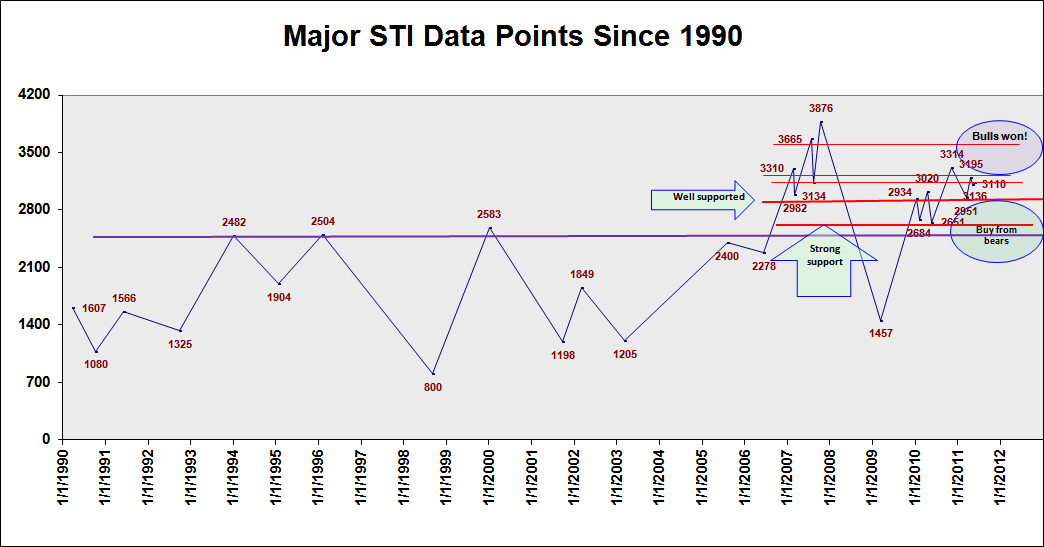
You can profit from the Power of Market Cycles

I believe you may heard it many times - "You can't time the market!".  I think it is nonsense.

At all times, market cycles exist in the real world. It is either big or small market cycles. Most of the time, you can't precisely time the high and low of each market cycles; but it doesn't mean you can't profit from the cyclical moves.

A good understanding and full acceptance of market cycles in your investing Mind can be an essential tool for those who wish to hold high dividend yield and multi-baggers in your portfolio for long-term (e.g. more than 10 years)

Markets are all about fear and greed.


During a bull market you are more confident of buying as most people surrounding you are jolly making good money from the stock market and they are often boasting their wins. You just don't want to miss the party.

During a bear market, it will be the opposite. Not many people are willing to talk about their losses. Even three of my favorite bloggers stopped blogging and disappeared from the cyberspace. May be they have taken another cyber name to avoid being identified as failures.

So are you emotionally and financially prepared to profit from STI market cycles?

See it for yourself.

Friday, 27 May 2011

Don't let stock market take you for a ride

Just For Laugh ....


Sometime, we may see netizens shouting happily when they see their stock prices moving up. Why happy when they have no intention of selling at all? It is just another emotional roller-coaster ride in the stock market.

Once there was a man who buried a pot of Gold in his backyard and everyday, he would go to his backyard to take a few minutes look at his buried pot of Gold. He felt very happy when he could obviously see that the pot of Gold was well hidden.

One day, he was shocked to discover that the buried ground was dug up and his pot of Gold was stolen. He was very sad and depressed.

One of his friend had an idea to help him. He buried some rocks at the same spot as the stolen pot of gold and then asked him to visit the same spot everyday and said to him that his pot of Gold was actually found and re-buried. The man became very happy after that.

Why are you so happy when you see your stock prices moving up if you are not selling at all?

Thursday, 26 May 2011

Keppel unit sells stake in Cebu shipyard for $23.7m


Biosensors: FULL YEAR FY2011

  • Total revenue US$156.6 million, up 35% over FY10
  • DES sales up 59% over FY10
  • Licensing revenue US$17.2 million, up 89% over FY10
  • Product gross margins 75% for FY11, compared to 70% in FY10
  • JV non-operating contribution of US$19.3 million; up 29% over FY10
  • Net profits of US$43.3 million, up 35% over FY10
  • Positive cash flows from operations of US$27.8 million

Playing The Game of Leverage (7)

Read? Playing The Game of Leverage (6)

I want to double up my money

Now, you have heard that the simple and fastest way to double up your money is by leveraging 10:1 for 10% returns on your borrowed capital.

But, in the investing world, there is no lunch either. Instead of getting free lunch, you might become the free Lunch for others.

If for whatever reasons that you still want to double your money, so how?

A more difficult and longer way without leverages is to use its cousin : Rule of 72

Read? The Best Secret in Investment and Trading – Compound Interest

Can you double up your money?

Yes, you can!

Just follow your heart and do it your way. No absolutely right or wrong.

Tuesday, 24 May 2011

IndoAgri shares dive to 18-month low

IPO pricing of its Indonesian unit seen as main cause


By FELDA CHAY

THE bloodletting would not stop for Indofood Agri Resources. Yesterday, shares of the Singapore-listed company tumbled 15.7 per cent to an 18-month low, largely in reaction to the palm plantation group's Friday announcement that it had priced the Indonesia initial public offering of subsidiary PT Salim Ivomas Pratama (SIMP) at 1,100 rupiah a share.

The offer price per share is at the lower end of the 1,060-1,700 rupiah indicative price range. Since announcing palm oil producer SIMP's listing on Feb 18 this year, IndoAgri's shares have plunged from $2.46 to yesterday's $1.72.

Yesterday alone saw a 32-cent dive after about 83 million shares changed hands, making it the third-most actively traded stock. Not helping the situation was the regional market fall, which in Singapore saw the Straits Times Index dropping by 1.8 per cent.

According to JP Morgan, its calculations show that 'the PT SIMP IPO is valuing IndoAgri at just $1.41 per share', a 30.9 per cent discount to its Thursday close before factoring in any upcoming mergers and acquisitions, and any holding company discount. Trading of IndoAgri's shares was halted on Friday.

The US$408 million in proceeds that will be raised from the offering would just be sufficient for SIMP's planned debt repayment of US$200 million, and capital expenditure of around US$200 million, said JP Morgan.

After the IPO, IndoAgri's stake in SIMP will decline to 72 per cent from 90 per cent.

In a report, Goldman Sachs noted that 'the IPO could pose downside risks to our IFAR (IndoAgri) earnings estimates through potential EPS (earnings per share) dilution, as well as possible holding company discount once its main operating asset is listed separately'.

It believes that IndoAgri's 2011 earnings per share could be diluted by 12 per cent.

Last month, IndoAgri said that net profit for its first quarter rose to 514.3 billion rupiah (S$73.6 million) - 66 per cent higher than the 309.8 billion rupiah it earned a year ago.

The rise, which came on the back of higher selling prices and sales volumes for palm products, took earnings per share for the three months ended March 31 to 5.1 cents, up from 3.1 cents a year earlier.

Revenue was up 38.6 per cent to 2.93 trillion rupiah, from 2.1 trillion rupiah last year.
------------------

Createwealth8888: Panic selling by BBs

Noble Group launches US$2.25b loan facility

SINGAPORE - Singapore-listed commodity firm Noble Group said on Tuesday it has launched the syndication of its US$2.25 billion revolving loan facility.

The facilities comprise a US$675 million 364-day committed and a US$1.6 billion three-year committed unsecured revolving loan facility, the company said.

Noble has appointed ABN Amro Bank NV, Banco do Brasil SA, Bank of America, The Bank of Tokyo-Mitsubishi UFJ, Citigroup, Commerzbank AG, Rabobank International, DBS Bank, Goldman Sachs, the Hongkong and Shanghai Banking Corporation, ING Bank, JPMorgan Chase, Natixis, the Royal Bank of Scotland Societe Generale and Standard Chartered as the bookrunner mandated lead arrangers. -- REUTERS

Monday, 23 May 2011

Keppel secures B Class jackup rig order from Dynamic Offshore Group

Keppel FELS Limited (Keppel FELS) has secured a contract with Vision Drilling Pte Ltd (Vision Drilling), a wholly-owned subsidiary of Dynamic Offshore Drilling Limited (Dynamic Offshore Drilling), to build its first KFELS B Class jackup drilling rig for US$180 million.


Slated for delivery in 1Q2013, the rig will be able to operate in water depths of 350 feet with a drilling depth of 30,000 feet and accommodate 120 men.

Dynamic Offshore Drilling has the option to build an additional rig to be exercised before 3Q2011.

Mr Naresh Kumar, Chairman of Dynamic Offshore Drilling, said, "While this is Dynamic Offshore's first collaboration with Keppel FELS, we are no strangers to its excellent project execution and dedication to safe, on-time and within-budget deliveries. My team and I have previously worked very closely with the Keppel FELS team on two KFELS B Class jackup rigs which have been deployed under long term contracts with strong day rates with a Fortune 500 National Oil Company.

"After the Gulf of Mexico oil spill, oil companies around the world prefer newbuild premium rigs with enhanced safety features and equipment reliability. With over 60% of the current Jack up fleet over 25 years old, it is an impetus for us as experienced drilling contractors to invest in premium high quality jackups with the world's leading shipyard. We are looking forward to build a number of rigs with the strong partnership of Keppel FELS in the years to come".

Mr Wong Kok Seng, Managing Director of Keppel FELS, added, "We are glad to be working with familiar partners. Mr. Kumar is highly respected in the industry and Dynamic Offshore Drilling is backed by a recognised team of professionals.

Customers come to us because of our award winning products, excellent execution of projects and our commitment and ability to deliver rigs of the highest standards. In building their first rig to our KFELS B Class design, we are pleased to be able to support them in meeting the market requirements of newer rigs with superior technical and safety capabilities."

With 33 such units delivered worldwide, the KFELS B Class design continues to be the preferred jackup choice for drilling operators.

John Gellert, President of Seacor Marine LLC ("Seacor") and Board Member of Dynamic Offshore Drilling said, "Seacor is pleased to be a part of the project as an investor and joint venture partner in Dynamic Offshore Drilling. With the long term rising demand for premium jackups, we are looking forward to the development of the company (Dynamic Offshore Drilling)."

Dynamic Offshore Drilling's rig is equipped with enhanced features to expand the operational coverage of the rig. Provisions have been made for the rig to work in high pressure high temperature (HPHT) environments and have Offline Stand Building capabilities.

Developed by Keppel's technology arm, Offshore Technology Development, the KFELS B Class jackup design provides maximum uptime with reduced emissions and discharges. Its environmental-friendly features won the KFELS B Class design the prestigious Engineering Achievement Award from Institution of Engineers Singapore in 2009.

The above contract is not expected to have a material impact on the net tangible assets or earnings per share of Keppel Corporation Limited for the current financial year.

Sunday, 22 May 2011

Playing The Game of Leverage (6)

Read? Playing The Game of Leverage (5)

Unexpectedly, you may become poorer in the next Bear when you fail to leave the party before Mid-night clock strikes at 12.

You may heard it many times that Leverage is a double-edged sword and it can kill! But, may be it is not leverage that kills. It is Deleveraging that actually kills.

Deleveraging is an attempt to decrease or pay off debts or loans. If people or instituitions are unable to pay off their debts quick enough; they will be at risks of defaulting or become bankrupt.

When the Bear market endures, more and more peoples and instuitions will become unable to loan back and refinance. Soon, they will be forced into more deleveraging at higher losses and coupled with more mass redemptions coming from the retail investors. As a result the market will collapse. When market collapses, it will become the "Mother of All Margin Calls" and Market Crash happens!

When you have not deleverged quick enough when Market Crash, you may become poorer!

BYO Wines

Just For Laugh ....

Read? Punggol Promenade is a 5-kilometre long public waterfront promenade

Yesterday, at my regular weekend evening jog from Hougang to Lorong Halus Wetland along Punngol Promenade and a bridge from the Punggol Promenade side that will bring you across Serangoon River to the Lorong Halus Wetland.

Yesterday, I saw something really different. I saw two men in their late 40s or early 50s chatting and drinking chilled Red wine at the middle of this bridge overlooking Serangoon River. There was a cooler bag to keep the wine bottle chill too.

Good life men! An inexpensive way to share good wines and pass time.
Related Posts with Thumbnails