I started serious Investing Journey in Jan 2000 to create wealth through long-term investing and short-term trading; but as from April 2013 my Journey in Investing has changed to create Retirement Income for Life till 85 years old in 2041 for two persons over market cycles of Bull and Bear.

Since 2017 after retiring from full-time job as employee; I am moving towards Investing Nirvana - Freehold Investment Income for Life investing strategy where 100% of investment income from portfolio investment is cashed out to support household expenses i.e. not a single cent of re-investing!

It is 57% (2017 to Aug 2022) to the Land of Investing Nirvana - Freehold Income for Life!


Click to email CW8888 or Email ID : jacobng1@gmail.com


Welcome to Ministry of Wealth!

This blog is authored by an old multi-bagger blue chips stock picker uncle from HDB heartland!

"The market is not your mother. It consists of tough men and women who look for ways to take money away from you instead of pouring milk into your mouth." - Dr. Alexander Elder

"For the things we have to learn before we can do them, we learn by doing them." - Aristotle

It is here where I share with you how I did it! FREE Education in stock market wisdom.

Think Investing as Tug of War - Read more? Click and scroll down


Important Notice and Attention: If you are looking for such ideas; here is the wrong blog to visit.

Value Investing
Dividend/Income Investing
Technical Analysis and Charting
Stock Tips

Wednesday, 9 April 2014

Dare to Be Great???


To greatly improve your investing performance; benchmark against the best.


Dare to Be Great???


Keppel extends near market, near customer strategy into China

Company signs agreement to manage a shipyard in Quanzhou, China

Keppel Offshore & Marine Ltd (Keppel O&M), through its wholly owned subsidiary, FELS Offshore Pte Ltd, has signed a management services agreement with Titan Petrochemicals Group Limited (Titan) - a company in which commodities trading conglomerate Guangdong Zhenrong Energy Co. Ltd. (GDZR) is a major shareholder - and Titan Quanzhou Shipyard Co. Ltd (TQS), to manage the TQS shipyard.

TQS, located in Quanzhou in Fujian Province, is one of the largest shipyards in China, occupying a total area of 110ha with 3,600m length of coastline.

When completed, TQS will have four ultra-large and wide dry docks, including one of the largest modern-designed docks in China, which will enable it to convert double hull vessels such as Floating Production Storage and Offloading (FPSO) units. Besides ship repair and conversion capabilities, the yard is also able to construct offshore rigs including jackups and semisubmersibles.

Under the agreement which is for a 30-year period, renewable thereafter as mutually agreed, the yard, managed by Keppel O&M, will undertake projects using Keppel's proprietary designs.

TQS is wholly-owned by Titan, which is a provider of logistics, transportation, distribution and marine services for petrochemical products in Asia. This agreement is conditional on the completion of the on-going financial restructuring of Titan and the resumption of the trading of its shares on the Hong Kong Stock Exchange.

Mr Chow Yew Yuen, CEO of Keppel O&M said, "The offshore oil and gas market in China has been growing significantly, and there is increasing demand for high specification rigs and production vessels. At the same time, China is a market which has strong preference for China-made products. Having this yard is an extension of our near market, near customer strategy and enables us to service the Chinese market with our suite of proprietary solutions while meeting its requirement of building in-country. This is further complemented by our other shipyard in China, Keppel Nantong, which undertakes specialised shipbuilding and offshore fabrication.

"With 20 yards around the world, we have the experience in managing existing shipyards and optimising their operations, just as we have done so in Brazil, the Netherlands, USA and the Philippines. Together with the strength of GDZR's extensive connections and experience in China, and our expertise and established track record in the global offshore and marine industry, we are confident that this is a win-win partnership that will enable Keppel and Titan to become a major offshore solutions provider for China."

Mr Zhao Xu Guang, Chairman of Titan added, "We are looking to enhance our presence in the offshore and marine business, and partnering Keppel, the world's leading rig builder, is a significant step in this direction. I am confident that with Keppel managing this yard which has good development potential, we will be able to quickly build up the track record of the shipyard and deliver winning Keppel designs and products to Chinese oil and gas operators. Having studied the market, we believe there are a significant number of potential projects that this yard is capable of undertaking."

Both Keppel and Titan are optimistic about the growth potential of China's offshore and marine industry. China's dependence on oil and gas imports has increased from 43% to 56% in 2012, and is expected to exceed beyond 60% in the next few years. With its oil production on land having reached a plateau of 200 million tonnes annually, China is looking to expand its offshore oil and gas production to meet rising energy demands domestically.

In its 12th five-year plan, China announced plans to more than double its investment in offshore exploration and production (E&P) activities to RMB 300 billion, up from RMB 120 billion in its 11th five-year plan. Offshore oil and gas production is also targeted to double to 100 million tonnes, from 50 million tonnes, annually.

The above agreement is not expected to have any material impact on the net tangible assets and earnings per share of Keppel Corporation Limited for the current financial year.

- End-

Tuesday, 8 April 2014

Sembcorp expands industrial wastewater treatment business in Hubei


Sembcorp Industries will be expanding its industrial wastewater treatment business to China's Hubei province, with the development of its first beachhead in Jingmen City.

Sembcorp said it would own a 95 per cent stake in the joint venture to build, own and operate an industrial wastewater treatment plant in the Jingmen

Chemical Industrial Park. Jingmen Xinyuan Investment Company, wholly owned by the Duodao District Government of Jingmen city and a business arm of the JCIP Administration Committee, will hold the remaining 5 per cent.

The total project investment of 98.7 million yuan will be funded through a mix of equity and borrowings.

Sembcorp's 95 per cent share of the equity investment amounts to 37.5 million yuan (S$7.8 million), which will be financed by internal funds.


Difference between Knowledge and Wisdom in the stock market- See the chart!


In the stock market, we need both knowledge and wisdom to become rich in the next window of opportunity. Seeing is not believing. See the above chart again. Now. Seeing is ....!

For seniors and veterans in the stock market, check your own wisdom benchmarking in 1998, 2001, 2003, and 2009; only the wise ones were laughing to the bank and the more knowledgeable ones are still talking loudly!

Right?


US stocks fall more than 1% as tech slump continues

NEW YORK: US stocks on Monday slumped for a third day in a row as investors worried about whether high-flying technology stocks are overvalued and cautiously anticipated earnings season.

The Dow Jones Industrial Average tumbled 166.84 points (1.02 per cent) to 16,245.87.

The broad-based S&P 500 sank 20.05 points (1.08 per cent) to 1,845.04, while the tech-rich Nasdaq Composite Index declined 47.97 (1.16 per cent) to 4,079.75.

The losses followed weakness since the middle of last week. Technology and biotech stocks have been among the feeblest equities, although a handful of hard-hit equities posted gains Monday.

"Most of this selling has concentrated on these darling stocks and I guess investors are questioning their value," said Peter Cardillo, chief market economist at Rockwell Global Capital.

Cardillo also attributed the losses to "a little anxiety before earnings."

Earnings season unofficially kicks off Tuesday with Alcoa after the markets close and with reports Friday from banking giants JPMorgan Chase and Wells Fargo.

Weak technology stocks included LinkedIn (-3.7 per cent), Yahoo (-3.5 per cent) and Tesla Motors (-2.2 per cent). Apple lost 1.6 per cent and Google fell 0.9 per cent.

But some other tech and biotech stocks bounced back. Biogen advanced 2.1 per cent, while Facebook added 0.4 per cent and Netflix edged up 0.2 per cent.

Financial stocks were generally weak, including Bank of America (-2.0 per cent), Wells Fargo (-1.8 percent) and Dow members Goldman Sachs (-2.9 per cent) and American Express (-2.9 per cent).

A handful of companies in the Dow posted increases, including technology companies IBM (+1.4 per cent), Intel (+1.2 per cent) and Cisco (+0.6 per cent).

Cardillo said some investors may be moving funds out of "darling" momentum stocks to more "defensive" names. IBM, Intel and Cisco all pay dividends.

Ireland-based Mallinckrodt announced it will buy US rival Questcor Pharmaceuticals in a roughly $5.6 billion cash-and-stock deal expected to expand the firm's drive in the specialty drugs field. Questcor shot up 18.7 per cent; Mallinckrodt fell 2.5 per cent.

Dow member Pfizer slumped 3.0 per cent despite reporting over the weekend that its palbociclib treatment resulted in "significantly prolonged" survival rates for patients with advanced breast cancer. However, Morgan Stanley said the timing for regulatory approval remained unclear.

Bond prices rose. The yield on the 10-year US Treasury declined to 2.70 per cent from 2.73 percent Friday, while the 30-year dipped to 3.56 per cent from 3.59 per cent. Bond prices and yields move inversely.


Monday, 7 April 2014

The Best Investment Advice I Ever Received

by Alexander Green, Chief Investment Strategist    

At the recent Investment U Conference at the beautiful Park Hyatt Aviara in Carlsbad, Calif., the speakers each shared their answer to the question "What is the best piece of investment advice you ever received?"

That's a tough one. Over the past 29 years, I've been a stockbroker, an investment analyst, a money manager and a financial writer. I've made good money in the market. And I've taken my lumps (especially in the early days).

However, we weren't asked to talk about the most important lessons we learned from our own experiences. We were asked to talk about the single best piece of investment advice we'd ever received.

I decided not to pass along some of the obvious ones, even though they hold great value for those who haven't heard them.

Take Warren Buffett's classic encapsulation of stock market psychology: You want to be fearful when others are greedy and greedy when others are fearful.

If you have the guts to follow this one rule, you can ignore everything you ever learned about sales, earnings, cash flow and profit margins. When investors are panicked and filled with pessimism, buy. And when they are supremely confident an asset has nowhere to go but up - be it stocks, gold or real estate - get the heck out.


This Time It's the Same

If you're ever tempted to doubt Buffett's contrarian advice, you might remember another gem I considered using from investment legend John Templeton: The four most dangerous words in investing are: "This time it's different."

Investors who ever got fully margined on stocks, highly leveraged on pre-construction condos or ran to cash near a market bottom could have saved themselves a lot of agony (and money) by heeding Templeton's words. Bubbles form. Bubbles burst. Asset performance reverts to the mean. Bank on it.

I also briefly toyed with something uttered by boxing champ Mike Tyson. "Everyone has a plan until they get punched in the mouth."

Tyson didn't mean this as market advice, of course, but it's entirely apropos. In the past I worked with hundreds of individual investors and was surprised how folks who were confident they would invest for the long term and buy the dips abandoned ship as soon as the waves began hitting the deck.

Everything was hunky-dory until they got punched in the mouth. Then all bets were off.


Your Worst Enemy


But, in my estimation, the truly best piece of investment counsel I ever received was dug from the pages of Benjamin Graham's investment classic The Intelligent Investor. "The investor's chief problem - and even his worst enemy - is likely to be himself."

If you want to see the person most responsible for your investment plans not working out the way you imagined, go stand in front of the mirror.

If you say it's not your fault because you turned your money over to a broker, insurance agent or registered rep who handled it poorly, well, who made that decision to delegate?

If you take advice from an investment letter editor who's been on the wrong side of the market the last five years, well, who decided to subscribe to that letter and act on the advice?

If you say you don't know enough to manage your money yourself, whose fault is that? Investing is not rocket science. Yes, it takes a little time - and a little trial and error - to learn the basics. But if you've spent more time watching Seinfeld reruns than obtaining the knowledge essential to securing your financial future, you'll find little sympathy here.

Taking responsibility for your financial future is liberating. After all, you can't control the economy, can't affect the financial markets, can't set Fed policy and can't foresee the future. But the really important factors you can control.


The Seven Factors


For example, the future size of your investment portfolio will be determined by seven - and only seven - factors:


  1. How much you save.


  2. How long you let it compound.


  3. Your asset allocation.


  4. Your security selection.


  5. The annual performance of your investments.

  6. The expenses you absorb.


  7. And the taxes you pay.
  8.  

Only one of these factors you cannot control: the annual performance of your investments. So what should you do? Revisit the list. You should save as much as you can, let it compound as long as you can, asset allocate properly, diversify broadly, minimize your investment costs and tax-manage your portfolio.

If you don't understand these things, you need to. (We talk about them regularly here.) If you aren't doing these things, you should be - in both good times and bad.

History shows that the highest returns don't accrue to those with the biggest brains... but to those with the strongest stomachs. Wall Street is littered with the bones of those who knew exactly what to do at market tops and bottoms yet couldn't bring themselves to do it.

In sum, it's only when you take responsibility for your investment decisions that you experience success and the security and satisfaction that comes with it. And if you don't find success?

As Shakespeare reminds us, "The fault, dear Brutus, is not in our stars, but in ourselves."

Good investing,

Alex

Making utilities a pillar in Sembcorp


Sembcorp Industries' CEO Tang Kin Fei has played an instrumental role over the past 2 decades. By LEE MEIXIAN


SOME 20 years ago, Sembcorp Industries, a heavyweight in Singapore's utilities sector and a blue-chip conglomerate, didn't actually have a utilities business.

Today, utilities, comprising energy, water, solid waste management and on-site logistics, contributed $450 million in 2013 net profit - more than half the $820 million total net profit reported that year.

Moreover, profit from utilities is expected to double in the next five years, on the back of a strong development pipeline of power and water projects in mostly rapidly developing economies.

One person who was instrumental in adding the utilities pillar to the company's then largely marine operations back in 1995 is Sembcorp's present-day group president and CEO Tang Kin Fei.

The utilities business arose because of a conundrum that Mr Tang found himself grappling with back when he was heading Sempec, a seven-person unit of Sembawang Engineering engaged in onshore plant engineering services.

Sunday, 6 April 2014

Book : The Joy of Not Working


Becoming Man or Woman of Leisure


Simi LP Theory on investing made simple???


Just For Thinking ....


The more Uncle8888 thinks back, the more he thinks that investing is as simple as LP Theory: It is either Tua LP or Bo LP?


In 1998, AFC, he missed out the best once in his lifetime opportunity to huat tua tua from the stock market.

Bo LP!!!

Why???

A single household income with three kids at age of 10, 8, and 3 and not financially well prepared for crisis; Uncle8888 sibei bo lam par!

How to huat?


In Sep 2011, WTC Attack and 2003 SARS, Uncle8888 was well prepared since Jan 2000 by consolidating all his spare money into his biggest war chest ever.

Limpeh wu lam par. Not bad. So huat ah!


In 2009, GFC, wu lam par but impotent!

He missed out again on second time! KNS!


Impotent. Got lam par also no need.


Lesson learnt for the next crisis.

Practise Lam Par Theory!

Tua Lam Par comes from bigger war chest???

Investing made simple! Right?


Saturday, 5 April 2014

Nasdaq sinks more than 2.5%, leads market lower

NEW YORK: The Nasdaq Composite Index tumbled more than 2.5 per cent on Friday, as investors overlooked a solid US jobs report to sell off prominent names from across the tech sector.

The Nasdaq sank 110.01 points (2.60 per cent) to 4,127.73.

The Dow Jones Industrial Average fell 159.84 (0.96 per cent) to 16,412.71, while the broad-based S&P 500 slumped 23.68 (1.25 per cent) to 1,865.09.

The Department of Labor reported the US economy added 192,000 jobs in March, essentially meeting expectations and suggesting a continuation of the trend of slow but steady improvement in the labour market.

But analysts said the sell-off was spurred not by the jobs report or other news, but by the same negative sentiment that has hit tech and biotech names intermittently over the last few weeks.

A recurring concern is that hot technology stocks like Facebook and Netflix are overvalued.

"It is not about economic news, or earnings, or geopolitics; this is a market event," said Alan Skrainka, chief investment officer of Cornerstone Wealth Management.

"This is the frothiest part of the market cracking in a big way. Small caps are overvalued and the hottest names in the Nasdaq are leading the way down."

The losses among tech companies were broad based and included giants like Apple (-1.3 per cent), Microsoft (-2.8 per cent) and Google (-4.7 per cent).

Also declining significantly: Facebook (-4.6 per cent), Tesla Motors (-5.9 per cent), Netflix (-4.9 per cent), LinkedIn (-6.3 per cent). Biotech names took a hit, including Biogen (-4.4 per cent), Celgene (-4.3 per cent) and Gilead Sciences (-2.4 per cent).

But the tech sector had one bright spot with Friday's first day of trade for GrubHub. The online food ordering company quickly jumped 30.8 per cent to $34 from its initial public offering price of $26 per share.

Used-car retailer CarMax fell 4.2 per cent on earnings that missed expectations by a penny at 52 cents per share. Revenues also fell short of expectations, even though total units sold rose 12 per cent.

A potential acquisition of Swedish pharmaceutical company Meda by US peer Mylan collapsed after Meda announced its board rejected the proposal and that all talks were terminated. Mylan rose 1.5 per cent.

Bond prices jumped. The yield on the 10-year US Treasury fell to 2.73 per cent from 2.79 per cent Thursday, while the 30-year dropped to 3.59 per cent from 3.63 per cent. Bond prices and yields move inversely.

As retail investors can we supplement our earned income through active (DIY) investment strategy? Worth the time and effort doing it???


As retail investors can we supplement our earned income through active (DIY) investment strategy?


Worth the time and effort doing it???


Three Things to do ...

ASK,

MEASURE,

DECIDE.


From Jan 2000 to 4th Apr 2014


Once upon a time .... in History and ... in Dream Land; but woke up to reality!


Friday, 4 April 2014

4 in 10 S'porean employees want to retire at 55

SINGAPORE: Almost four in 10 employees in Singapore want to retire at the age of 55 - 10 years earlier than the retirement age set by the government, revealed the 2014 Randstad Award survey released on Friday.

The survey of 6,546 employees in Singapore also found that respondents would be motivated to work longer if their workplace offered a more relaxed schedule, friendlier atmosphere and shorter work hours.
Randstad Country Director for Singapore Michael Smith said the findings provide organisations with a clear insight on how best to engage their top talent in order to retain them.
"Singapore is already facing a talent crisis, with many organisations finding it difficult to meet the demand for skills.
“If a situation arises where a large group of the talent pool are unwilling to work till the retirement age, this will make the talent shortage challenge even more acute for organisations here.
“Employers need to constantly evolve their talent management strategies by understanding the motivations of their employees of all ages, including return-to-work mothers and the mature-age workforce," said Mr Smith.
The survey found that female employees, in particular, find flexible working hours a key motivator for staying in the workforce.
Mr Smith said this is not surprising, given female employees tend to think about family priorities at some stage during their careers.
"Today's constantly changing world of work means that there is no one-size-fits-all approach.
“Employers need to continuously rethink their approach to ensure they are meeting the needs of their employees. These include establishing flexible working arrangements, a positive working environment and work-life balance.
“Yet it is critical for employers to strike the balance between keeping their employees happy and maintaining productivity to ensure their business is well placed for the next phase of growth," added Mr Smith.
The survey also found that competitive salary and employee benefits remain the most important factors for employees in Singapore when they choose an employer.
This is the third consecutive year where salary and benefits have taken the top spot.
The top three key employer personality traits employees in Singapore look for are: reliable, honest and sincere.
Another survey finding was that Singapore employees spend an average of 42 minutes travelling to work.
This is close to their acceptable time of 39 minutes. 

How a Financial Crisis Can Help Your Retirement

By Joe Udo

It's been five years since the global financial crisis, and the stock market has made a remarkable recovery. The S&P 500 rose 125 percent and is now at an all-time high. The bull market has been great for many of us who kept investing through the difficult years. Financial downturns can actually be good learning experiences. If we encounter a crisis early in our investing journey, we have plenty of time to recover and learn from our mistakes.

A recent study from Fidelity found that American households have made huge strides in their personal finance habits. Many investors have taken the following steps to secure their finances further:

Save more. Investors increased their retirement contributions over the last 5 years, which means they are likely to be more prepared for retirement.

Better prepare for the unexpected. Many households have reduced their personal debt over the last few years. They also started or increased their emergency fund. Unexpected events will have less of an impact on your life if you have adequate savings to cushion the blow.

Rethink risk. Many investors sold stocks during the downturn and shifted to bonds. Of course, it's difficult to know when to get back in and a lot of people missed part of that 125 percent S&P 500 gain. Investors need to examine their risk tolerance to figure out a plan they can stick with over the long term.

Many investors lost a lot of money during the financial crisis, but the long-term lessons we learned are invaluable. There will be another financial crisis in the future, and we need to apply these lessons to avoid losing even more money next time. It's much better to go through these financial crises when you are young rather than when you are getting ready to retire.

Investing opportunities during the financial crisis. For younger investors, the financial crisis was a boon. It provided an opportunity to buy stocks at bargain basement prices. Even if your portfolio lost 50 percent of its value, it is still a small amount in the grand scheme of things when you're young. Young people didn't have a huge amount of money to lose. When you're starting out, it's more important to increase your saving rate and to learn how to invest for the long term.

It's also good to go through a big correction so you can see how the stock market recovers. You can learn from this experience and be more prepared for the next downturn. The downturn was an opportunity to figure out your risk tolerance and your target asset allocation. Many investors thought they could handle a stock market drop. However, when the S&P 500 dropped 50 percent, they really couldn't handle it. If you set your risk tolerance correctly, then you should be able to stick to your asset allocation plan and ride out the down years.

Once you have a long-term plan and a good asset allocation target, you just need to stick with it and rebalance occasionally. Of course, we all change as we get older and you will need to reassess your risk tolerance every 5 years or so. Most of us will become more conservative and our portfolio needs to reflect that.

Personal finance lessons. Even if you don't follow the stock market, a personal financial crisis can be a good learning experience. If you lose a job, you will learn to cut costs and keep some emergency funds for the future. If you lose a house to foreclosure, then you will know not to buy too much house next time. Losing a well-paying job can be difficult, but you will learn how to live a moderate lifestyle and avoid overspending. These financial setbacks can be tough, but if you have an open mind you will learn from your experience.

Joe Udo blogs at Retire By 40 where he writes about passive income, frugal living, retirement investing and the challenges of early retirement. He recently left his corporate job to be a stay at home dad and blogger and is having the time of his life.

Thursday, 3 April 2014

Compound Interest is not the same as Compound Returns (5)


Read? Compound Interest is not the same as Compound Returns (4)


CPF Logo


Your CPF OA @ 2.5% and SA, MA and RA @ 4% are compound interests.


They are NOT the SAME as compound investment return.

Compound investment return over market cycles may turn negative too.

Get it?


Don't be a victim! 3 ways to control your investing destiny

 Lee Munson of Portfolio LLC ticks off three ways investors hurt themselvse more than the crooks every could.


1. Focus on the size of your nest egg not your monthly performance

Did you beat the S&P500 (^GSPC) in the first quarter? Trick question. The real answer is that it doesn’t matter. After you retire you won’t be able to pay your bills on outperformance. You need to build wealth. That means patiently contributing to a retirement fund not outperforming your neighbor.

“What matters is that when you retire you have enough income to pay yourself,” suggests Munson. Brag about your performance all you want but if you can’t spend it in a grocery store after you retire it doesn’t count as real money.

2. Trade less

For all the attention brought to the dangers of trading on Wall Street the fact is it’s never been easier or more efficient for individuals to daytrade. As Felix Salmon pointed out yesterday most transaction never get anywhere near a trading floor. Execution and commision are fine, the problem is trading itself.

Munson suggests carving out a small trading account for your speculative investments. Most investors have a little gambler in them. Rather than pretend otherwise carve out some speculative assets for your higher-risk speculations but keep your retirement funds sacrosanct.

3. Trade smart

Munson was once a high-flying NY trader. Now he’s seen the light, focusing on building long-term wealth for more passive investors. He’s found the switch to “boring” to be much more profitable than when speed trading.

“Get a plan and be very, very boring. If you want to make more money it’s not about chasing alpha or chasing down trades. It’s about systematically working a plan.”

People who absolutely must trade can carve out their speculative accounts as suggested above but they should expect to lose. That being the case Munson would rather take his cash and go to Vegas. “I prefer casinos where you get a free show and a buffet.”

Love & Investment – The Right Thing to do!


Read? 4 Things Love and Investing Have in Common


Read? Love & Investment – Similar But Different


Love & Investment – The Right Thing to do!


Marry the Right one and stay faithful for long time to enjoy the fruits of the labour during courtship.
Right and Hold.
No need for hard work to sustain the relationship as it is now based on faith or strong belief.
No more emotional roller ride as you have enough emotional buffer to cushion it away.
Smile every time when you receive your CDP statement or CPF investment statement. (Sound like Dear Minister?)
- See more at: http://thefinance.sg/2014/04/02/love-investment-similar-but-different/#sthash.E7tHWoUS.dpuf
Marry the Right one and stay faithful for long time to enjoy the fruits of the labour during courtship.
Right and Hold.
No need for hard work to sustain the relationship as it is now based on faith or strong belief.
No more emotional roller ride as you have enough emotional buffer to cushion it away.
Smile every time when you receive your CDP statement or CPF investment statement. (Sound like Dear Minister?)
- See more at: http://thefinance.sg/2014/04/02/love-investment-similar-but-different/#sthash.E7tHWoUS.dpuf
Marry the Right one and stay faithful for long time to enjoy the fruits of the labour and initial "investment cost" during courtship.


Right and Hold.


No need for hard work to sustain the relationship as it is now based on faith or strong belief.


No more emotional roller ride as by then you should gain enough emotional buffer to cushion it away.

 
Smile every time when you receive your CDP statement or CPF investment statement.


You know where is your problem. Right one?


S&P 500 ends at another record

NEW YORK (Reuters) - The S&P 500 closed at another record high on Wednesday as signs of steady private-sector hiring suggested that the economy was slowly building momentum after a winter-related pullback.

That also put more focus on Friday's government jobs data, which is among the most widely watched economic indicators.

"There's positioning ahead of that report," said Bucky Hellwig, senior vice president of BB&T Wealth Management in Birmingham, Alabama.

He also said "there was money moving in at the end of the quarter so now there's an upward bias."

The jobs report is expected to show that employers added 200,000 to nonfarm payrolls in March, the largest gain in four months, according to a Reuters poll of economists.

Eight of 10 S&P 500 sector indexes ended in positive territory, led by the consumer discretionary sector index (.SPLRCD), up 0.7 percent.

Wednesday's data from payrolls processor ADP showed U.S. private-sector employers added 191,000 workers in March, slightly below the 195,000 forecast, while gains in the previous month were revised to 178,000 from a previously reported 139,000, signaling that a winter-related impact on job growth earlier this year was easing.

Orders for long-lasting manufactured goods jumped 1.6 percent in February, the biggest rise since September and above a 1.2 percent estimate, the Commerce Department said. January's durable goods orders were revised to show a larger drop of 1.0 percent instead of the previously reported decline of 0.7 percent.

The Dow Jones industrial average (^DJI) rose 40.39 points or 0.24 percent, to end at 16,573. The S&P 500 (^GSPC) gained 5.38 points or 0.29 percent, to finish at 1,890.90, a record closing high. The S&P 500 also hit an intraday record high of 1,893.17.

The Nasdaq Composite (^IXIC) added 8.416 points or 0.20 percent, to close at 4,276.456.


Wednesday, 2 April 2014

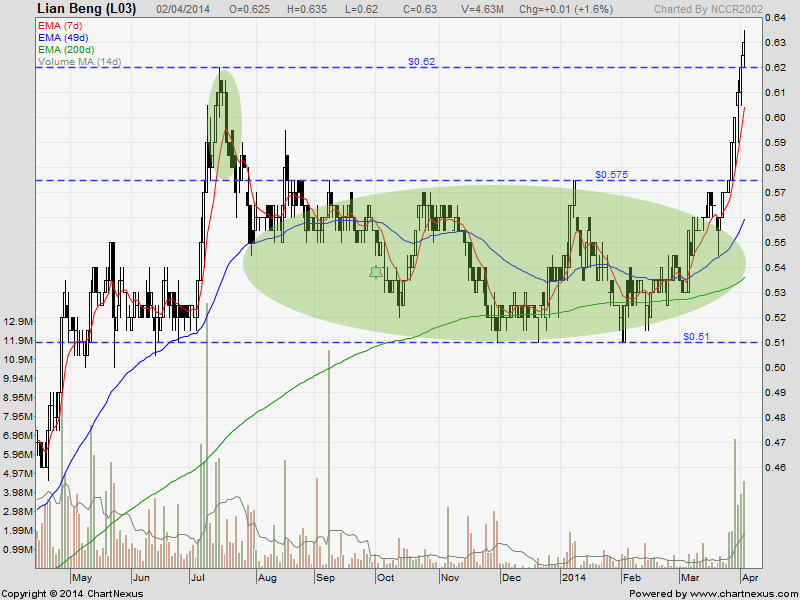
Me too: Lian Beng (3)


Read? Me too: Lian Beng (2)


No stop-loss?

Guess what?


Nightmares and more than six years of pain in the ass with annual dose of Panadol!

See the picture for yourself and self-explanatory.


Is the pain in the ass finally over without the annual dose of Panadol?
 
At today's closing price of $0.63, CAGR for TSR over 6.2 is 3.1%.
 
It is on par with inflation rate @ 3%
 
 
Consolation holding!
 
 
Breaking out from long consolidation should be bullish in nature.


CapitaLand's The Ascott buys serviced residence in Hong Kong

CapitaLand020414
CAPITALAND's wholly-owned serviced residence business unit, The Ascott Limited, has acquired an operating serviced residence in Hong Kong for HK$545 million (S$88.8 million) - PHOTO: BLOOMBERG

CAPITALAND's wholly-owned serviced residence business unit, The Ascott Limited, has acquired an operating serviced residence in Hong Kong for HK$545 million (S$88.8 million).

The 55-unit property will be rebranded as Citadines Mercer Hong Kong in the third quarter of 2014.

Located in Sheung Wan on Hong Kong Island, Citadines Mercer Hong Kong is next to the central business district, close to Soho and Lan Kwai Fong.

The serviced residence is only a minute walk to Sheung Wan Mass Transit Railway, a five-minute walk to Hong Kong- Macau Ferry Terminal and a 10-minute walk to the International Finance Centre where many multinational companies and financial institutions are based.

China's Cofco to buy 51% of Noble's unit for US$1.6b


30461179
Cofco Corp., China's largest food company, has agreed to buy a majority stake in Noble Group's agriculture unit in a deal that values the latter at US$3.22 billion - PHOTO: REUTERS

Cofco Corp., China's largest food company, has agreed to buy a majority stake in Noble Group's agriculture unit in a deal that values the latter at US$3.22 billion.

On Wednesday, Noble said Cofco (Hong Kong) Limited, a unit of Cofco Corp, joined by Hopu Investment Management Co., a private-equity fund, will buy 51 per cent of its unit, Noble Agri International Limited (NAL) for US$1.6 billion.

If successful, Noble said the estimated gain from the sale is US$64.80 million.

The proposed sale price is equal to 1.15 times of 51 per cent of the audited book value of NAL for the financial year ending December 31, 2014.

Book: Mental Healthcare Of The Elderly

Mental Healthcare Of The Elderly


In recent years, Asian countries have begun to rethink, reorganise and introduce innovations to improve their mental health services. Mental Healthcare of the Elderly contains some of these new ideas and is a primer for health professionals who are involved in the care of elderly people with mental health problems like depression and dementia.

Read? For how long can we control our mind? Don't need to talk about investment! (5)


CW8888:


Lucky, we are Asian!


Uncle8888 has been reading more books on aging and researching into the next phase beyond financial planning for retirement income for life.

The Mind.

The same Mind in the three M's of investing - Method, Money Management, and Mind.


Dementia is scary as the mind is failing at the rate that we are not even aware. It can only be pick up by our family members.

Body is still working but mind is failing. When Body is failing and Mind is still working, we can use our money to buy help. 

When Body is still working but mind is failing; we may not even know how to get help. Lots of money in the bank also useless.


Nowadays, Uncle8888 has realised that his three children are actually "hedges" for his spouse and himself.

Hedge can end up with good value or worthless. That is the nature of hedging; but at least, he and his spouses has more hedges than the norm.

The risk of failing hedge will be lower.


Tuesday, 1 April 2014

Signed LOA for the Catcher FPSO

BW Offshore has signed a Letter of Award (LOA) with Premier Oil for a FPSO to operate on the Catcher oil field in the UK North Sea.

The LOA will be converted into a final contract subject to final partner sanction and Department of Energy and Climate Change (DECC) approval, expected to be completed during Q2 2014. The field is owned by Premier Oil (50%, operator), Cairn Energy (30%) and MOL (20%). 

The firm charter period of the contract is 7 years, with extension options. Based on a field life of 10 years, the contract value is USD 2.3 billion including FPSO charter rate and opex. 

BW Offshore was awarded a FEED study as part of a funded tender process by Premier Oil in Q4 2012, and has performed extensive engineering studies on the project during 2013 and Q1 2014. 

BW Offshore's scope includes the delivery of the FPSO, mooring system, installation and operation of the unit throughout the charter period. The FPSO will have a processing capacity of 60,000 bopd and a storage capacity of 650,000 bbl.

BW Offshore will order a new built hull from Japan for the project, while conversion and integration work will be performed in Singapore. The FPSO shall be ready for production mid-2017.


CW8888: Kep Corp?


The project will be financed by a project specific bank facility of USD 800 million and BW Offshore’s existing liquidity.

Sembcorp wins industry and govt recognition for China water business


GOOD things come in pairs. For Singapore's Sembcorp Industries, it is gaining both industry and government recognition for its industrial water business in China.

The first was a major award for its wholly owned Chinese subsidiary, Sembcorp China.


It won the "Leader in Wastewater Treatment for Chemical Industrial Parks" category in the China Water Industry Annual Award 2013.

The award, organised by China's most influential environmental media China-WaterNet, recognises Sembcorp's achievements in providing industrial wastewater treatment within chemical industrial parks in China over the past decade, as well as its success in securing new wastewater treatment pro-jects in the Panjin Fine Chemical Industrial Park in Liaoning province and Caofeidian Chemical Industrial Park in Hebei province in 2013.


STI : Tan Ku Ku


Any April Fool today?


Related Posts with Thumbnails