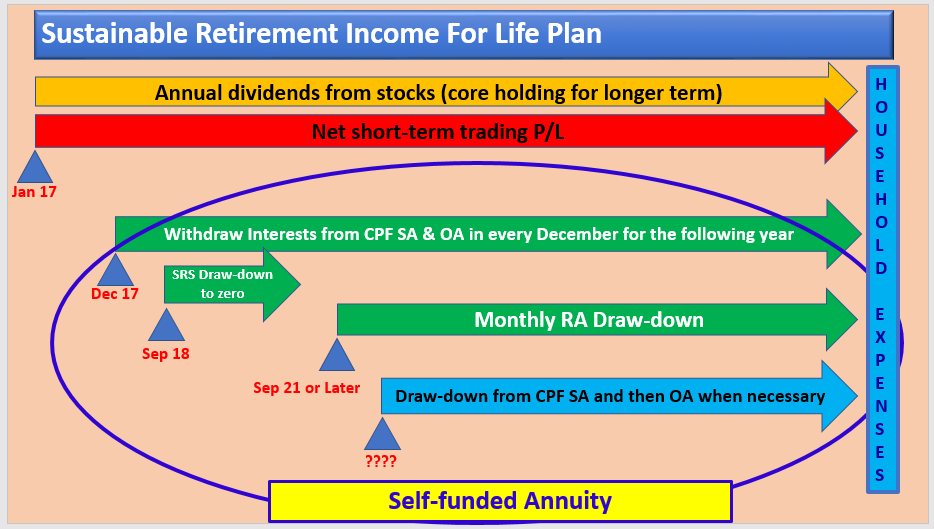
I started serious Investing Journey in Jan 2000 to create wealth through long-term investing and short-term trading; but as from April 2013 my Journey in Investing has changed to create Retirement Income for Life till 85 years old in 2041 for two persons over market cycles of Bull and Bear.

Since 2017 after retiring from full-time job as employee; I am moving towards Investing Nirvana - Freehold Investment Income for Life investing strategy where 100% of investment income from portfolio investment is cashed out to support household expenses i.e. not a single cent of re-investing!

It is 57% (2017 to Aug 2022) to the Land of Investing Nirvana - Freehold Income for Life!


Click to email CW8888 or Email ID : jacobng1@gmail.com


Welcome to Ministry of Wealth!

This blog is authored by an old multi-bagger blue chips stock picker uncle from HDB heartland!

"The market is not your mother. It consists of tough men and women who look for ways to take money away from you instead of pouring milk into your mouth." - Dr. Alexander Elder

"For the things we have to learn before we can do them, we learn by doing them." - Aristotle

It is here where I share with you how I did it! FREE Education in stock market wisdom.

Think Investing as Tug of War - Read more? Click and scroll down


Important Notice and Attention: If you are looking for such ideas; here is the wrong blog to visit.

Value Investing
Dividend/Income Investing
Technical Analysis and Charting
Stock Tips

Showing posts sorted by relevance for query goals. Sort by date Show all posts

Saturday, 13 May 2017

Why Do You Have To Set S.M.A.R.T Investing Goals???


Read? The Goal Is To Have No Goals, But To Have...

1. When you have goal, the route to it becomes a labour. Put it another way, it is too linear and anything linear is hardly fun or interesting. 

2. The imagination becomes closed to other possibilities. A goal limits your actions. There isn't room to explore other pathways. 

3. The goal usually need to be precise and has time-limit. This is exact reason why goals backfire - they encourage us to focus narrowly.

As retail investors; you are answerable to nobody except yourself and also there are no bosses to set S.M.A.R.T Goals or KPIs for you to achieve and reward you accordingly.

Why do you have to set S.M.A.R.T investing goals for yourself?

For investing goals; you avoid acting smart and be dumb by setting Stretch Goals or Band Range Goals.

Like Uncle8888 setting his 10-years investing goals


For his F.I.R.E Goal; when he made it! Of course; he Bom Pi Pi and tells everybody it is the way he has made it.

Once you are successful; you can say whatever way you like it and how you have made it. 

Goals or No Goal is irrelevant!

Just show your big number. You are likely to get Wow!

So you either set F.I.R.E Goal for yourself or naturally you will get fired when time comes.

You will one day be fired from your full-time job either involuntarily through retrenchment or statutory on your official retirement age.

Of course; you can set F.I.R.E Goal; when you made it you Bom Pi Pi; but when you don't. You still naturally be fired! This is no big deal as you don't have to answer to anybody. Right?


Thursday, 6 April 2017

Goals, System And Process Are Not Mutually Exclusive! (1)


Uncle8888 has lived long enough and witness more than enough people growing up in the same era as him; but those who have CLEARLY communicated their Goals upfront in their early years; somehow they eventually achieved their Goals way ahead of their peers who are still dreaming of striking ToTo JackPot in their 60s! BTW; he is one of them every Mondays and Thursday dreaming it!


Our Goals can provide THAT direction and push us forward to THAT direction in the long-term and eventually we will built for ourselves our own well-designed system and committing to the process to pursue our clearly stated Goals.

Stating our Goals without committing effort, resources and time to build our own System and refining and adjusting our process to pursue our Goals is just Day Dreaming!

Let Uncle8888 shared his own experience of setting his Goals and what follows on year after year until the Goals are achieved!

Goal of Self-insured Fund by 60


Read? Long Term Personal Financial Goal - Self-insured Fund by 60!!! (2)


After reading if you have bother to read them; what is the difference?

The Grasshopper's Way - No Goal!

 I've just gone to my insurance company this afternoon and surrendered my remaining last whole life insurance. I ended my term life insurance policy 4 years ago when I returned back to Singapore.

Whole life insurance policies break even after 20 years. So had to patiently wait until today.

I bought this whole life policy just before my 28th birthday 20 years ago. Man! I'm now 48!?

Where did these 20 years go?

The Ant's Way - Setting Goal well ahead of his time in term of decades!

Uncle8888's last life insurance policy will mature in Mar 2016 and thereafter he will be self-insured with his own fund and supported by Medisave and Medishield. 

He made that decision in his 30s and works towards this 20 over years long-term personal financial goal.

Now, who says long-term goal is "useless"?


.... to be continued 


Thursday, 19 January 2017

SMART Goals and Smart System Are Not Mutually Exclusive!!!


Ants will know this very well as they are planners and executors for their goals. It is about setting Goals and then sitting on our ass and dreaming that the Goals will somehow be achieved by that time frame.

Ants will plan, execute, revise and do whatever it takes to reach the Goals whether it is earlier; on time or late. Ants already have their System in place to achieve their SMART Goals.

The Goals will be achieved! It is not dreaming and hoping!

Posted on Sunday, 21 February 2016

Read? The Last Two Financial Goals! Long Journey of 40 Years!


Saturday, 8 January 2011

Portfolio Management - Measuring your success!

Read? Portfolio Management - Too much cash may become a problem (2)

How do you measure your investing success in the stock market?

First thing first, STOP doing this!

Momentarily in Agony over a losing stock? That is not a wise thing to do.

It is expected that most people are going to lose money in the stock market and may even lose big ones in their investing/trading life-cycle over multi-years of bulls and bears.

Yes, so far I have picked a few MULTI-BAGGERS but I also picked two ZERO-BEGGARS. The fact is when you start looking for potential multi-baggers, you may actually be looking at potential multi-beggars too. So it is up to you to believe it or not? And do remember that you are not as good as investor/trader as you think.

When you want to measure your investing success, it is no good to look at stocks to measure your success. You may want to measure your investing success against your investing goals. Once you have met your investing goals, you have succeeded. Congratulate yourself for that year and take it one year at a time as investing is a marathon race and you still have many years to go. So don't be Momentarily in Happiness over winning stocks!

So what is your investing goal in the stock market?

  1. Beating bank fixed deposit interest rate
  2. Beating inflation rate
  3. Building up your passive income streams
  4. Building up your child's university fund
  5. Building up your retirement fund
  6. Building up your wealth to reach financial independence stage
  7. or etc...
Different investing goals will require different level of investing knowledge and skills; and also require different time frame to define your investing success.

For investing goals like item no 4-6, your investing success is not measure in months or years; but it is measured in terms of decades. Any bad move in your portfolio during the next few big bear markets may cause serious damages to your portfolio and recovery to meet your investing goals may become extremely difficult.

Your investing goals matters

For example, if your investing goal is as small as just beating bank fixed deposit interest rate; then you may have low hanging fruits to pick. It may be quite easy to achieve, right?

Give you some tips. Visit here: Some SGX Stocks with a Minimum of 4% Dividend Yield . Close one eye and throw a few darts and pick your choices.You are likely to beat your investing goals most of the time if not all the times.

The higher your investment goals, the higher level of 3M's is required and you may have to go beyond just being reasonably good at Method, you may need to keep improving on other aspects of 3M's - Mind and Money at the same time. Read? Mind, Method, and Money

Saturday, 14 April 2012

To observe due diligence, observe yourself first.

For retail investors, due diligence is about understanding themselves and how an investment product fits in with their life goals, investment horizons and risk profiles


Createwealth8888's comments: How many retail investors seriously do due diligence and put the risks of losing large capital before dreaming of huge rewards.

Generally, the nearer an investor is to retirement, the lower his risk profile should be. In other words, as a rule of thumb, investors should concentrate on making their money work harder for them during their younger years, and on protecting their investment gains as they approach retirement age.

Gerald Foo
Chief Operating Officer
Walton International Group (S) Pte Ltd

RECENTLY, the Monetary Authority of Singapore (MAS) announced new measures to safeguard inexperienced retail investors from buying certain types of investments without knowing what they are buying into.

Since January, banks and other financial institutions have been assessing customers' financial knowledge and investment know-how before allowing them to buy exchange-traded funds, investment-linked insurance policies, structured notes and other complex instruments.

The latest move by MAS highlights the ongoing need for financial institutions to undertake due diligence in terms of "screening" potential customers, and ensuring that certain products are only sold to investors who understand the inherent risks of these asset classes.

However, due diligence cuts both ways. While it is true that financial institutions must practise due diligence, the same can also be said of retail investors themselves.

In a nutshell, retail investors should undertake two forms of due diligence before parting with their hard-earned money - understanding themselves and understanding the product.

Understanding themselves is arguably the most fundamental form of due diligence investors must undertake, because it provides an overall investment framework based on their objectives, risk profiles and investment horizons.

For starters, investors should identify certain goals or milestones in life (such as their retirement or their children's university education), and how far these milestones are from the present time (the investment horizon). Then, they should work out the amount of money they will need when these milestones are reached. Doing the above will give them a clearer idea of the rate of return that any investment should yield over the investment horizon in order to reach their goals.

Createwealth8888's comments: Most retail investors may have clear investing goals; but many do not have clearer ideas of realistic yield or rate of return over the investment horizon in order to reach their goals. They have not seriously put in the expected number in their investment yield or rate of return worksheet. Worse still many are just tracking and monitoring their portfolio and yet thinking that they are measuring their investment performance to reach their investing goals. Without proper measurement, it is difficult to revise investment strategies and necessary risk taking over market cycles to meet investing goals.

The next thing to do is to ascertain their risk profile, which indicates the level of "uncertainty" they can realistically stomach while investing. Risk profile entails many things - current age, preferred retirement age, investment know-how, risk tolerance and much more. Generally, the nearer an investor is to retirement, the lower his risk profile should be. In other words, as a rule of thumb, investors should concentrate on making their money work harder for them during their younger years, and on protecting their investment gains as they approach retirement age.

After ascertaining their risk profile, the next step would be to analyse their income and cash flow - their monthly take-home pay, expenditure patterns, savings levels and so on. This will give them a better idea of what kinds of lump-sum or regular investments they can undertake so that they do not over- or under-invest their spare funds.

Investors will only be able to judge the suitability of any investment - the second form of due diligence - when they understand themselves first.

Createwealth8888's comments: It is so easy for retail investors to go around reading investment and finance blogs and get so excited and motivated over some bloggers' investment strategies and success without seriously understanding themselves first and knowing that their account size must fix into their investment strategies and investing goals over the investment horizon.

Read? Account size really matters!

For example, when they are faced with a product that is considered low-risk, they ought to ask themselves if the projected rate of return is sufficient to meet their goals, given their investment horizons. However, if the product is labelled high-risk, they ought to consider if the returns are commensurate with the level of uncertainty that the investment entails, as well as their own ability to deal with a possible loss of capital if the investment turns sour.

Investment payouts

Besides the product's inherent risk, investors should also understand the conditions under which investment payouts are made. Some products hold the promise of high payouts - but only if a certain stringent criterion is met, or after a minimum investment period has elapsed. People who have invested in such products might be unable to liquidate these assets and hence find themselves short of cash as various milestones approach.

Hence, it is important to compare the product's estimated holding period (the projected amount of time before liquidation occurs) and your investment horizon. This is especially crucial if you plan to invest in mid- to long-term asset classes, such as land investment. For example, from Dec 1, 1998, to Dec 31, 2010, Walton International, a group of asset management and real estate companies, has fully or partially exited 43 land projects. Of these projects, the shortest holding period was 2.36 years and the longest was 19.35 years as audited by one of the big four audit firms.

Many kinds of investment products also come with various fees attached, such as expense ratios and management charges. Investors should scrutinise the fee structure to understand how the financial institution puts their money to work - or how much the institution pays its staff using their money. Either way, such fees will erode some gains and investors have to accept that reality.

Forex risks are another reality that investors of foreign-denominated assets have to accept. Some investors choose to avoid forex risks altogether by parking all of their funds in local investments. However, portfolio diversification is a great risk mitigator and therefore exposure to markets outside Singapore allows investors to avoid putting all of their eggs in one basket.

Perhaps the best way to mitigate forex risks would be to understand the fundamentals for various foreign currencies and their long-term trend vis-à-vis the Singapore dollar. Then, look for investments in currencies that are likely to appreciate against the Singapore dollar over the length of the investment horizon.

Even after you have fully understood a product, do not plunge into the investment straightaway. Do additional research to locate any similar products, and compare the various offerings in terms of potential returns, inherent risk, investment time frames and so on. Then choose the one that best fits your goals and needs.

Due diligence is a cumbersome process - but it is rightly and necessarily so. This is because investors should only part with their hard-earned money if they have a clear picture of what they want to achieve, and how they plan to go about doing so.

Monday, 4 May 2015

Personal Financial Goals and Business Goals???


Business Goals?

So what if you screw them up. Just look for another job and set another business goals. No big deal!


Personal Financial Goals?


When you screw up your own personal financial goals; you may have a hell of time fixing them up. You think you suka suka find another set of goals and then say I am okay. So what?


Thursday, 28 May 2015

Keep your Goals on hand and close to your ear and face???


A goal is a dream with a deadline — Napoleon Hill

How does Think And Grow Rich address goal setting?

Read? How To Set Goals – Lessons From Napolean Hill & Tim Ferriss


1. Determine exactly how much money you desire – don’t be vague.

2. Determine exactly what you intend to do in order to earn the money you desire. What value are you going to offer? Remember, there is no free lunch.


3. Establish an exact date for when you plan to possess the amount of money you desire.


4. Establish a definite plan for achieving your desire, and start right this moment, whether or not you feel you’re ready.


5. Write out a clear statement of how much money you are going to acquire (the amount from step 1), what you intend to do in exchange for the money (the value from step 2), the date you’ll acquire it by (the date from step 3), and your specific, actionable plan for reaching the desired monetary goal (the plan from step 4).

6. Twice daily, read your written statement out loud to yourself. Do it once in the morning, and once at night. While you read the statement, visualize yourself executing on your plan and visualize the money in your possession.

The goal setting principles above fit into a larger framework of what Hill calls creating “burning desire to win”, but it is essential to the framework presented in Think And Grow Rich. While Hill focuses on goal setting as it applies to financial success (the book is called Think and Grow Rich after all), the same principles can be applied to anything you want to achieve.


CW8888:

Do you set your goals like talking in the coffee-shop? 

Talk talk only and do very little follow up to visualize and realize your goals. 

Ya!You may not arrive on time as planned. So what!  But, you finally arrive at your goals. This is what it should be for all who have goals and plans! 

Most importantly we KNOW that we have ARRIVED!


Uncle8888 keeps his goal on hand and closely to his ear and face!

This is the way how he visualizes his goals. His mobile phone's wallpaper.


Tuesday, 28 October 2014

Goals : Anyhow strike???


Goals: Do you think star strikers anyhow shoot at the goal post without aiming for a goal?


Year end coming, your bosses are going to set S.M.A.R.T Goals for you to determine your next year salary increment, bonuses, and promotion and review your KPIs achievement for this year.


Ants set Goals for the community (family). Grasshopper dances around and then whispers to the Ants one day ... "Alamak, I forgot about How will the Future You thank you? (2)"


How to set Goals like Ants and still do it like Grasshopper?

Track, measure, visualize, review and revise and revise. 

Quarter by quarter. 

Year by year. 

We may be late in our journey; but we will do our best to arrive.

Read? Q3 2014 Investment Performance Report 

Read? 14 Years of Personal Journey towards Financial Independence when staying employed becomes an option!


How?

Learn from the star strikers!

The Team, The Manager, The Club, and The Fans will thank them!

Who thank us for our own financial goals?

Future Us!!!

 
Goals: Do you think star strikers anyhow shoot at the goal post without aiming for a goal?


Sunday, 28 June 2015

Got Goals. Got Plans. But No Shame!!! (2)


Read? Got Goals. Got Plans. But No Shame!!!

SMOL: Grasshoppers fly with BOTH wings. Ants have forgotten the art of flying after their maiden mating flight. More like the Queen conveniently don't share this truth with her daughters... 


Okay. Ants don't fly so ants lose out?

Never mind. Ants know that bad times and uncertainties are always some years ahead of them so they plan and plan. 

Got Plan A, Plan B and Plan C. 

They will crawl anyhow. They will crawl anywhere to build up bit by bit a large Reserve or Reservoir for the long Sunny days when Grasshoppers are dancing happily for the longest. Long summer. Shiok!


Tap 3 (Plan A: 10-years investment goals from 2012 to 2021)

Cash flow from his investment portfolio come from his realized net profit/loss (Uncle8888 won't like to sell at losses. He seldoms has net realized losses. If the paper losses become so unbearable; he will just write them off and take a hit on his performance for that year. It is non cash item like any company accounting principles) and dividends received for the year.

Since he is not an active trader most of his cash flow will come from dividends.

Ants don't anyhow pluck Goals from the sky hor! He will count using Microsoft Excel to the nearest decimal points and not akar akar using his 21 up and down fingers. :-)

His basis for his 10-year Goals for Tap 3

Tap 3 is his yearly goal to meet his yearly family living expenses for the next 10 years (2012 to 2021). His family living expenses are calculated from his historical expenses when he suddenly woke up and realized the importance of tracking his family expenses if he wanted to know "How Much Is Enough?". 

Trust but Verify! 

He trusts History but verify the Numbers with future inflation and with Chart, Graph and the Image. 

How Future You Will Thank You!


and when History becomes Goals.

His Goals is more commonly known by folks as passive income.  

Depending passive income from dividends? 

Someone has already said ...


I feel that dividend into is not very passive nor dependable. It is a good supplement but cannot be "depended" on.


Uncle8888 has known Mr. Market too well. We can't really trust Mr. Market and be too dependent on him to meet our day-to-day survival.


Know The Three Risks? Your Personal Finance and Investment - Three Risks That Are Seldom Actively Discussed by Personal Finance and Investment Bloggers


Ants are good at planning so he has Plan B (Tap 1 : His Large Reserve or Reservoir)


His assets for Tap 1 is NOT subjected to market asset pricing volatile so it is non-volatile asset class.

Tap 1 is normally closed and will only be turned on to top up Tap 3 when Tap 3 is not enough during poor market condition and dividends are not enough to cover his family living expenses.


Tap 1 is built with large capacity in mind to last till his EOL...


Plan C (Tap 2: Medical and Health Care Self Funding)


$XX,XXX as emergency cash + CPF MA, SA, and RA and also covered by MediShield and ElderShield.


Now, who said Ant cannot fly?


Saturday, 1 October 2011

The next 10 years (2012 - 2021) Investing Goals


Setting Goals ~ Aristotle

  • First, have a definite, clear practical ideal; a goal, an objective.
  • Second, have the necessary means to achieve your ends; wisdom, money, materials, and methods.
  • Third, adjust all your means to that end!

Past Investing Goals (2003-2011)

In this long investing journey, I have successfully completed the Growth path; and by conventional wisdom of investing during retirement phase I should be taking the Income path for the next 10 years investing goals.

Next 10 years (2012 - 2021) investing goals


The current Investing/Trading strategy that takes me along this investing journey from 2003 - 2011 is as below:

But, I realize that there is some weakness in current investing/trading in meeting yearly investing goal. The short-term trading performance will tend to have significant impact on the investing goal. It can either lead to under or over-performing the yearly investing goal and also depends too much on trading profit and losses.

Reserve Capital from CPF OA

Now that I have unlocked the reserve capital from CPF OA for investing. I will have to think of new investing/trading strategy for the next 10 years investing goals and conventional wisdom is to take the Income path.

Strategy A - Change to Income investing and do some fun trading

Dumping most of the reserve capital into fixed capital and also re-diverting most of the current re-cycling capital into fixed capital to stay invested in the stock market for dividends; but retains some re-cycling capital for fun trading. 

This is passive income investing approach. Frankly speaking, I feel that there is nothing to shout about this strategy as there is no shortage of good dividend yielding stocks to pick. Dividend investing will require intensive fixed capital to stay invested in the stock market to receive those dividends so account size really matters. It is relatively easier for investors who have large capital to execute it well to meet their investing goals.

I will just need to pump in enough fixed capital to roughly receive the anticipated amount of dividends to meet the investing goal. If the anticipated dividends fall short, I will then pump in the rest of the reserve capital into fixed capital to make it works.

Strategy B - Change to Income investing, fun trading and fighting the next Bear


It is quite similar to Strategy A, but this one will require lots of patience to see cash rotting in the bank while waiting for the next Bear to come. But, will he come?

In Strategy B, it may limit my capability of pumping in more reserve capital into fixed capital to get enough dividends so there will be risk of not meeting the yearly investing goal.

Strategy C - Continue with current strategy with added capital


Allocating the reserve capital into fixed and re-cycling capital will greatly improve the chance of meeting yearly investing goal and even high chance of over-performing it.

Strategy D - Continue with current strategy but aiming to build more wealth in the next Bear 
  
Pumping in part of reserve capital into fixed capital to raise the level of passive income will improve the chance of meeting the yearly investing goal while waiting for the next Bear to strike to grow wealth.

Conclusion

A, B, C or D?

I still have few more months to think over it. Anyone? A,B,C, D?


Saturday, 31 December 2011

Dreaming of financial independence by 55!

2011 is an important year for Createwealth8888. Why?

Read? Four Financial Progressive Stages

It was many years back .....

One day, after reading the book on "Rich Dad Poor Dad" by Robert, I began to like the idea of passive income, financial freedom and getting out of rat race so much that I have a mind flip. I began dreaming of financial independence by 55 and keep dreaming till this day.


(Another book that helped me is "Think and Grow Rich" ) Read? Two Books That Change My Views

But, how to achieve this wonderful dream?

Business or Investment?

For me, the choice is quite obvious. Without much talent for Business; I would have to take the Investment path to financial independence. Next, I would have to decide whether properties or stocks? I decided on stocks as I believe stocks are easier to execute.

Read? Why you must not stop dreaming of reaching financial freedom and pursue it?


Why we must get out of rat race as early as possible? Read? Regret of the Dying


Why 55?  When I began that dream, Singapore's official retirement age was 60; but now, it is 65. Too bad folks! We will have to work longer. 60 is the new 55.

Actually, when I have this dream I have already achieved financial security so financial independence is just the next step and leaded me to this simplistic thinking. If I put in enough time and effort to educate myself to become savvy with long-term investing and short-term trading; I will be able to create wealth from the stock market. (This is how I named the title of this blog. This is why I am still blogging since 2006).


I started reading many finance and investment books that I could find in NLB libraries. I also started to follow closely many investment and trading blogs, forums, cboxes closely and to identify who were the experts and gurus and hoping to learn more tips and tricks from them. (But, unfortunately, some of my superheroes were killed in 2008/2009. Read? Following My Superheroes!)

I also attended many investment and trading previews to hear from Gurus themselves; but all of them have failed to convince me to part my hard earned money to attend their so-called easy money making programmes. May be I was too stingy!

Setting Goals

It was only after a few years in the stock market, I realised that I must get real and set concrete goals to achieve this dream. I then set progressive yearly investment goals to be achieved from 2003 to 2011. This is how the investment marathon race for 2003 to 2011 has started. Basically, it is living part of my life in financial news and market and riding the emotional roller coaster ride up and down with the market.


2011 is an important year for Createwealth8888

Announcing final result

It is like students and parents waiting for the announcement of PSLE, GCE 'O' and 'A" level result.

The final result for 2003 - 2011 is as follows:


OMG! I missed the end goal!

I only achieved only 58.6%.

The reason for not achieving 2011 goal is so obvious! Look at the Red arrow in the above chart.

Sianz!!!

Financial Independence by 55

Lagi sianz .............


Look at the plunge in 2008 bear. Just a few moments of foolishness and greediness in me to bet much bigger in 2008 and the dream never come true!!!

I have to dream once again till 2015.

My net worth as on 30 Dec 2011


My net worth as on 30 Dec 2011 market closing price.

  1. Capital already invested in stocks and subjected to market volatility = 5% of net worth.
  2. Capital not invested yet and available as cash on hand = 20% of net worth.
  3. 30% of net worth comes from net profits from stocks and re-invested back into stocks and subjected to daily market volatility.
  4. 45% of net worth are assets not affected by market volatility.
Volatility is name of the Game


How bad will the next bear hit my portfolio?

My stress test result on my portfolio indicated that it may not be as bad as compared to 2008 Bear.

I am better prepared for the next bear this time than in 2007. Now, I will have far more bullets to take on the bear. See the chart below:


In 2007, I have too much capital invested in stocks and too little bullets.
In 2008, I have too little bullets to recover.
In 2012, I think I am quite balance with stocks and bullets.

Track, Measure and Visualise!

It is very important that we can visualise our portfolio performance and know how are we doing?

Can we reach our goals with the current investing strategies?

Know our XIRR!


  1. XIRR since one year ago = -2.5% (negative growth)
  2. XIRR since 3 years ago = +10.0%
  3. XIRR since 9 years ago = +11.0%
  4. XIRR since 12 years ago = +9.3%
2011 is a very difficult year with my current investing strategy. It has failed so badly. I will go to Batam in the New Year 2012 to think over it.

I never have so much cash for investing!

2011 is even more important year for me when I unlocked my Division of Commandos in my CPF OA to battle the next bear; but it can be a double-edged sword too. I can lose big.

Setting the new goals


The next 10 years of progressive goals (2012 to 2021)


I have been tracking my annual expenses since 2000. The next 10 years of progressive goals are inflation adjusted at 3% rate based on this formula to compute the likelihood annual expenses to determine the amount required in retirement.
 
Likelihood Annual Expenses =
 
(Max Expense since 2000 + 4 x Avg Expenses since 2000 + Minimum Expense since 2000) / 6


The Money tree has grown and is bearing fruits

Sometime in life, we will reap what we have sowed. I will be reaping what I have sowed. Read? One click! That is more than enough to generate passive income for a long time.

These fruits will ease my future goals.

I hope to sow more One Click in the next bear.

I realized that passive income from stock dividends is fantastic once you got damn right. You don't even need to lift a finger to receive it. Really wonderful!


How will I end the next race in 2021?


Will I have the wisdom not to repeat the same few moments of foolishness and greediness in me?


Monday, 7 September 2015

Set Your Goals and Enjoy Your Journey too!!!


For every overseas vacations; Uncle8888 will plan his routes and set his goals to walk up mountains and walk long trails to reach the destinations (Goals). 

Along the journey; he will do many stops to smell the flowers and watch the insects. 


Having goals doesn't stop anyone from stopping to smell the flowers and watch the insect?


So what wrong with Goals? 

When the Goals don't look right at that moment; there is no shame to do some minor adjustment and move on. We will arrive at the destination or about there but may not be absolutely there!  So what shame?


Sunday, 5 July 2015

You Think That Long Run In The Stock Market Is All About Winning???

We must take a very close look at this image and fully understand the serious impact of large losses. Once large losses have happened; it becomes very difficult to recover. It is just Mathematics!


We must avoid getting into large losses and the most commonly large losses are due to repetitive averaging down till a single stock position turned into a large percentage of one's investing capital e.g. 40 to 60%.  Often it was too late when we suddenly realized it.


Now, Uncle8888 strongly believes he has understood it well. He has learned it first hand from his own investment marathon race from 2003 to 2011 to meet his Yearly Goals.


You can see what happened after a large loss in 2008! It became so difficult for him to recover from his large losses.

Prevention is better than cure! Avoid large losses.


For his next 10-years investment marathon race from 2012 to 2021; Uncle8888 has completed changed his investing strategies and Goals. There is no absolute need for him to actively trade for cash flow to meet his yearly target. No need!


What happened in 2008 will unlikely to happen again as his investing strategy has changed.

No more Snakes and Ladders game. Only Ladders game! :-) 


Past Goals: Yearly Goals (2003 to 2011)

Future Goals: 10-years Yearly Cumulative Goals (2012 to 2021) i.e. focusing absolutely at the outcome on 2021.  
 
Same but different!


In 2007, his War Chest was so low that recovery from losses was tough. He saw more fear than opportunities.

In 2015, his largest War Chest ever since Jan 2000, there is no sense of fear yet; but he still can't escape some feeling of regrets. 

Patience and discipline must prevail!


So, remember my Sifu saying this: "It is better to regret NOT making more than to feel SO SORRY of losing our hard earned money!"


Prevention is better than cure! Avoid large losses.


Thursday, 30 January 2014

3 in 10 Singaporeans worry over failing to meet financial goals


According to a new study by Nielsen, almost two-thirds of consumers in Singapore (65%) believe they will achieve all their financial goals for the future. While a significant proportion of those is aware of the need to take a pro-active approach to saving and investing - 50 percent say they will need to closely monitor and adjust investments from time to time in order to best meet their financial expectations – a meagre 15 percent thinks that the current planning efforts will suffice for the future.

Conversely, more than one-third of Singaporean respondents (35%) have no confidence they will meet all their financial goals with either current or modified asset allocations.

“Understanding consumer sentiment on the saving strategies used to fund financial goals provides insight into how consumers are responding to the challenge of ensuring financial security,” said Luca Griseri, Head of Financial Services, Nielsen Singapore and Malaysia.

“As growing numbers of the population enter retirement age in Singapore, there are growing concerns about reliance on government funds to support expenses such as retirement, health care and education.”


The Nielsen Global Survey of Saving and Investment Strategies polled more than 30,000 Interneti respondents in 60 countries to evaluate how consumers around the world are preparing for current and future financial expenses. Nielsen evaluated 16 different saving and investment strategies used to fund a range of 14 long- and short-term financial goals.

Consumers in Indonesia and Philippines were the most financially optimistic in the Southeast Asia region, with 88 percent and 83 percent respectively believing they will achieve all their financial goals for the future.
Related Posts with Thumbnails