I started serious Investing Journey in Jan 2000 to create wealth through long-term investing and short-term trading; but as from April 2013 my Journey in Investing has changed to create Retirement Income for Life till 85 years old in 2041 for two persons over market cycles of Bull and Bear.

Since 2017 after retiring from full-time job as employee; I am moving towards Investing Nirvana - Freehold Investment Income for Life investing strategy where 100% of investment income from portfolio investment is cashed out to support household expenses i.e. not a single cent of re-investing!

It is 57% (2017 to Aug 2022) to the Land of Investing Nirvana - Freehold Income for Life!


Click to email CW8888 or Email ID : jacobng1@gmail.com


Welcome to Ministry of Wealth!

This blog is authored by an old multi-bagger blue chips stock picker uncle from HDB heartland!

"The market is not your mother. It consists of tough men and women who look for ways to take money away from you instead of pouring milk into your mouth." - Dr. Alexander Elder

"For the things we have to learn before we can do them, we learn by doing them." - Aristotle

It is here where I share with you how I did it! FREE Education in stock market wisdom.

Think Investing as Tug of War - Read more? Click and scroll down


Important Notice and Attention: If you are looking for such ideas; here is the wrong blog to visit.

Value Investing
Dividend/Income Investing
Technical Analysis and Charting
Stock Tips

Sunday, 9 February 2014

Risk and Stock Price Volatility: Many are still confuse???


Risk and Stock Price Volatility: Many are still confuse???

As long-term retail investors, our risks come from permanent loss of our investing capital or loss of holding power causing us to realise our paper losses into permanent losses.


Stock price volatility itself is NOT a direct risk to our investing capital; but it will seriously affect the performance of our investment portfolio total returns. (e.g. CAGR or XIRR)


Read? Permanent Loss of Capital


Read? When a Giant Gain Causes Pain (3)


The Moral of Story

Don't ever come to the stock market and calling yourself  "long-term" investors when you actually need to draw-down your money sometime over the next few year to fund certain expenses e.g. housing, wedding or children university tuition fees, etc


The Stock Market by nature is volatile!

See it for yourself.

Selling at the wrong market timing is bloody painfully!


What is the real meaning of Market Volality to retail investors???


Just For Laugh ...


What is the real meaning of Market Volatility to retail investors?


When you are sitting on paper losses of your investment costs and waiting to get out of the market?


When we are not seriously affected, there is no feeling of market volatility .

Right?


Saturday, 8 February 2014

Book: Get Rich Carefully


What moves a stock?


Read and find out yourself


Read? Who Moves My Market? - Part 2


Jim Cramer's Get Rich Carefully (Signed Edition)

Saving, Lending and Investing (5) - Revisit

Read? Saving, Lending and Investing (5) - Revisit


Until you get yourself seriously educated and know the difference in Saving, Lending, and Investing or else you keep comparing


and


SMRT : Time to keep an eye on it???


Dividend may be cut down to 1 cent from 2.5 cents???


CapLand to focus China growth efforts in five city-clusters

BT 20140208 LKCAPITALAND8 948976
MR LIM
CapitaLand has a pipeline of over 60,000 residential units, having built over 40,000 units for mass-market and high-end projects. - FILE PHOTO

Singapore

CAPITALAND, marking its 20th year in China, is looking to deepen its presence in five city-clusters spanning the country.

The five city-clusters are Beijing and Tianjin in the north; Shanghai, Hangzhou, Suzhou and Ningbo in the east; Guangzhou and Shenzhen in the south; Chengdu and Chongqing in the west; and Wuhan in central China.

The chief executive of the real estate company, Lim Ming Yan, said: "The growing market trend towards larger integrated developments in these markets is an opportunity for us to harness synergies across our competencies in developing homes, offices, shopping malls, serviced residences and fund management.

US stocks surge more than 1% despite weak jobs growth


NEW YORK: US stocks surged on Friday despite a labour report that said the US economy added far fewer jobs than expected in January.

The Dow Jones Industrial Average shot up 165.55 points (1.06 per cent) to 15,794.08.

The broad-based S&P 500 gained 23.59 (1.33 per cent) at 1,797.02, while the tech-rich Nasdaq Composite Index advanced 68.74 (1.69 per cent) to 4,125.86.

The gains came after the Labor Department said the economy added 113,000 jobs in January, far below the 175,000 forecast.

Analysts said there were some positive aspects to the report, such as the rise in labour force participation.
Some analysts said the unusually severe winter weather in January may have been a factor in the tepid jobs growth.
"In general, it was a disappointing jobs report," said Jack Ablin, chief investment officer at BMO Private Bank.
"But if you buy the argument that the polar vortex has had an impact on the economy then it's probably a pretty good jobs report."

Apple rose 1.4 per cent after chief executive Tim Cook said in an interview that the company bought back $14 billion in stock in the wake of a disappointing earnings report released in late January that hit Apple's valuation.
Citigroup shares shot up 2.3 per cent on a bullish research note by Bank of America, which said worries about the bank's weak fourth-quarter earnings and exposure to emerging markets were excessive.

Internet travel company Expedia got a big lift from fourth-quarter earnings of 92 cents per share, handily beating estimates of 86 cents. Shares jumped 14.3 per cent.

Expedia's results also boosted other online travel companies, including TripAdvisor (+9.5 per cent) and Priceline (+5.0 per cent).

Twitter, which lost nearly one-fourth of its value Thursday on a disappointing earnings outlook, enjoyed a partial recovery. Shares advanced 8.6 per cent.

But one tech company that suffered Friday was LinkedIn, which projected 2014 revenues of $2.02-$2.05 billion, well below the $2.16 billion expected by analysts. Shares tumbled 6.2 per cent.

Gap Inc. jumped 5.8 per cent on data that showed it bucked the trend of weak retail sales during the year-end holiday shopping season. Fourth-quarter comparable sales rose one per cent.

The retailer forecast earnings of 65-66 cents per share for the fourth quarter, more than the 61 cents projected by analysts.
Bond prices were mixed. The yield on the 10-year US Treasury slipped to 2.67 per cent from 2.70 per cent, while the 30-year rose to 3.67 per cent from 3.65 per cent. Bond prices and yields move inversely.

Thursday, 6 February 2014

BW closing the net on Catcher


Premier Oil is set to award imminently a contract for a floating production, offloading and storage vessel for its Catcher project off the UK, with a ship-shaped unit being touted by BW Offshore apparently the preferred option ahead of a competing cylindrical floater from Teekay.

Keppel secures repeat contract from UMW for jackup worth US$218 million

Keppel FELS Limited (Keppel FELS), a subsidiary of Keppel Offshore & Marine Ltd (Keppel O&M), has secured a contract from UMW Drilling 8 (L) Ltd, a wholly-owned subsidiary of UMW Oil & Gas Corporation Sdn. Bhd. (UMW Oil & Gas), for a KFELS B Class jackup rig worth US$218 million.

It will be the third KFELS B Class jackup rig for UMW Oil & Gas and is scheduled for delivery in 3Q 2015. The first jackup - UMW NAGA 4 - was delivered in February 2013 and the second - UMW NAGA 5 - is expected to be completed by 2Q 2014.

Mr Rohaizad Darus, President, UMW Oil & Gas said, "The KFELS B Class rigs are efficient drilling platforms with industry-leading features and have been well-received by the market. Our first jackup constructed by Keppel FELS, UMW NAGA 4, is currently deployed in offshore Malaysia while our second rig, UMW NAGA 5, is expected to be delivered in May this year and has already secured a charter from Nido Petroleum Philippines.

"We have taken this opportunity to acquire another KFELS B Class jackup from Keppel FELS to enable UMW Oil & Gas to accelerate the growth of our assets portfolio and meet the strong demand for premium jackup drilling rigs in the Asia Pacific region. Keppel FELS has been a good partner for us in delivering high quality rigs on time and without incidents. Teaming up with the world's leading rig builder is a boost to our aim of being Malaysia's premier drilling contractor."

The new rig is the 75th KFELS B Class ordered since 2000. Developed by Keppel's technology arms, Offshore Technology Development and Bennett Offshore, the KFELS B Class jackup rig is able to operate in water depths of 400 feet, drilling depth of 30,000 feet and accommodate up to 150 men.

Mr Wong Kok Seng, Managing Director (Offshore) of Keppel O&M and Managing Director of Keppel FELS said, "We are glad that UMW has chosen to build a third rig to the KFELS B Class design. Having our own proprietary rig designs empowers us to customise solutions for each client to suit their unique requirements in the shortest time possible. This provides us with a huge competitive advantage in terms of responding to clients' needs, which are changing with the advancement of drilling technology.

The KFELS B Class rig incorporates Keppel's advanced and fully-automated high capacity rack and pinion elevating system, and self-positioning fixation system. It provides maximum uptime with reduced emissions and discharges. For its environmental-friendly features, the KFELS B Class design was bestowed the Prestigious Engineering Achievement Award from Institution of Engineers Singapore in 2009.

The new contract is not expected to have a material impact on the net tangible assets or earnings per share of Keppel Corporation Limited for the current financial year.


CW8888's Keppel Order Book Tracking

Uncle8888 noted that this order at USD218 million is $4m higher than UMW NAGA 4 rig purchased in June 2012 at a cost of USD214 million.


COVs fall to S$3,000 in Jan 2014, figure last seen during 2009 financial crisis

SINGAPORE: Cash-over-valuation (COV) premiums for Housing and Development Board (HDB) flats fell to S$3,000 last month -- matching the previous low in June 2009 during the global financial crisis.

A flash report by the Singapore Real Estate Exchange (SRX) showed on Thursday that the median COV in January fell by S$2,000 from December 2013.

Eight out of 28 HDB towns saw zero or negative median COV. Sengkang and Punggol led the drop with negative overall COVs, while Bishan, Geylang, Jurong West, Sembawang, Woodlands and Yishun recorded zero overall median COV.

The report also showed that almost three in 10 HDB deals closed below valuation.

Transaction records showed that 28.5 per cent of HDB resale deals were closed below valuation last month, an increase from the 20.4 per cent that closed below valuation in December 2013.

Overall, HDB resale prices gained a marginal 0.3 per cent in January, thwarting the general decline in monthly prices since April 2013.

According to flash estimates, 893 HDB flats were sold in January's resale market, a slight drop from 910 units in December 2013.

On a year-on-year basis, January's resale volume posted a 34.6 per cent drop from 1,365 flats sold over the same month of last year.

Rental volume dropped 18.7 per cent year-on-year.
An estimated 1,319 HDB flats were rented last month, 6.8 per cent less than December 2013's 1,415 rental transactions. On a year-on-year basis,


January's rental volume posted a 18.7 per cent drop from 1,623 flats leased over the same month of last year.
HDB median rents stayed constant at S$2,300 in January, after two consecutive monthly drops in November and December. 

Yield of dreams: Investors have "a once in a lifetime opportunity" in blue chips

Read? Yield of dreams


Yield of dreams: Investors have "a once in a lifetime opportunity" in blue chips


.......................................


This is exactly the same type of dream Uncle8888 has been dreaming.

More than once in a lifetime opportunity in blue chips.

Coming???


Yield of dreams in blue chips!!!


Wednesday, 5 February 2014

SML : Falling down! Poor result expected?


STI : Where to???


Singapore shares ended lower on Wednesday with the Straits Times Index slipping 5.71 points to 2,960.09.

Some 1.87 billion shares, valued at S$1.15 billion were traded. Gainers numbered 176 while losers numbered 235.


DBS, A*STAR to set up joint R&D lab

DDBSJWD0502
The joint lab, the first of its kind between I²R and a bank in Asia, is also part of an ongoing journey by DBS to innovate the future of banking - PHOTO: BLOOMBERG

DBS Bank and A*STAR's Institute for Infocomm Research (I²R) on Wednesday announced that they will be setting up a joint lab to research new ways to engage customers through the use of innovative technology.

The joint lab, the first of its kind between I²R and a bank in Asia, is also part of an ongoing journey by DBS to innovate the future of banking.

It aims to develop commercial and actionable solutions and products in the financial sector, conduct new research and leverage existing intellectual property in data analytics, mobile technology, social platforms and other leading edge technologies.

This three-year partnership will enable DBS to tap into the vast network of more than 600 researchers and engineers at I²R.

SGX securities and derivatives trading volumes plunge in January

The value of stocks traded on the Singapore Exchange (SGX) plunged 44 per cent in January from a year ago amid the turbulence that affected most regional stock markets.

SINGAPORE: The value of stocks traded on the Singapore Exchange (SGX) plunged 44 per cent in January from a year ago amid the turbulence that affected most regional stock markets.

In a statement, SGX said the total value of securities traded fell to S$22.5 billion last month from S$40.1 billion in January 2013.

The average daily value of stocks traded on SGX dropped around 40 per cent to S$1.1 billion from S$1.8 billion.

Derivatives volume declined seven per cent on-year to 8.8 million contracts last month, but over-the-counter (OTC) transactions cleared on SGX's AsiaClear system rose six per cent to S$6.9 billion.
 

DBS, OCBC see jump in brand value

While both improve their global ranking this year, UOB slips two spots to 89th

BT 20140205 JLBANK5UWEY 943169
 

Top bank in S'pore and Asean: DBS has a brand value of US$4 billion this year, up 15.4 per cent from a year earlier. - PHOTO: BLOOMBERG
DBS and OCBC have improved their global brand ranking among lenders in the world with double-digit growth, a study by Brand Finance has found. UOB, however, experienced tepid growth and saw a fall in its global ranking.

According to the annual Top 500 Banking Brands ranking, the three local banks collectively have the greatest brand value of any Asean country, with a total brand value of US$8.5 billion.

Brand valuation agency Brand Finance calculated brand value by examining the royalties which a company would have had to pay to license its brand if the firm did not already own it. This form of calculation for intangible assets is known as the "royalty relief" method.

DBS is ahead of its local peers with a brand value of US$4 billion this year, up 15.4 per cent from a year earlier. It is ranked 54th place among 500 global banks this year, up four positions from 58th place previously.

Tuesday, 4 February 2014

Lian Beng: Award Of S$117 Million Contract.

Lian Beng Group Ltd's wholly-owned subsidiary, Deenn Engineering Pte Ltd has secured a construction contract worth approximately S$117 million for the Construction of a Multi-Storey Building..

S'pore stocks end lower for fourth straight session

SINGAPORE: Singapore shares continued to slide on Tuesday, as disappointing US manufacturing data sank US and other Asian markets.

The Straits Times Index fell for the fourth straight session, dropping 25.15 points, or 0.84 per cent, to close at 2,965.80.

The index remained below the key support level of 3,000 points and at 14-month low.

Tuesday's sell-off was attributed to worse-than-expected US manufacturing figures, which most analysts see as a blip caused by "adverse weather conditions".

Sentiment was also weighed down by ongoing fears of capital flight caused by Fed tapering, and a slowdown in the Chinese economy.

Total volume stood at 1.99 billion shares valued at S$1.27 billion.


Losers overwhelmed gainers by a three to one margin, with 328 counters declining while 108 stocks finished higher.
Property shares were mostly weaker, with City Developments shedding 3 cents to S$8.68, CapitaMalls Asia dropping 2.5 cents to S$1.69, and Keppel Land moving down 3 cents to S$3.10.

Banks also ended lower -- DBS fell 24 cents to S$16.30, OCBC lost 8 cents to S$9.09, while UOB declined 28 cents to S$19.50.


To see the diagram below.

Right click and "open link in new window or tab" to see.


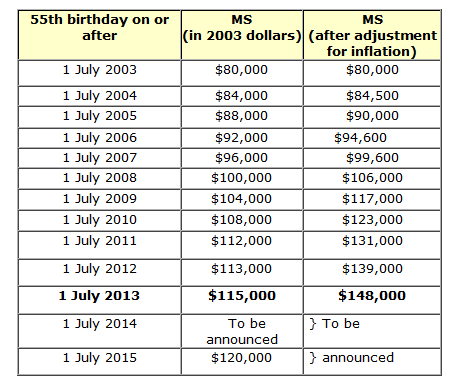
CPF Minimum Sum - The Inflation Rate?


Read? Reaching 55


How much is the Minimum Sum?

Setting aside the Minimum Sum (MS) when you reach 55 ensures that you have some regular income from age 65 to live on in your retirement.

The MS was set at $80,000 in 2003 and will be raised gradually until it reaches $120,000 (in 2003 dollars) in 2015. These amounts will be adjusted yearly for inflation.


If you are unable to set aside your full MS in cash, your property, bought with your CPF savings, will be automatically pledged for up to half of your MS.


CW8888's calculated inflation rate based on the above table for $115K in 2003 dollar value to the actual minimum sum required at 1 Jul 2013 of $148K is 2.6% annual compounded over 10 years.


US stocks tumble on weak manufacturing data


NEW YORK: US stocks on Monday fell more than two percent after a surprisingly weak US manufacturing report sparked another round of selling amid concerns about the strength of the global economy.

The Dow Jones Industrial Average tumbled 326.05 points (2.08 percent) to 15,372.80.

The broad-based S&P 500 fell 40.70 points (2.28 percent) to 1,741.89 and the tech-rich Nasdaq Composite Index slumped 106.92 points (2.61 percent) to 3,996.96.

"This is the beginning of the correction that we have been waiting for," said Peter Cardillo, chief market economist at Rockwell Global Capital.

The sell-off came after a report showing US manufacturing sector growth slowed sharply in January. The Institute for Supply Management's purchasing managers index sank to 51.3 from 56.5 in December, not far above the 50 level between expansion and contraction.

Cardillo said economic data "are certainly not good," but noted that some of the weakness could be attributed to extremely cold weather that depressed consumption and other activity.

Scott Wren, senior equity strategist, said a stocks correction was inevitable after investors excessively bid up equities in late 2013 on improving economic data.

"We're in a modest-growth, modest-inflation environment," Wren said. "People got carried away with a perceived acceleration of the economy."

Wren predicted the S&P 500 could fall as low as 1,700, but recommended that clients use the retreat as a buying opportunity.

General Motors fell 2.3 percent after January US vehicle sales slumped 12 percent, while Ford declined 2.7 percent after its January sales dropped seven percent.

January is typically the toughest month for auto sales as showrooms empty out following big year-end sales in December. But unusually brutal winter weather this year kept people at home and even delayed delivery of sales to government and corporate fleets.

Telecommunications stocks sank after a price cut by AT&T on family plans for smartphones raised worries about toughening competition. AT&T fell 4.1 percent, Verizon lost 3.4 percent and Sprint gave up 5.1 percent. Both AT&T and Verizon are in the Dow.

Pfizer was the only member of the Dow to rise, gaining 0.7 percent after announcing positive clinical data on its palbociclib medication for post-menopausal women with advanced or newly diagnosed metastatic breast cancer.

Bond prices jumped. The yield on the 10-year US Treasury fell to 2.58 percent from 2.67 percent on Friday, while the 30-year dropped to 3.54 percent from 3.62 percent. Bond prices and yields move inversely.

Monday, 3 February 2014

Coney Island to open to public in 2015

Pulau Serangoon, commonly known as Coney Island, will open to the public next year. 

Located off the northeastern coast of Singapore, the Urban Redevelopment Authority said under the Master Plan, a part of Coney Island is zoned for residential, sport and recreational use.
As the land is not immediately required for development, a part of Coney Island will be kept as an interim park for the time being.
The rest of the island is zoned for park use.
Tender documents stated that Coney Island will have infrastructure such as a bird watching station, walkways and solar street lights.
But one analyst said there is no need for residential units within such a small island.
Nicholas Mak, research head at SLP International, said: "It destroys the peace and the quiet that is on the island.
"If you wanted to keep a part of it as a nature reserve, for recreation, water sports, why do you need to introduce additional housing units there? It is not as if we are short of residential land within the main island of Singapore."
 

STI closed below 3,000!


Singapore shares ended on Monday with the benchmark Straits Times Index down 36.27 points to close at 2,990.95.

Volume was 1.52 billion shares worth S$948 million.

Losers outnumbered gainers 274 to 138


Sembcorp Strengthens Presence in the Growing Indian Power Market with a Second Project

-The project will benefit from synergies with Sembcorp’s adjacent TPCIL power project

Singapore, February 3, 2014 - Sembcorp Industries (Sembcorp) is pleased to announce that through a wholly-owned subsidiary, it has signed a conditional agreement to acquire 45% of NCC Power Projects (NCCPP), which is currently building a 1,320-megawatt coal-fired power plant along the coast of Nellore in Andhra Pradesh. This project will double Sembcorp’s power generation capacity in India and increase its footprint in the country’s growing power market.

NCCPP’s upcoming plant is located on a site adjacent to Thermal Powertech Corporation India (TPCIL), Sembcorp’s first power plant investment in India. The proximity of the two plants will enable Sembcorp to benefit from substantial synergies. The two plants will utilise the same infrastructure, such as that for coal importation and logistics. They will also be run by the same Sembcorp management team in Nellore. Located in India’s southern region, where economic growth and the demand for electricity is strong, both projects will be well-positioned to contribute to meeting the country’s rising power needs.

Like the TPCIL plant, the NCCPP plant will utilise supercritical technology, which allows for enhanced efficiency and reduced emissions compared to other conventional plants. Currently, construction of the NCCPP project is about 30% completed and it is expected to come onstream in early 2016. Piling and foundation works have been finished in key areas and structural work for the boilers has commenced on site. Financing for the project has also been secured, with 75% of the project cost funded through long-term limited recourse rupee-denominated project finance loans and the remainder funded by shareholders’ equity. The project will be fuelled by both domestic and imported coal. It has already received a Letter of Allocation for its domestic coal supply from Coal India. Like the TPCIL project, the NCCPP project is a coastal coal-fired power project and will benefit from reliable delivery of coal from the nearby Krishnapatnam port.

Sembcorp’s investment for the stake will amount to Rs. 848 crores (approximately S$175 million). The consideration for Sembcorp’s stake was determined based on the book value and fair market value of the project and will be financed by a mixture of internal funds and borrowings. NCCPP is currently jointly owned by Gayatri Energy Ventures (GEVPL) – Sembcorp’s project partner for the TPCIL plant – and NCC Infrastructure Holdings (NCCIHL), a subsidiary of Indian conglomerate, NCC Limited (NCCL). Upon completion of the transaction, Sembcorp will hold 45% of NCCPP, while the remaining 55% will be held by NCCIHL, which in turn will be jointly owned by NCCL and GEVPL.

The investment strengthens Sembcorp’s position in India’s power sector, which is expected to grow substantially over the next decade. The Central Electricity Authority of India projects that power demand will continue to increase steadily and it is expected that baseload deficit will remain between 8% to 10% until 2022. Sembcorp believes that the positive medium to long-term outlook for India, combined with urbanisation, industrialisation and the growth of the middle class, will continue to drive this growing energy demand.

The new project comes as Sembcorp’s existing TPCIL project nears completion. Construction of the TPCIL plant is more than 80% completed, and the project is on track to begin testing and commissioning of its first 660-megawatt unit from the second quarter of 2014. Commercial operations are targeted to begin in the third quarter of 2014, with the plant’s second 660-megawatt unit expected to come onstream by the end of the year. The TPCIL project has secured a long-term power purchase agreement for the sale of 500 megawatts of power to the Andhra Pradesh Power Distribution Companies, as well as domestic coal supply agreements for both its units.

Tang Kin Fei, Sembcorp Group President & CEO, said, “With our first power project in India progressing well and on track for completion this year, we are now pleased to embark on our second power plant investment there. This acquisition will provide the opportunity for Sembcorp to increase our foothold in India’s power market, where we see opportunities for our business to grow significantly in the years to come.

“The NCCPP project’s close proximity to TPCIL will also allow us to realise operational synergies, such as the use of common coal importation and logistics infrastructure and the same Sembcorp management team.”

The transaction is subject to the fulfillment of conditions precedent, including approvals from the relevant authorities and the lenders. Additional conditional agreements would also be entered into giving Sembcorp the right and obligation to take an incremental 20% stake in NCCPP and an incremental 16% stake in TPCIL respectively, subject to and upon the respective projects having obtained requisite formal approvals by relevant authorities in India. Details on these further acquisitions will be announced as appropriate upon finalisation.

This transaction is not expected to have a material impact on the earnings per share and net asset value per share of Sembcorp Industries for the current financial year.

- END -
 

Swiber clinches 5 contracts worth US$235m


Swiber Holdings on Monday announced a series of five "sizeable" contract wins worth a total US$235 million (S$299.8 million).

Three of these contracts, which amounted to US$145 million, were awarded to the group for works that will be executed in Latin America and Southeast Asia.

The remaining two contracts were awarded to Swiber's associate company and joint venture firm, for services that will be executed in Southeast Asia.

These contracts will begin immediately and are expected to be completed in next two years, it said.

Sunday, 2 February 2014

CPL Historical since 2000


History will repeat itself. It is just the matter of how much of it that happens again!

Do your own guessing.


Saturday, 1 February 2014

When a Giant Gain Causes Pain (3)


Just For Thinking ....


Read? When a Giant Gain Causes Pain (2)


Insanity: doing the same thing over and over again and expecting different results.

Read more at http://www.brainyquote.com/quotes/quotes/a/alberteins133991.html#AJPb3gUyjj2ucXPW.99
Albert Einstein is widely credited with saying “The definition of insanity is doing the same thing over and over again, but expecting different results”.  - See more at: http://ideapharma.com/announcements/the-definition-of-insanity-is-doing-the-same-thing-over-and-over-again-but-expecting-different-resul#sthash.4W8UHYgu.dpuf
Succeeding as an investor takes a strong mind, but a stronger heart. That is especially true when stocks plunge—or soar.

In his letter this week to investors in his hedge funds, manager David Einhorn of Greenlight Capital pointed to “the parabolic rise of a growing number of market-leading story stocks.”


For those young investors who have not seen GFC, don't assume that you have strong mind and strong heart to play this Game. The plunge may be too much to take!

3M's in Investing: Method, Mind, and Money Management


-73%, -74% and -75% Plunge!!!


It will take an immune heart and insane mind to take such plunge, survive and continue like nothing has happened!

Right?


Dow Jones Industrial Average sank 149.76 points (0.94 per cent) to 15,698.85


Gold falls for the week on US growth; ends under $1,240


Spot gold was last down 0.3 percent to $1,239 an ounce, after a 2 percent drop overnight. U.S. gold futures for April delivery settled $2.60 lower at $1,239.80 an ounce, down 1.9 percent on the week after five straight weeks of gains.

But January's early strength was enough to push gold to its first monthly rise in five. The metal rose about 3 percent for the month.

"The market is struggling to break above the $1,275 level or below $1,225, and I think we will stay around these levels again next week as market participants position themselves ahead of the U.S. nonfarm payroll numbers,'' said Afshin Nabavi, head of trading at MKS SA.

The dollar index was up 0.2 percent on the day, close to a one-week high hit on Thursday. Global shares fell as they struggled to shake off the difficulties that have spread from emerging markets.


NEW YORK: US stocks on Friday fell sharply on continued unease over emerging markets and a number of high-profile earnings disappointments.

The Dow Jones Industrial Average sank 149.76 points (0.94 per cent) to 15,698.85. The broad-based S&P 500 fell 11.60 points (0.65 per cent) to 1,782.59, while the tech-rich Nasdaq Composite Index lost 19.25 points (0.47 per cent) at 4,103.88.

Anthony Conroy, head of global trading at Bank of New York Convergex Group, said Friday's losses were prompted by a confluence of factors, including some weak earnings reports and the sense of some investors that a correction was inevitable after the 2013 rise in stocks.

"The economy is probably okay," Conroy said. "I think the emerging markets are probably weaker than expected."
Amazon sank 11.0 per cent after earnings came in at 51 cents per share, well below the 66 cents forecast by analysts.

Results were hit by a sharp rise in expenses.

Dow component Chevron fell 4.1 per cent after earnings slumped 32 per cent compared with last year and revenues of $56.2 billion badly underperformed the $63.1 billion forecast by analysts.

Microsoft gained 2.7 per cent on reports the company is closer to naming Satya Nadella, head of the cloud and enterprise division, as its next chief executive.

Google jumped 4.0 per cent after reporting that revenues on "click" ads rose by nearly a third. Google also announced a new dividend payment.
Chipotle Mexican Grill jumped 11.7 per cent after earnings jumped 30 per cent on a 9.3 per cent rise in comparable restaurant sales. The company also raised its 2014 sales forecast Earnings at MasterCard were 57 cents per share, three cents below expectations, sending its shares down 5.1 per cent.

Mattel tumbled 12.0 per cent after earnings missed the $1.20 per share estimate by 13 cents due to a six percent decline in worldwide sales.
Social games company Zynga shot up 23.6 per cent after announcing it was buying mobile game and animation firm NaturalMotion for $527 million.

Bond prices rose. The yield on the 10-year US Treasury fell to 2.67 per cent from 2.69 per cent, while the 30-year declined to 3.62 per cent from 3.64 per cent.

Cost of outsourcing your investment e.g. STI ETF (2)


Just For Thinking ...


Any idea of what is the total cost of outsourcing your investment over long run?
 
 
Annual costs of  0.3% sounds like paying peanuts to fund manager. Right?
 
Do some warming up exercise first before we continue ...
 
 
Once you have understood "Beware of percentage". Let us move on.


Paying 0.3% based on Expenses over Net Asset Ratio is really peanut!
 
How about paying 11.2% based on Expenses/Income Ratio?
 
Still peanuts???


Friday, 31 January 2014

DBS and OCBC are 2 of largest 100 banks in the world


Ranked 79th and 95th largest, respectively.

SNL Financial has released its first ranking of the largest 100 banks in the world based on assets, and two from Singapore made it to the list: DBS Group Holdings Litd. ranked 79th with $319.87b in assets while Oversea-Chinese Banking Corp. Ltd. came in at 95th with $255.74b.

Overall though, banks in China, the United Kingdom, France and Japan dominated the highest rungs of the list, comprising the five largest banks, based on assets.

Beijing-based Industrial & Commercial Bank of China Ltd. ranked as the largest bank in the world as of Sept. 30, followed by London-based HSBC Holdings Plc and France-based Crédit Agricole Group. The fourth largest bank is Paris-based BNP Paribas SA and the fifth largest is Tokyo-based Mitsubishi UFJ Financial Group Inc.

But U.S. banks would be included in the mix if adjusted for the netting of derivatives that is not permitted under IFRS, SNL Financial data showed.

According to the report, SNL ranked the banks based on the assets they report under their respective accounting regimes. Industrial & Commercial Bank of China had $3.062 trillion in assets under IFRS, converted into U.S. dollars, as of Sept. 30.

JPMorgan Chase & Co., which reports under U.S. GAAP, had $2.463 trillion in assets as of Sept. 30, making it the sixth largest bank in the world. However, if JPMorgan followed IFRS accounting principles, it would most likely rank as the largest bank in the world, SNL reckoned.

Trading for "passive income" using leverage vs Long-term investing for passive income using our own capital.


Just For Thinking ....


1984: Memories of the Brighton bomb

"Today we were unlucky, but remember we only have to be lucky once - you will have to be lucky always."

This was the IRA's chilling statement soon after they had carried out the attempted assassination of the British Cabinet at The Grand Hotel, Brighton, 20 years ago.


Trading for "passive income" using leverage vs Long-term investing for passive income using our own capital.

See the difference!


In trading for "passive income" using leverage e.g. selling naked options on margin account; you will have to be lucky always. One day you get very unlucky, you may blow up like this guy.

A read real life story? How I Blew Up $105,000 In My Trading Account

For long-term investing for passive income using our own capital, it is like mirror image of it.

You don't always get lucky for years; but one day, you may get lucky and grow a Money Tree that can produce high passive income for a long time.


When you have spend enough time reading, reading and reading many finance and investment blog postings over the years; but forget about those blog posts that have commercial interests in selling you courses.
 
Do you realise that Mr Market will always have his way to show us the right way to build our wealth from the stock market is through investing in companies growing their business revenues, cash flow and profits either through expanding, enhancing or innovating their products and services offering to their global consumers and producers?


Thursday, 30 January 2014

Cost of outsourcing your investment e.g. STI ETF


Just For Thinking ...


Any idea of what is the total cost of outsourcing your investment over long run?


3 in 10 Singaporeans worry over failing to meet financial goals


According to a new study by Nielsen, almost two-thirds of consumers in Singapore (65%) believe they will achieve all their financial goals for the future. While a significant proportion of those is aware of the need to take a pro-active approach to saving and investing - 50 percent say they will need to closely monitor and adjust investments from time to time in order to best meet their financial expectations – a meagre 15 percent thinks that the current planning efforts will suffice for the future.

Conversely, more than one-third of Singaporean respondents (35%) have no confidence they will meet all their financial goals with either current or modified asset allocations.

“Understanding consumer sentiment on the saving strategies used to fund financial goals provides insight into how consumers are responding to the challenge of ensuring financial security,” said Luca Griseri, Head of Financial Services, Nielsen Singapore and Malaysia.

“As growing numbers of the population enter retirement age in Singapore, there are growing concerns about reliance on government funds to support expenses such as retirement, health care and education.”


The Nielsen Global Survey of Saving and Investment Strategies polled more than 30,000 Interneti respondents in 60 countries to evaluate how consumers around the world are preparing for current and future financial expenses. Nielsen evaluated 16 different saving and investment strategies used to fund a range of 14 long- and short-term financial goals.

Consumers in Indonesia and Philippines were the most financially optimistic in the Southeast Asia region, with 88 percent and 83 percent respectively believing they will achieve all their financial goals for the future.

The Federal Reserve extends taper and stocks slide lower


NEW YORK: US stocks fell sharply on Wednesday on worries over turbulence in emerging markets, a decline that steepened after the US Federal Reserve cut back its monetary stimulus for the second straight month.

The Dow Jones Industrial Average slumped 189.77 points (1.19 percent) to 15,738.79.

The broad-based S&P 500 fell 18.30 points (1.02 percent) to 1,774.20, while the tech-rich Nasdaq Composite Index declined 46.53 points (1.14 percent) to 4,051.43.

Michael James, managing director of equity trading at Wedbush Securities, said the Turkish central bank's doubling of its benchmark interest rate took investor concerns "to another level", prompting the retreat from stocks and other risky assets.
A similar move in South Africa also failed to stem the erosion of its currency.

After European stocks slumped, US stocks opened in the red and dropped further after the Fed announced that it will reduce asset purchases by another $10 billion in February to $65 billion, a decision that was widely expected.
"People are edgy," primarily because of the uncertain outlook on emerging-market economies, said Peter Cardillo, chief market economist at Rockwell Global Capital.

He said the Fed's move, as well as a mixed bag of earnings reports, were smaller factors in the sell-off.
Dow component Boeing sank 5.3 percent after it forecast essentially flat earnings in 2014 due to modest increases in commercial airplane deliveries and lower revenues from US defence orders.

AT&T fell 1.2 percent amid concerns that the company's outlook for cash flow had been cut. Morgan Stanley rated the company's lofty payouts to shareholders a "wide concern."

Citigroup, which has a comparatively large presence in emerging markets, fell 3.1 percent on concerns about the outlook in these economies. JPMorgan Chase and Bank of America lost just 0.4 percent and 0.3 percent, respectively.
Yahoo tumbled 8.7 percent after reporting a six percent drop during the fourth quarter in display ad revenue that has long been at the core of Yahoo's income.

Dow Chemical shot up 3.9 percent after earnings of 65 cents per share bested the 43-cent analyst forecast. The company announced a 15 percent dividend increase and an expansion to its share buyback program from $1.5 billion to $4.5 billion.

Bond prices rose sharply. The yield on the 10-year US Treasury fell to 2.68 percent from 2.75 percent on Tuesday, while the 30-year declined to 3.62 percent from 3.67 percent. Bond prices and yields move inversely.


Related Posts with Thumbnails