I started serious Investing Journey in Jan 2000 to create wealth through long-term investing and short-term trading; but as from April 2013 my Journey in Investing has changed to create Retirement Income for Life till 85 years old in 2041 for two persons over market cycles of Bull and Bear.

Since 2017 after retiring from full-time job as employee; I am moving towards Investing Nirvana - Freehold Investment Income for Life investing strategy where 100% of investment income from portfolio investment is cashed out to support household expenses i.e. not a single cent of re-investing!

It is 57% (2017 to Aug 2022) to the Land of Investing Nirvana - Freehold Income for Life!


Click to email CW8888 or Email ID : jacobng1@gmail.com


Welcome to Ministry of Wealth!

This blog is authored by an old multi-bagger blue chips stock picker uncle from HDB heartland!

"The market is not your mother. It consists of tough men and women who look for ways to take money away from you instead of pouring milk into your mouth." - Dr. Alexander Elder

"For the things we have to learn before we can do them, we learn by doing them." - Aristotle

It is here where I share with you how I did it! FREE Education in stock market wisdom.

Think Investing as Tug of War - Read more? Click and scroll down


Important Notice and Attention: If you are looking for such ideas; here is the wrong blog to visit.

Value Investing
Dividend/Income Investing
Technical Analysis and Charting
Stock Tips

Saturday, 18 January 2014

It is more than just being lucky!!!


Just For Thinking ..


It is more than just being lucky!!!

The truth is ...

It is more of living with regrets and often feeling stupid!


Why?

Hindsight wisdom. We are full of it!


Friday, 17 January 2014

CPL : Don't believe in History???


DBS among S&P's top 10 Asia stock picks for 2014


DBSBB1601
 
 
DBS Group Holdings has been named one of S&P Capital IQ's top 10 Asia stock picks for 2014 - the only Singapore stock to make the list - PHOTO: BLOOMBERG

DBS Group Holdings has been named one of S&P Capital IQ's top 10 Asia stock picks for 2014 - the only Singapore stock to make the list.

The research platform for Standard and Poor's noted that Singapore's largest bank, with a market cap of S$42.2 billion, has appreciated 15.2 per cent in 2013, outperforming the Straits Times Index's 0.3 per cent decline.
It gave DBS a "4-stars" "buy" rating.

"DBS' valuation remains attractive, in our opinion, at (a) prospective 2014 price-to-book ratio of 1.1x versus domestic peers' multiple of 1.2x-1.4x,'' it said

DBS handles $2.4b of bond sales; more to come
 

DBS Bank, the nation's largest debt player, has started the year with a bang - with a slew of bond sales involving multiple currencies.

In just two weeks, with fixed-income marketing hotting up, it has done more than $2.4 billion in deals - these include the year's first perpetual issue and first offshore yuan bond - as companies are jolted into action ahead of an expected interest-rate rise and investors are becoming active again.

Clifford Lee, DBS head of fixed income, said: "So far, activity has been good."

In addition to several Singapore-dollar deals, DBS has churned out yuan and US dollar issues; there is also a sukuk or Islamic bond in the pipeline.


CPL - Lucky Round Number @ $4 (SOLD)


Lucky Round Number @ $4

Read? CPL - Sold ROC 37%

But , it did went above $4 so it is not the best of luck!


One year later, avoid being unlucky!


Wednesday, 15 January 2014

3 ways you can simplify your money life

Opinion: Be a better investor, and behave like one


By Brian Portnoy


For most of us, much of life, including our finances, is premised on the idea that the freedom to choose is a good thing. And the more choice, the better: A wide range of options brings with it many positive benefits, including the increased chance we’ll be able to get what we want, competition among vendors, and the inherent virtue of variety.

This desire is not just some arbitrary state of affairs. There is substantial evidence from the behavioral and neurosciences that we are hard-wired this way. Our brains react more positively when facing a rich set of choices, versus a limited one.
        

Up to a point, that is.

Indeed, there is equally compelling research suggesting that there are mental “tipping points,” after which we face the negative consequences of what some social psychologists refer to as “choice overload” . More becomes less. Accordingly, in wealthy societies we face a “paradox of choice” — we naturally crave more choice, but the more we obtain the more miserable we become.

While it may sound trivial, anyone who has tried to pick out the right flavor of jam at a supermarket knows exactly what this overload feels like. Unfortunately, while this problem applies to wide swaths of our social lives, it has been barely mentioned in the world of investments. But its profound relevance requires much more consideration .

Let’s start with a couple of facts:

The number of funds from which to choose has grown exponentially, with now upwards of 10,000 available mutual funds. Exchange-traded funds (ETFs) add another 1,000 choices to the pile.

Brian Portnoy


Second, our choices are growing considerably more complicated, especially after the shock of the 2008 financial crisis and our current low-interest rate environment, in which lower-risk yield is hard to come by. Most notably, there is the stratospheric rise of hedge fund-style investments that are accessible to mom-and-pop investors.

Often referred to as “liquid alternatives,” this emerging category is expected to garner close to $1 trillion in new investments by the end of the decade. There are already hundreds of these products available. And for many fund companies, their top marketing priority in 2014 and beyond is extending their suite of alternative offerings. Long/short equity, hedged credit, merger arbitrage, global macro — these complex strategies and others can now rest in your portfolio with only a few clicks of a mouse.

But distinguishing among these countless choices has never been more difficult.

So what to do? While the challenge is thorny, here are three ways to find simplicity in a world of overwhelming choice:

1. Be proactive

Sometimes just knowing what we’re up against is half the battle. We all intuitively understand the paradox of choice, and that often more is less. Yet with investing, like other forms of consumption, there is often pleasure in the process of discovering the new, new thing and sometimes even acquiring it.

Somewhat ironically, the most foundational modern principle of building portfolios is based on the idea of owning a lot of different investments, ones that ideally have low correlations. Diversification, in a sense, is about having more. But accumulating more in the hope of finding diversification often doesn’t work.

Building the right portfolio is a demand-side challenge: it should be based on one’s particular needs and constraints. Don’t aggravate it with supply-side problems. It should not be based on what’s for sale. I don’t know how many books and shirts I’ve bought in the middle section at Costco that I’ve neither read nor worn.

2. Be skeptical

Just because something is interesting or new doesn’t mean we should pick one up.

There are now hundreds of alternative mutual funds that give access to strategies that the supposedly most sophisticated investors in the world have been using for decades.

Why shouldn’t the individual investor have access to the same strategies and solutions? Fair point. We all should.

But do hedge funds for the everyman make much sense? Maybe, but there’s no easy answer without understanding two things. First, what does the fund do? With alternatives, this is much harder to answer than with traditional long-only products. A hedged equity fund and global macro offering are wildly different, for example. Even within a Morningstar category such as “Market Neutral” there are funds with significantly different risk profiles.

Second, and more importantly, what do we need to meet our objectives? One of the hallmark features of many alternative strategies is that they have a lower correlation to traditional long-only stock and bond investments. Low correlations are what make modern portfolio theory work — they are the engine of diversification. Stocks and bonds already have a lower correlation to one another. Alternatives may buttress a portfolio further — or might just complicate an already unwieldy roster.

Another feature is downside protection. Because hedge funds hedge, most of them tend to lose less money in down markets. But for a goal that’s far in the future, such as college or retirement, why give up long-term return potential in exchange for near-term insurance?

3. Be patient

That’s right. Sit on your hands. Resist the temptation to fix what might not be broken. Of course, this is not advice to naively “set and forget” one’s investment line-up. But it pertains to not chasing the latest hot dot. And it certainly pertains to resisting selling when markets are down and buying when markets are up. Our biology and smart investing are at odds here; doing nothing sounds easy, but it’s actually quite hard.

This is a skill where arguably individual investors have an advantage over the professionals. The latter almost always feel the need to do something in order to appear in control. Everyday folks with neither the time nor inclination to trade and tinker are often better able to separate signal from noise by staying somewhat out of the fray.


Are you investing like Tortoise or Rabbit?

Just For Thinking ...


Tortoise beats rabbit in China pet ski-off


BEIJING: A tortoise beat a rabbit in a skiing competition held for pets and their owners in northern China, a report said on Tuesday.

Cats and dogs faced off against a menagerie including a rooster and a yellow duck in a race to the finish line on snowy slopes in China's Hebei province, the state-run China News Service said.

The 40 human competitors were allowed to place their animals on skis or sledges, or could guide the pet with a lead while skiing, the report said.

In an unexpected outcome akin to an ancient Greek fable, a tortoise beat a rabbit, with the shelled reptile eventually claiming third place overall, the report said.

"Because the rabbit loved jumping and didn't follow its owner's commands, it was overtaken by the tortoise," it said.

The tortoise - which would normally be expected to hibernate during the winter - apparently hitched a ride on its owner's ski equipment, the report added.


CW8888:

Uncle8888 is investing like a Tortoise and hibernating for Fat Bear to come


Are you jumping around like a Rabbit in the market now and hoping to win the Race?


Tuesday, 14 January 2014

CPL : 2.92 breaking???


I plan but I fail!!


I plan but I FAIL!

Are we Ants or Grasshopper?

Ants always be prepared and worry too much?

Read? Dreaming of financial independence by 55!


So what happen after that?

Read? Mara River : Reaching the Edge of Financial Independence!!!


LATE ARRIVAL TO DESTINATION BUT LANDED SAFELY!!!


US stocks tank ahead of earnings reports


NEW YORK: US stocks tumbled Monday ahead of a raft of corporate reports as earnings season gets into full swing this week.

The Dow Jones Industrial Average shed 179.11 points (1.09 per cent) at 16,257.94.

The broad-market S&P 500 skidded 23.17 (1.26 per cent) to 1,819.20 and the tech-rich Nasdaq lost 61.36 (1.47 per cent) at 4,113.30.

Stocks opened modestly lower then traded near the flatline until midday, before steadily selling off all afternoon.
Traders were "likely playing their cards close to the vest before 4Q earnings season and the economic calendar kick into gear," Charles Schwab & Co. said in a market note.

On Tuesday, before markets open, JPMorgan Chase, the biggest US bank, and Wells Fargo will report earnings and the government will release data on December retail sales covering the important holiday shopping season.
Yoga apparel retailer Lululemon plunged 16.6 per cent after lowering its fourth-quarter revenue and earning guidance and highlighting it saw January sales and traffic trends "decelerate meaningfully."
Fashion retailer Express sank 4.6 per cent after lowering its fourth-quarter guidance and reporting weak January traffic to date.

General Motors fell 1.1 per cent after signalling it was close to resuming dividends, according to media reports. Its Chevrolet brand won the top car and truck of the year awards at the Detroit auto show.

In merger and acquisition news, Beam, the maker of Jim Beam bourbon, agreed to be acquired by Japan's Suntory Holdings for US$83.50 a share in a US$16 billion deal creating the spirit sector's third-largest player.

Beam skyrocketed 24.6 per cent to US$83.42.

Google slipped 0.6 per cent. After the market closed, the search giant announced it was buying Nest, a smart-home company that makes thermostats and smoke alarms, for US$3.2 billion in cash. Shares were up 0.5 per cent in after-hours trading.

Chinese search engine Qihoo 360 Technology rose 3.0 per cent after a Stifel upgrade from "hold" to "buy," saying "2014 is the year of significant search monetization for Qihoo, fuelling strong revenue growth and potential upside surprise."
Bond prices rose. The yield on the 10-year US Treasury slipped to 2.83 per cent from 2.86 per cent Friday, while the 30-year fell to 3.77 per cent from 3.80 per cent. Bond prices and yields move inversely.

Sunday, 12 January 2014

How boring 'secret' to being rich (2)


Read? How boring 'secret' to being rich


The Hard Truth

Not all of us can succeed in climbing the corporate ladder.


By late 30s and early 40s; we should already know it.

We should then switch to climbing investment ladder by all means.


Where is the climb up the corporate ladder?

Uncle8888 tio stuck!!!


Really boring at 4.8% CAGR over 18 years!


Climbing Invest Ladder
 
 
It is less boring with CAGR of 9.7% over 14 years.
 
 
It does help him in wealth building for an average worker like Uncle8888.


Thursday, 9 January 2014

DBS to invest up to S$15m in tech deal with IBM

SINGAPORE: DBS Bank is looking to invest up to S$15 million over the next three years in a technology deal with IBM.

Under the agreement, DBS will apply IBM's expertise in areas like data analytics to its wealth management business.

DBS said it is targeting a roll out of the new technology in the second half of this year.

Nearly three years ago, a computer system called Watson beat human contestants in an American gameshow, “Jeopardy”, proving that computers can think.

And now, IBM, the firm that created Watson, is bringing that technology to industries like healthcare and banking.

IBM on Thursday signed an agreement with DBS Bank, making the bank the first in Asia to use the technology.

Bridget van Kralingen, senior vice president of IBM Global Business Services, said: "We, in fact, today in New York have the creation of the Watson division in IBM which will have a billion dollars in investment to support the creation, development and implementation of Watson technology. To reinforce how strategic this is for IBM, the last time we created a separate division around a technology was actually when we built System/360, which was the mainframe."

Currently across the industry, investment advice given to wealth management clients revolves around the consensus view of the bank's research team.

DBS said the Watson technology will help its relationship managers provide investment advice that is tailored to each customer's investment and risk profiles.

Piyush Gupta, chief executive officer of DBS Group Holdings, said: "The new way of doing things is that the computer aggregates data -- every market, every asset class, (and) every country. And then, depending on every customer's individual profile and preference, it can spew out a recommendation. That completely changes the nature of the game, because now you're customised to a segment of one."

The agreement comes as traditional banks push to digitise more of their processes in a bid to compete with non-bank financial institutions like Paypal and Alipay.

DBS said it will launch more technology initiatives in the coming weeks targeted at its payments, and small and medium enterprises (SME) banking business units.

Wednesday, 8 January 2014

DBS: Sudden bullish???


The Beautiful Wedding at any costs? - Re-posting


Wah!  

Now, so many people started talking or commenting about it!


Uncle8888 blogged about it on Wednesday, 28 January 2009 when the Cake was not so Hot!

Sometimes, we do read about some couples that spent tens of thousands of dollars on their wedding, which when you boil down to it, is just one day.

Take it as experience from those have married themselves, it's not worth overspending on weddings just to have a 'perfect, once-in-a-lifetime' memory.

Because after all, when the wine is drunk and the guests have gone home, that's when your true marriage starts. How happy a marriage you will have depends on what you and your spouse do after the wedding day, not during

Of course, you need to spend for your grand wedding, the question is about no OVERSPENDING, period.

Do you want to read a book where Chapter 1 is very exciting and grand, and then followed by chapters after chapters full of struggling and missing opportunity of active or passive investing due to much smaller capital?

Your Marriage could be like climbing Swissôtel The Stamford hotel at 226 metres with 73 floors after your wedding night unless you are fortunate enough to take a LIFT (rich parents) up. But, not everyone is so fortunate to take a LIFT, and likely many will have to climb the staircases.


So, do you want to load up your haversack with more loads to carry up with this climb?

Some indicators to consider whether one is overspending? Like any indicators, only you know it better.

Ratio 1: Total Wedding Expenses/Nett Annual Earning after Tax

Ratio 2: Total Wedding Expenses/Nett Annual Saving


Read? The Beautiful Wedding at any costs?

Stocks finish higher, with S&P 500 halting three-day losing streak

The Dow Jones Industrial Average rose 105.84 points, or 0.6 percent, to 16,530.94, with UnitedHealth Group leading gains that included 24 of the blue-chip index's 30 components.

The S&P 500 rose 11.11 points, or 0.6 percent, to 1,837.88, with health care and technology leading gains that included all but one -- materials -- of its 10 major industry sectors.

The Nasdaq advanced 39.50 points, or 1 percent, to 4,153.18, led by Neurocrine Biosciences, up nearly 90 percent after the company late Monday said one of its experimental drugs helped treat the symptoms of an illness that causes involuntary spasms.

For every share that fell, two rose on the New York Stock Exchange, where 699 million shares traded. Composite volume hit 3.5 billion.

The U.S. dollar edged higher against the currencies of major trading partners and the 10-year Treasury yield used in determining mortgage rates and other consumer loans fell 2 basis points to 2.945 percent.

On the New York Mercantile Exchange, crude-oil futures gained 46 cents, or 0.5 percent, to $93.05 a barrel; gold futures declined $8.40, or 0.7 percent, to $1,229.60.


Tuesday, 7 January 2014

Temasek Holdings exploring ways to offer bonds to retail investors

SINGAPORE: Temasek Holdings is exploring ways to offer bonds to retail investors in Singapore.

In response to a letter in TODAY newspaper, Temasek's managing director of corporate affairs Stephen Forshaw said this will provide an alternative investment opportunity for those seeking stable returns with lower risks.

The investment firm is looking into how to make it practical and efficient to offer bonds to retail investors.
Mr Forshaw said the firm will share details when ready.
According to its latest annual report, Temasek's bonds have received the top rating from Standard & Poor's Ratings Services and Moody's Investors Service since 2004. Its bonds are usually offered to institutional investors.
The firm's total shareholder return had averaged 16 percent since its inception in 1974. The firm is mostly invested in stocks and shares of companies.
Temasek said it invests for the long term and the total market value of its portfolio can rise or fall by 30 per cent or more, during volatile periods such as the global financial crisis.
"We are mindful that past opportunities and conditions are not likely to repeat in the coming decades. Furthermore, global structural risks remain," added Mr Forshaw. 

Don't ever tell me more money is no good!!!


Just For Laugh ...


Don't ever tell me more money is no good!!!

Living in one-room HDB rental flat till Uncle8888 got married and bought a 4-room HDB flat. He knows what is called poor!

So don't ever tell him more money is no good!!!

Want more money. Absolutely YES!

To monetise his free time by doing some part-time work after office hours for more money. No!

Uncle8888 prefers to create wealth from the stock market.

Why???

To get out of the Rat Race as soon possible!

Get it?


Monday, 6 January 2014

OCBC in exclusive talks over Wing Hang Bank


CW8888: So OCBC is playing catch-up but way behind DBS?


Nsiocbc26114
 
OCBC Bank said on Monday that it had entered into "an exclusivity agreement" with the substantial shareholders of Wing Hang Bank on Dec 31, 2013 - PHOTO: REUTERS

OCBC Bank said on Monday that it had entered into "an exclusivity agreement" with the substantial shareholders of Wing Hang Bank on Dec 31, 2013, with a view to taking over the Hong Kong bank.

Wing Hang's substantial shareholders are members of the Fung family, its affiliates and related family trusts, and BNY International Financial Corporation. The exclusive arrangement will last until the end of January 2014.
OCBC did not say how much it intends to pay for Wing Hang.

News reports late last week and over the weekend said OCBC had offered less than the two times book value Wing Hang was seeking.

Semb Corp : One more try???


Sunday, 5 January 2014

How boring 'secret' to being rich

invest, thesundaytimes, Jan 5, 2014


What is the secret to getting rich?


1. Born Rich

2. Marry Rich

3. Start your business

4. Climb Corporate Ladder

5. Climb Investment Ladder


Uncle8888 strongly agreed with 4 and 5.

Especially on No 4.

Climbing corporate ladder is the sure way to become rich.

Young people should at first attempt to climb corporate ladder instead of investment ladder.

Why?

In climbing investment ladder, your Account Size Really Matters!

Where to find your investing capital?

From your earned income and saving. Right?


Read? No Goal. No Aim. No Dream. You are more likely to end up as an Average in your 60s! (2)


The Hard Truth

Not all of us can succeed in climbing the corporate ladder.


By late 30s and early 40s; we should already know it.

We should then switch to climbing investment ladder by all means.


Investment Ladder


By then, we may have reasonable Account Size to climb investment ladder.

Get it?

Follow Uncle8888's Wealth Formula?


Saturday, 4 January 2014

14 Years of Personal Journey towards Financial Independence when staying employed becomes an option! (3)


Just For Thinking ...


Read? 14 Years of Personal Journey towards Financial Independence when staying employed becomes an option! (2)


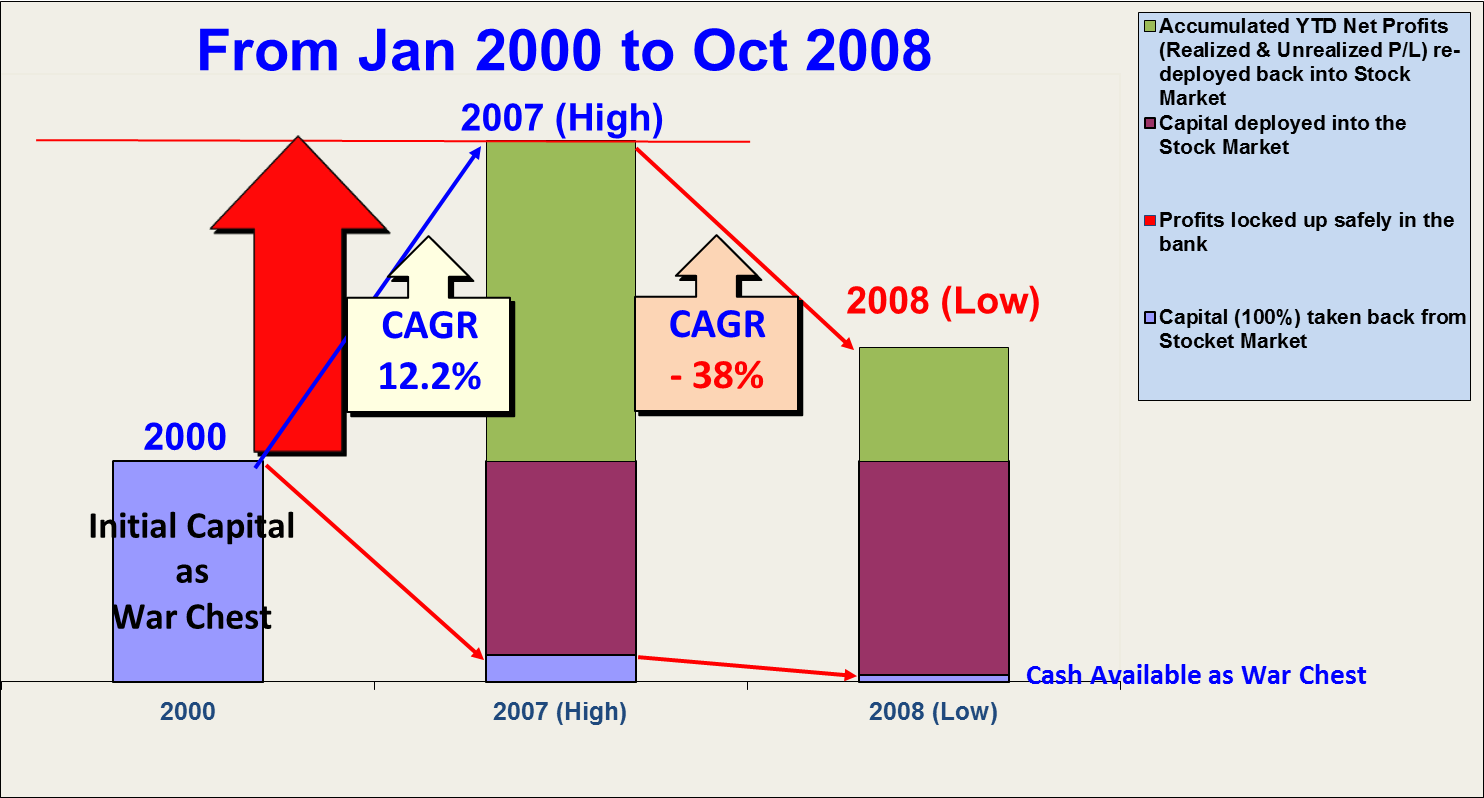
Now Uncle8888 tells you the True Story behind this Chart ...


From Jan 2000 to Oct 2007 (7 Year later ..... )


It doesn't matter if a cat is black or white, so long as it catches mice. - Deng Xiaoping

Who care Blue Chips, Blue-Black Chip or Shit-Chips when they are making money for Uncle8888 in the stock market. Right?


When your Earning From Investment is 79% of your Total Earned Income after Tax from your day job while eating some snake at the office to watch the Market.
 
Sibei Song! Right?


Mai Hao Lian!!!


Black Cat or White Cat???

Never Mind!

Chun Bo?

From Oct 2007 to Oct 2008.

One year later ...


The Truth is ....
 
 
Black Cats are Curse!!!
 
White Cats are Blessing!!!


When Uncle8888 turned into Blue Chips Uncle.

Only Blue.

Really Blue this time!


Three years later ...

Who says Blue Chips are not Value Investing?


Read? Return of The King!


Now, what is Uncle8888 waiting ....


Great Singapore Sales and Fall of The King!


Friday, 3 January 2014

Keppel Tele & Tran: Planning Data Center REIT Listing in Singapore

 
By Chun Han Wong 

SINGAPORE--Keppel Telecommunications & Transportation Ltd. (K11.SG) said Friday it is planning to list a real-estate investment trust, focused on data centers, on the Singapore Exchange.

Keppel T&T, a unit of Singaporean conglomerate Keppel Corp. (BN4.SG), is still reviewing its plans for the proposed REIT, such as the trust's portfolio, as well as the size and timing of the IPO, it said in a filing to the Singapore Exchange. Those plans are dependent on market conditions and regulatory approvals, among other things, it said.

According to people with knowledge of the deal, Keppel T&T is looking raise more than 500 million Singapore dollars (US$400 million) from the IPO. The REIT could be listed late in the first quarter of this year, and would hold assets from its local and overseas data center businesses, the people said.

Keppel T&T operates data centers in Singapore, Europe, Australia and Malaysia. The company along with AEP Investment Management, a Singapore-based company that specializes in cross-border real-estate investment strategies, also operates Securus Data Property Fund, a Shariah-compliant data center fund that invests in a global portfolio of high quality data-center assets.

Keppel Corp., in which state-investment company Temasek Holdings has a roughly 20% stake, has business interests ranging from building rigs to real estate and owns about 80% of Keppel T&T.

Singapore is a sought-after destination for trust listings and has benefited from investors seeking higher yields at a time of low interest rates. Singapore laws stipulate that companies that list their assets through REITs have to pay yield for their lifetime to their unit holders. There are no rules governing yields of other types of investment trusts, which could hold assets ranging from ports to telecom, although most of them provide yields for a set period.

Singapore is Asia's biggest center for trust listings. Last year, of the more than US$5 billion raised via IPOs in Singapore, close to 90% was of business trusts, including REITs.

US stocks fall on new year's first day of trade

US stocks Thursday kicked off the new year in the red, falling decisively in a sell-off that analysts chalked up to profit taking following solid gains in 2013.

 
NEW YORK: US stocks Thursday kicked off the new year in the red, falling decisively in a sell-off that analysts chalked up to profit taking following solid gains in 2013.

The Dow Jones Industrial Average fell 135.31 points (0.82 per cent) to 16,441.35.

The S&P 500 declined 16.38 (0.89 per cent) to 1,831.98, while the tech-rich Nasdaq Composite Index gave up 33.52 (0.80 per cent) at 4,143.07.

Markets were closed Wednesday in observance of the New Year's Day holiday.

Analysts said investors likely took the first day of trading of 2014 as an opportunity to rebalance portfolios after markets surged last year, pushing the S&P 500, a broad measure of the markets, up nearly 30 per cent.

A typical strategy is to wait to rebalance until a new tax year, said Sam Stovall, chief investment officer at S&P Capital IQ.

"The thought is you probably take some of those profits and redeploy them in areas that did not do as well in the prior calendar year," Stovall said.

The retreat came despite reports that showed the strongest US construction spending in four years and a solid reading on US manufacturing activity. Tempering that data was a mediocre report on Chinese manufacturing activity, Stovall said.
Technology giant Apple shares fell 1.4 per cent after Wells Fargo downgraded the stock on concerns about its profit-margin outlook.

Online professional networking service LinkedIn lost 4.2 per cent after Citigroup cautioned that tracking information on LinkedIn activity suggested "near-term caution" on the stock.

Bank of America jumped 3.4 per cent after Citigroup upgraded the stock. Bank of America is well-positioned as a "play" on a US economic recovery due to its "exposure" to its US consumer base, Citi said.

Martha Stewart Living Omnimedia vaulted 8.8 per cent after it and retailer Macy's announced a settlement of Macy's lawsuit alleging Stewart violated a merchandising agreement by striking a deal with retail rival J.C. Penney. The terms of the settlement were not disclosed. Shares in Macy's were unchanged.

Bond prices rose. The yield on the 10-year US Treasury bond fell to 2.99 per cent from 3.03 per cent Tuesday, while the 30-year dipped to 3.92 per cent from 3.96 per cent. Bond prices and yields move inversely.
 

Thursday, 2 January 2014

Book : Value Investing


How to become a disciplined investor?


Get started at NLB. It is free!

It is definitely much more than you learnt from paid courses.


Wednesday, 1 January 2014

Game Plan for 2014


2013 Review

1. A Personal Record Breaking Year in Portfolio Value


Portfolio Value = Capital* + Cash Available for investing (War Chest)

                          = Current Value of stocks holding + Realised P/L + Un-realised P/L + Total Dividends accumulated since 1 Jan 2000

* No new funding added into portfolio since 1 Jan 2000 (Lousy saver!)


13 new Records broken in 2013!


2. STI Historical Major Points since 1990


2014 Game Plan

1. Year 3 Goal against 10-Year Targets


Insanity: doing the same thing over and over again and expecting different results -  Albert Einstein


To meet Year 3 Goal, something must be done differently in 2014!

2. Still waiting ...


One way of waiting is to swap CPF stocks into cash stocks and letting the cash rotting at higher interest rate.
 
 
3. Time the Market Strategy


US stocks cap stunning year with fresh records

US stocks powered to fresh records during the last session of 2013, closing out a year of stunning gains that some analysts say could continue in 2014.


NEW YORK: US stocks powered to fresh records during the last session of 2013, closing out a year of stunning gains that some analysts say could continue in 2014.

The new records for the Dow Jones Industrial Average and the broad-based S&P 500 capped the best year for American stocks since the 1990s and confirmed the recovery from the 2008 financial crisis.

Investors repeatedly bid up equities on a cocktail of loose monetary policy, corporate earnings growth and the steadily rebounding economy.

Tuesday's gains, another 0.44 per cent for the Dow and 0.40 per cent for the S&P 500, came on the back of more positive economic data - consumer confidence was bouncing back from a lull and home prices continued to rise

The Dow notched 52 new records during 2013, gaining 26.5 per cent to end the year at 16,576.66. It was the blue-chip index's best one-year percentage increase in more than 15 years.

The S&P 500 advanced 29.6 per cent to 1,848.36, smashing the record barrier 45 times. It was the largest one-year gain since 1997.

The tech-rich Nasdaq Composite, while still well short of its all-time record, closed the year at its best level since the 2000 .com crash, adding 38.3 per cent for the year to 4,176.59.

The vast majority of companies on the S&P 500 - 457 of them - gained for the year, illustrating the broad character of the year's bull run.

"There were not a lot of losers," said Howard Silverblatt at S&P Dow Jones Indices. "This was a very broad market."
2013 "would rank up there as one of the best years in my memory," said Greg Peterson, director of investment research at Ballentine Partners. "It was an extremely good year."

The year's breakout stocks included video streaming company Netflix, which more than tripled in value during 2013, and electric-car maker Tesla, which rose more than four-fold, ending the year amid rumours that it could be taken over by one of the auto majors.

Netflix, along with electronics retailer Best Buy and Micron Technology, were the three biggest gainers in the S&P 500, while Newmont Mining was the biggest faller, down more than 50 per cent as gold prices plunged 28 per cent during the year.

The biggest gainer on the Dow for the year was aerospace giant Boeing, which withstood a bumpy stretch related to its flagship 787 before rallying on strong global demand from airlines.

The only company on the Dow to fall was IBM, which gave up 2.1 per cent amid challenges to the legacy technology giant's business from the new technology leaders.

Changes in index membership underscored the shifts in corporate power. On the Dow, Alcoa, Bank of America and Hewlett-Packard were replaced by Goldman Sachs, Nike and Visa.

The S&P 500 dropped slumping retailer J C Penney, which shed more than 50 per cent of its value, replacing it with social networking company Facebook, which more than doubled in 2013.

Twitter's entry to the market, raising US$1.8 billion, made some of the biggest news during the year. The still money-losing social network power's stock quickly more than doubled from its offer price of US$26 to above US$63 on Tuesday.

Other big IPOs came from hotelier Hilton Worldwide Holdings and oil pipeline operator Plains GP Holdings.
There was confidence among analysts that the bull market would continue into 2014, though many questioned whether the gains of 2013 could be matched.

Key questions concern the pace of the US economic recovery, and especially jobs growth, and how the market absorbs the hit from the Federal Reserve's stimulus cutback.

Another big unknown is whether companies can grow revenues after record profits in 2013, as much of the gains came through cost-cutting.
Related Posts with Thumbnails