I started serious Investing Journey in Jan 2000 to create wealth through long-term investing and short-term trading; but as from April 2013 my Journey in Investing has changed to create Retirement Income for Life till 85 years old in 2041 for two persons over market cycles of Bull and Bear.

Since 2017 after retiring from full-time job as employee; I am moving towards Investing Nirvana - Freehold Investment Income for Life investing strategy where 100% of investment income from portfolio investment is cashed out to support household expenses i.e. not a single cent of re-investing!

It is 57% (2017 to Aug 2022) to the Land of Investing Nirvana - Freehold Income for Life!


Click to email CW8888 or Email ID : jacobng1@gmail.com


Welcome to Ministry of Wealth!

This blog is authored by an old multi-bagger blue chips stock picker uncle from HDB heartland!

"The market is not your mother. It consists of tough men and women who look for ways to take money away from you instead of pouring milk into your mouth." - Dr. Alexander Elder

"For the things we have to learn before we can do them, we learn by doing them." - Aristotle

It is here where I share with you how I did it! FREE Education in stock market wisdom.

Think Investing as Tug of War - Read more? Click and scroll down


Important Notice and Attention: If you are looking for such ideas; here is the wrong blog to visit.

Value Investing
Dividend/Income Investing
Technical Analysis and Charting
Stock Tips

Monday, 25 July 2011

SEMBCORP’S SOLID WASTE MANAGEMENT SUBSIDIARY AWARDED S$121 MILLION REFUSE COLLECTION AND RECYCLING CONTRACT IN SINGAPORE

Sembcorp Industries announces that its solid waste management subsidiary, SembWaste, has been awarded a S$121 million, seven year contract by the National Environment Agency (NEA) to provide refuse collection and recycling services to the Bedok sector in Singapore.


With the contract, Sembcorp now serves five out of nine geographical sectors in the country. Refuse collection and recycling operations for the new sector will commence on November 1, 2011.

This transaction is not expected to have a material impact on the earnings per share and net asset value per share of Sembcorp Industries for the current financial year.

Rotary Engineering bags 13 contracts totalling S$40m

SINGAPORE: Mainboard-listed Rotary Engineering has clinched 13 contracts totalling S$40 million from April this year for projects based in Thailand and Singapore.


Singapore-based projects included a contract for mechanical works for an oil major, as well as for construction of two fuel tanks and a water tank for Alstom Power Singapore.

In Thailand, the group will embark on the construction of piping for Thai Tank Terminal and the building of 9 storage tanks for Thai Oil Public Company.

Rotary's chairman and managing director Chia Kim Piow said that the company will "continue to be vigilant in its pursuit for new and interesting projects".

Going forward, Mr Chia said that Rotary is keen to continue playing a part in the development of Singapore's oil and gas industry and infrastructure.

"We are still very busy prospecting for new business here in Singapore, in the region and further afield," he said.

"There are opportunities and we continue to field many enquiries. The challenge is to ensure that we select the right deals."

- CNA/cc

Singapore's June inflation up 5.2% on-year

SINGAPORE: Singapore's Consumer Price Index in June rose 5.2 per cent year-on-year.


This was in line with market expectations, and compares with the 4.5 per cent rise in May.

The upward cost pressures were concentrated in the usual sectors of transport, housing and food.

A rise in accommodation costs and electricity tariffs pushed up housing costs by 8.8 per cent.

The cost of transport increased by 10.4 per cent because of more expensive cars and petrol, while food prices rose 3.1 per cent on-year.

Education and stationery costs moved up 3.3 per cent and healthcare cost increased by 2.3 per cent.

Core inflation - which excludes more volatile items such as accommodation and transport - rose 2.3 per cent year-on-year.

On a month-on-month basis, headline CPI slipped 0.2 per cent, while core inflation remained unchanged.

On a seasonally adjusted basis, the Consumer Price Index rose by 0.4 per cent in June. Excluding accommodation costs, the June CPI was up 0.3 per cent.

- CNA/al

Sunday, 24 July 2011

Twin pack, BCI -24 Black and Color - Brand new to be given away

I have so much problem in aligning the old printer to print nicely and decided to throw it and get a new printer. So now I have one box of Twin pack Canon BC1-24 Black (one pack open up) and one box of brand new Twin pack Canon BC1-24 Color to give away as part of Keep Green movement.

You want them. Pls email me. You have to collect them either at Hougang Mall or Hougang MRT station Control Room's Exit/Entry as handover point.

Home for Living and not for profit taking (6)

Read? Home for Living and not for profit taking (5)

Reading is easy and writing is hard. To keep writing more to defend a particular view is even harder. When it becomes necessary to defend it further, I will have no choice but to do it.


I will have no issue when peoples start debating Property vs. Stocks investing. Each side will share their own investing experiences and performance results. Each side will try to convince each other that one of them is more right than the other and I have no problem in accepting either conclusion. But, when some people start to compare their HOME vs. Stock investing, then I will have strong view. That is the reason why I have been writing several blog posts on "Home for Living and Not for Profit Taking."

Stocks are for investing or speculating. There is no doubt about it. If you have two or more houses; one of the houses will become your home and the rest of them can be for investing or speculating. But, if you only have one house and that is your home. Home is for living and not for investing or speculating for profit.

Why do we buy a house?

We will want to buy a house when we plan to get married and start a family. Some married couples may choose to remain as DINK (Dual Income No Kids) while some other married couples may SINK (Single Income aNd Kids) and most family will have kids.

Most of us when we married we will want to buy a HOME to begin a different phase of our life. A family life either with kids or without kids. A home is for living with our family. Unlike singles, they can choose to live in their existing home (in fact, it is their parents' home but one day can became theirs too). Singles can choose to buy a home for living and then have absolute freedom to do what they like within their home. Their parents cannot stop them.

Single can also choose to buy a house as second home to live and at the same time it can be a house (property) for investing or speculating. He/She can later sell his/her house for profit and return to his/her home (parents' home).

Home has Utility Value

Home has utility value. We utilize it for our living as a creature of comfort. Stocks don't have any utility value and we don't utilize our stocks for our living at all. Because home is a utility when we sell our home we have to replace it either by renting, buying a second home or moving back to stay with parents. But, when we sell our stocks, it is not necessary to replace them as stocks have no utility value.

Even if you sell your first home and replace with it a second home to live. The utility value of the two home  can never be the same. One of the them will have higher utility value.

Let get back to the case study of my ex-neighbour as it is easier to understand the utility value using real life example.

His first home sold will have higher utility value since it is just one bus stop away from the MRT station and his second home bought is a few bus stop farther away from it. In the past, he and his family members can comfortably walk to MRT station from their home within 5 minutes. But now, he and his family will have to walk so much farther distance to the MRT station or incur additional transport cost to take bus to the MRT station. So there is some hidden cost in his second home.

Profit taking from stocks are pure monetary gains and there is no hidden costs associated with it. Profit taking from home will have monetary gains as stocks; but it is never pure monetary gains like stocks. Your monetary gains in your sold home may come in the way of lower utility value in your second home with hidden costs often are unaccountable.

Do you still want to compare HOME vs. Stock Investing in term of monetary gains?

Think again. Home for Living and Not for Profit Taking.

Saturday, 23 July 2011

Weekend Comment Jul 22: Keppel on top of its game


Home for Living and not for profit taking (5)

Read? Home for Living and not for profit taking (4)

Let re-visit the story of ex-neighbour who used to live one floor below.

After selling his 4 rm HDB flat and he bought another 4 rm HDB flat which is a few bus stops away from his previous flat.

So as case study, let us simplify some figure to make it easier to understand the Maths involved.

Cost of 1st flat = $55K
Sales of 1st flat = $300K
Paid back to CPF OA including back-date interests = $100K

So profit = $200K

Do you think that he made $200K multi-bagger profit on his 1st flat?

Let continue with the Maths.

His 2nd flat is just few bus stop away from his 1st flat and the 1st flat is just one bus stop away from MRT.

We can safely assume that the selling price of 2nd flat is definitely lower. Let assume $50K cheaper at $250K. He took a new 20 years loan of $150K with a bank after offsetting paid back to CPF of $100K.

Now he has $200K cash and $150K debt.

Did he actually make $200K multi-bagger profit on his 1st flat?


What is your answer?

A. He made $200K multi-bagger profit.
B. He didn't make any multi-bagger profit, his profit is just $50K i.e. $300K - $250K
C. He didn't make any multi-bagger profit. He made some profit. He swap $150K debt for $200K cash.

My answer is C. What is your?

Dividend Yield is good but avoid falling into potential Dividend Traps (2)

Read first? Investing Made Simple by Uncle8888 (12)

Read next? Dividend Yield is good but avoid falling into potential Dividend Traps

I thinking by reading in this sequence may be better in the thinking process.

I believe there are many bloggers, cboxers, forum particpants and investing kakis telling you that focusing on stock dividends as passive income is an important key to successful investing. Agree, right?

Perhaps, I am the rare blogger who dare to challenge you to rethink your investing strategy of focusing too much on passive income when you have no real need for it at this stage of your long investing journey and especially when you are not expecting to 'retire' from the workforce soon.

Friday, 22 July 2011

Two faces of debt: The Good and The Bad

The Good

Unless your residential home is a gift from your parents, you will have no choice but to take up your housing loan as good debt. This is also the cheapest loan in town. But, before you start thinking that this housing loan is definitely good debt and there is no mistake about it. Now I ask you to make sober estimates of your ability to repay and to factor in the likelihood that you or your spouse may suddenly out of the workforce for awhile and unable to bring in that additional income to pay part of the monthly mortgage payment.

Other than debt for your housing loan, debt as an investment tool is good as long as your investment income can come and stay above your borrowing cost. Any investors who use lots of debt as investment tool will never think that they are less savvy in investing and bad things seldom happen.

The Bad

Unless you have personal friends or relatives who were bankrupt or near bankrupt; it is just too easy to under-estimate or tempt to ignore the possibility of investment failure. When you make huge investment loss using too much debts, the effect can be crippling. When you realize it is bad; it is often too late!

Dividend Yield is good but avoid falling into potential Dividend Traps

Re-posting this article under different label after reading an email from one reader.

In the stock market where does the Money come from?

A picture is worth a thousand words. When you see a picture, it will strongly embedded in your mind for a long time


As you can see from the picture. Companies DISTRIBUTE stock dividends and other Investors/Traders in the stock market all together significantly CONTRIBUTE to the capital appreciation of stocks. The amount of money distributed by companies is pale compared to the amount of money contributed by other investors/traders.

Firstly, you are either contributing to the market or are taking contributions from the market.
 
Secondly, are you aware of possibility of falling into potential dividend traps?
 
I think one reader has become aware of potential dividend traps from the following sentences in his email to me.  
 
" ...  I was led into thinking in the long run, the total return on a stock is mostly from the dividend return and not from the capital appreciation. I think I read it in Jeremy Siegel's books, if I'm not wrong. But since 2009, my real experience tell me, it's not true."

Reaching 55 soon - CPF Minimum Sum @ $131K

Just For Thinking ...

Read? Reaching 55 soon - The Last investing Goal!

CPF Minimum Sum


The Ministry of Manpower announced in August 2003 that the CPF Minimum Sum (MS) will be raised gradually to reach $120,000 (in 2003 dollars) in 2013. The increase in MS, which includes an adjustment for inflation, is to ensure that Singaporeans set aside sufficient savings for their retirement. In line with this policy, from 1 July 2011, the prevailing MS will be revised to $131,000, up from $123,000. Members who can set aside the MS fully in cash can apply to commence their monthly payouts of $1,170 when they reach their draw down age. The new MS will apply to CPF members who turn 55 from 1 July 2011 to 30 June 2012.


Createwealth8888:

That minimum sum of $131K locked up at 55 and monthly payout of $1,170 or $14,040 per year commencing from 65 till 85 and that will give CPF members XIRR of 4.3% over 30 years.

I will use this benchmark of XIRR of 4.3% to set up my own 30 years retirement fund to beat it.


Thursday, 21 July 2011

Olam International gets best CEO award

SINGAPORE: The Singapore Corporate Awards (SCA) held on Thursday went to 30 companies and six individuals for leading the way in corporate governance and shareholder communication.


The SCA comprises five categories, including Best Managed Board Award and Best Chief Executive Officer Award.

Corporate winners such as Olam International, Keppel, CapitaLand and Singapore Airlines walked away with several awards.

Singapore Airlines was recognised in three out of five awards, including that for Best Investor Relations.

Olam International clinched two awards, with its CEO Mr Sunny Verghese taking the title of Best CEO.

Deputy Prime Minister Teo Chee Hean, who was the guest of honour at the event, said it was important that corporate governance framework and practices keep pace with international developments.

"We cannot sssume that companies operating in Singapore will benefit from the greater inflow of capital to Asia," he said.

Companies would need to invest in building strong corporate governance. This will engender investor confidence and signal to their investors their ability to sustain performance, said Mr Teo.

- CNA/ck

Keppel Q2 profit up 9%, sees good prospects for rigs


Kep Corp - High Dividend Yield stock??

Read? High Dividend Yield Stocks? (10)

H1 Interm dividend at 17 cts translating to max dividend yield of 12.9% and average dividend yield of 6.6% for total holding.  Really shiok! Thank you to Kep Corp CEO & Staff

I have been receiving good dividends from Kep Corp since 2001.

Kep Corp is a good example of high yield and high growth is not mutually exclusive. In the next crisis, remember to watch for these stocks.


Kep Corp : 2Q & 1H 2011 REPORT CARD

Net profit improved 7% to S$696 million, compared to


1. 1H 2010’s S$651 million (restated).

2. Earnings Per Share of 39.2 cents, up 6% from 1H 2010’s 37.0 cents (restated).

3. Annualised ROE of 19.5%.

4. Economic Value Added of S$472 million.

5. Cash outflow of S$697 million.

6. Net gearing of 0.10x.

7. Interim dividend of 17.0 cents per share.


MAS revises inflation forecast to 4-5%

SINGAPORE: The Monetary Authority of Singapore (MAS) has revised upwards its headline inflation forecast to between 4 and 5 per cent for 2011.


This was announced at a media briefing to release its latest annual report and is higher from its previous forecast of between 3 and 4 per cent inflation.

MAS said this upward revision comes on the back of higher accommodation costs which were boosted by an unexpected surge in number of tenancy contract renewals at current higher rental rates, as well as private road transport costs as COE premiums rose faster than expected.

MAS said that headline inflation should be seen in perspective, adding that a better measure is core inflation.

MAS said its forecast for core inflation remains unchanged at between 2 and 3 per cent for 2011.

Mr Ravi Menon, managing director at MAS added that MAS is not entirely satisfied with the inflation situation.

Core inflation remains slightly above the historical average of 1.7 per cent.

MAS will continue to keep a close watch on inflationary pressures and developments in key export markets.

MTI and MAS are reviewing Singapore's GDP growth forecast, for now MAS says the 5 to 7 per cent growth remains intact.

However Mr Menon added that if a pick up from the downturn in Q2 is weaker than currently expected, growth could come in at the lower half of the range.

MAS made investment gains of S$12.3 billion but recorded an overall loss of S$10.9 billion, its largest loss in 40 years on the back of a strong Singapore dollar.

MAS said that the current monetary policy stance of appreciating the Singapore dollar nominal effective exchange rate (S$NEER) policy band set in April this year remains appropriate.

The next Monetary Policy Statement is scheduled for October.

Excluding exchange rate effects, MAS achieved income and net capital gains totalling S$12.3 billion during the financial year ended March 2011.

- CNA/cc

Some tenants in arrears hold landlords to ransom

Createwealth8888: When you are unlucky, you vomit blood in earning such investment income. Earning this type of income is really suck!

---------------------------------

SINGAPORE: With Singaporeans increasingly turning to renting out their apartments for extra income, more disputes are flaring up between landlords and tenants, according to lawyers and property agents. And it is not only the landlords who are giving their tenants headaches.


Anecdotally, complaints of landlords being held ransom by tenants in arrears and refusing to move out are increasing.

Property agent G Rajan told Today that three out of 10 rental disputes in the last two years he handled, were from landlords. He said: "It's a lot of legwork and time spent going after the tenant."

A recent case involve a couple who were unable to drive out their tenant.

Mr Poh Boon Kay, 62, and his wife got SP Services to terminate the utilities account on March 7, hoping that this would prompt their tenant to move out.

However, the tenant lodged an objection to the termination. He got his lawyer to send a letter to SP Services citing that he was still residing at the premises and that termination of the tenancy was being disputed. The utilities services were restored.

In a letter to Mr Poh - which was seen by Today - SP Services said that, under the Electricity Act, it had an "obligation" to "supply utilities to occupants who require the supplies".

It added: "We have an obligation to reinstate the account opened by the tenant given that there is no sufficiently strong reason why we should not reinstate the account."

Mr Poh said his tenant "identified himself as a property agent and said he had clients and he would sign the tenancy agreement on their behalf". Mr Poh added: "Later, we found out that he had sublet the unit to some foreign women."

When contacted, the tenant declined comment.

In another case, nautical engineer M Gopalan said his tenant thrashed his Azalea Park unit and left him with S$4,400 worth of repairs.

The tenant also defaulted on payment three months into the tenancy and refused to vacate. Fortunately for Mr Gopalan, his property agent managed to contact the tenant's brother and eventually persuaded him to leave.

For most landlords, their only recourse is the legal route - taking out a court order to repossess the property and recover the arrears. But this entails cost and time, said lawyers.

Lawyer Abdul Rahman noted that a tenancy agreement is usually geared "towards the protection" of the landlord, and that the landlord has the "full option of the law" to go after the errant tenant.

Mr Rahman added: "(Landlords) need to cut their losses but the longer it takes to evict the tenant, the more the landlord is at the losing end ... There have been cases which went on for as long as four months in the courts."

Wednesday, 20 July 2011

Ascott opens first serviced residence in India

SINGAPORE: Ascott, CapitaLand's wholly-owned service residence business unit, will open its first serviced residence in India and operations will start from August 1.


The 96-unit property - Citadines Richmond Bangalore - is strategically located along Bangalore's well-known Richmond Road in the Central Business District.

The property offers a mix of spacious studio, one- and two-bedroom apartments as well as facilities such as gymnasiums, conference facilities and serviced offices.

Ascott currently has six other properties under development in India, which will cost S$300 million when fully developed over the next three years.

Ascott's CEO Lim Ming Yan said: "Significant demand for serviced residences in India's fast growing economy has resulted in India being a key market for Ascott.

"Besides investment, we are also seeking opportunities for management contracts or lease agreements such as the Citadines Richmond Bangalore to grow our network in the country."

- CNA /ls

Tuesday, 19 July 2011

My Net Worth Distribution Pie

When Singapore stock market crashes, I will feel poorer! Why?
Because 43% of my net worth comes from money made in Singapore stock market.


P.S:

I have zero debts and no investment property. Net worth excludes residential home, CPF SA and MA.

Portfolio=Capital+Profits+Unrealized P/L = Stocks(Closing Px)+Cash Available for Investing

CIT’s distributable income increases and portfolio revalues upwards.

Key highlights include:


• 2Q2011 amount available for distribution was S$12.3 million as compared to S$11.9 million for 1Q2011. This translated to a 2Q2011 distribution per unit (“DPU”) of 1.036 cents, which is 3.5% more than 1Q2011 DPU of 1.001 cents.

• Portfolio valuation as at 30 June 2011 resulted in an increase of 5.5%, or S$47.8 million, on a like-for-like basis, from the 31 December 2010 valuation. CIT’s total assets stand at S$1.1 billion as at 30 June 2011.

In addition, as previously disclosed to the market, the following items were completed during the quarter:

• Secured a S$320.0 million new term loan facility with a syndicate of four financial institutions. All-in debt cost is approximately 4.23% p.a.

• Completed the acquisitions of 4 & 6 Clementi Loop and 60 Tuas South Street 1 with a total valuation of S$46.4 million.

• Concluded a fully underwritten and renounceable Rights Issue with approx. 132.1 million new Rights Units issued on 15 April 2011 raising S$56.7 million.

Monday, 18 July 2011

Capitaland sells building in Beijing for S$205.8m

By ANGELA TAN


CapitaLand Limited said on Monday that it has sold a 21-storey building with 310 apartment units known as Ascott Beijing in China for S$205.8 million in cash.

'The divestment is consistent with CapitaLand's active capital management,' the property group said in a statement.

CapitaLand's subsidiary, Ascott Investments Pte Ltd (AIPL) has sold its entire stake in Hemliner Pte Ltd (HPL) to Splendid Wealth Group Ltd, which is a subsidiary of Ascott Serviced Residence (China) Fund (ASRCF).

ASRCF is a private equity real estate fund investing primarily in China. CapitaLand has a 36.1 per cent interest in ASRCF.

HPL owns 100 per cent of the registered capital in Hemliner (Beijing) Real Estate Co, Ltd (Hemliner).

The sole asset of Hemliner is the property, located in the prime district of Beijing, China.

CapitaLand's total carrying value of its investments in HPL as at 31 May 2011 was S$80.5 million.

Following the completion, HPL and Hemliner have ceased to be wholly-owned subsidiaries of CapitaLand. CapitaLand will have an interest of 36.1 per cent in Ascott Beijing through ASCRF.

Sembcorp Industries expects early completion of Oman plant

SINGAPORE: Sembcorp Industries said it is confident about completing the Salalah Independent Water and Power Plant in Oman ahead of schedule in April 2012.


The strong expectations came as its joint venture company, Sembcorp Salalah Power and Water Company successfully completes the first phase of the US$1 billion plant.

With the completion of the first phase, the facility has began dispatching 61 megawatts of power to a power grid in Southern Oman.

It was originally targeted to begin full commercial operations in the first half of 2012.

The power plant, which will have a total net capacity of 445 megawatts and a seawater desalination plant, will use reverse osmosis to produce 69,000 cubic metres of water per day.

Sembcorp Salalah Power and Water Company is 60 per cent owned by Sembcorp Utilities and 40 per cent owned by the Oman Investment.

- CNA/cc

SEMBCORP SUCCESSFULLY COMPLETES FIRST PHASE OF US$1 BILLION SALALAH INDEPENDENT WATER AND POWER PLANT IN OMAN

Singapore, July 18, 2011 – Sembcorp Industries (Sembcorp) is pleased to announce that the Sembcorp Salalah Power and Water Company, a joint venture company between Sembcorp’s fully-owned subsidiary Sembcorp Utilities and the Oman Investment Corporation, has successfully completed the first phase of its US$1.0 billion Salalah Independent Water and Power Plant (IWPP) in Oman. With the completion of the first phase, the facility began dispatching 61 megawatts of power, on schedule, to the Dhofar power grid in Southern Oman.

Targeted to begin full commercial operations in the first half of 2012, the Salalah IWPP will consist of a gas-fired power plant which will have a total net capacity of 445 megawatts and a seawater desalination plant which will employ reverse osmosis technology to produce 15 million imperial gallons (69,000 cubic metres) per day of water.

Mr Tang Kin Fei, Sembcorp’s Group President & CEO said, “We have met the tight schedule of 19 months from the signing of the Power and Water Purchase Agreement (PWPA) to complete the first phase of our Salalah IWPP on time. This is especially vital as the completion is timely to meet the surge in power demand in Dhofar, which coincides with the summer months every year.

Besides playing a significant role in providing power during the demand peak, the facility also enables Dhofar to obtain cheaper power during the summer period. We are confident to complete the entire project ahead of schedule in April 2012.”

Sembcorp, which was named the Water Company of the Year at the prestigious Global Water Intelligence's 2011 Global Water Awards, also clinched the Desalination Deal of the Year award for its Salalah IWPP project. Despite the deal coming at the tail end of the financial crisis, the project’s financing team nevertheless secured funding support at a competitive cost. Standard Chartered Bank, Bank of China, China Development Bank, BankMuscat, KfW-IPEX Bank, Sumitomo Mitsui Banking Corporation, National Bank of Oman and Bank Sohar supported Sembcorp in the financing of this project.

Sembcorp Salalah Power and Water Company is 60% owned by Sembcorp Utilities and 40% owned by the Oman Investment Corporation.
 
The completion of the first phase of the Salalah IWPP is not expected to have a material impact  on the earnings per share and net asset value per share of Sembcorp Industries for the current financial year.

Sunday, 17 July 2011

SEC Official Seeks Investor Alert on Retail Forex

Createwealth8888: Here in Singapore, every day we are seeing big advertisement placed by "Gurus" stating how easy to make money in retail forex trading to become financial freedom. When is MAS going to step in to regulate them?


By: Reuters


A top U.S. securities regulator is calling for a special investor alert to warn retail investors about the risks of trading off-exchange foreign currency contracts.

Luis Aguilar, a commissioner at the U.S. Securities and Exchange Commission, issued a statement this week expressing concerns about retail forex fraud.

Regulators have been worried about the risks posed by the use of leverage.

His written statement came after the SEC approved a temporary rule that will allow brokers to continue to sell retail forex contracts to less sophisticated investors until the agency decides whether to implement more robust consumer protection rules prescribed by the Dodd-Frank Wall Street overhaul law.

"I am concerned about the risks to retail investors," he wrote in a statement that explained his vote on the temporary rules.

"My support of the promulgation of an interim final temporary rule was subject to the condition that the Office of Investor Education and Advocacy be directed to issue an investor alert warning investors about the potential risks and conflicts inherent in off-exchange foreign currency transactions."

The retail foreign exchange market is a niche market that lets average investors bet on the direction of currency price movements. But over the years, it also has been a market favored by fraudsters.

Additionally, regulators also have been concerned about risks posed by the use of leverage, which allows traders to increase their profits, but also can lead to larger losses.

Last August, the Commodity Futures Trading Commission adopted retail forex rules for the firms it regulates that would cap leverage at 50-to-1 for major currencies and require forex dealers to hold more capital and abide by certain disclosure, reporting and record-keeping rules.

The CFTC already had planned to adopt these rules before the enactment of Dodd-Frank, but the Dodd-Frank law required the CFTC to speed up the deadline on finalizing the rules.

The Dodd-Frank law additionally required other regulators, including the SEC, to impose similar rules on the retail forex dealers they oversee.

If the regulators do not establish a regulatory regime for these transactions, then retail forex dealing would be prohibited.

The temporary rule approved by the SEC this week, which went into effect Friday, allows the firms to continue dealing in retail forex contracts until the SEC decides whether or not to adopt a more comprehensive oversight regime.

The SEC said it will consider a number of avenues, including proposing new rules to protect consumers, allowing retail brokers to operate as they do today, and possibly prohibiting retail foreign exchange trading altogether.

Uncle, Why your Chart so dumb leh? (2)

Read? Uncle, Why your Chart so dumb leh?

Look here! Uncle's chart is not dumb hor. Today, I realized that I actually belong to Kung Fu School of Naked Traders.

Naked Trading refers to trading without technical indicators i.e. the trader's chart is naked with no technical indicators. These naked traders only look at trends and chart patterns. They are also known as discretionary traders.

From the perspective of Technical Analysis, the classic example of a discretionary trader is one who uses chart patterns to make trading decisions in a visual, nonalgorithmic fashion. This type of trader seeks patterns in the charts and tries to determine what they mean given the market situation.

Investing Made Simple by Uncle8888 (20)

Read? Investing Made Simple by Uncle8888 (19)

Control Risk is NOT a choice in Investing

How does Uncle8888 control his risks?

  1. Limit investing capital exposure to any one stock.
  2. Diversify but Don't Over-Diversify in any one sector.

Limit investing capital exposure to any one stock

When his account size was small, he limits it to at most 10% of his total investing capital to any one stock and less than 20% to any one sector. But now his account size is bigger he limits to 5% to any one stock and less than 10% in any one sector.

He was shocked when he heard some of his cyber friends are investing up to 40-60% of their investing capital into one stock by getting it cheaper and cheaper. Are they thinking that they are smarter than Mr. Market?

In investing, as part of good risk control management, we must learn to respect Mr. Market. He may be wrong over days or weeks; but he is seldom wrong over months. Over a longer term, Mr. Market is mostly Right; and if Mr Market indicates that you are wrong; you have to bravely accept it and move on.


Diversify but Don't Over-Diversify in any one sector.

Read? Portfolio Management - Portfolio Risk (2)

Uncle8888 believes most retail investors can easily understand that diversification is part of good risk control management. But, the idea of "don't over-diversify in any one sector" as part of risk control management may not be easily understood by retail investors; especially passive income investors in REITs. Often they will have a portfolio full of them - only different in "kind, shape or size". Don't believe him? Check it out yourself.

In the market, there will always be industry or sector risk when one particular investment thesis or theme related to that industry or sector may go sour in the future. When that happens; then every one in the same sector or industry will be hurt. It is only the magnitude or degree of fall in each stock in the sector that will differentiate them. But, it will certainly hit your portfolio badly. No doubt about it.

Have you seriously check through your portfolio and see how many % of your investing capital is in the same sector or industry?

Saturday, 16 July 2011

Punting for quick profits from blue chips

Createwealth8888: I have been punting Noble and Olam since 2008. The returns from punting is not too bad.

Read? Noble  Olam
--------------------------------

Top candidates include Golden Agri, NOL, Noble, Olam, Genting Singapore, City Developments and Sembcorp Marine

By TEH HOOI LING
SENIOR CORRESPONDENT

SINCE November last year, the stock market has been trapped in a trading range of 3,000-3,300 points. Investors would see their stocks rise, then fall again a few weeks later. Except for those stocks which are yielding generous dividends, there is no profit for investors to pocket, except for those who go in and out for quick gains in the market.

In my years of watching the market, I've come to the conclusion that, at least in Singapore, on average it doesn't quite pay to punt in the small cap stocks. Yes, the volatility may be there, and you may be making some good money if you are nimble enough. But the question is for how long. There is a rather high chance that while you are holding that stock, screaming at you one morning is a newspaper headline relating to that stock. It could be that the cash that was supposed to be in the bank isn't there, or that the revenues and profits have been overstated, or that a fire has gutted the company's factory.

Small caps vulnerable

Such bad news will deal a big blow to the stock price of small cap stocks. It is not unusual for them to plunge 50-60 per cent in a day, which would mean all the accumulated profits that you had made previously might be wiped out. Worse still, you might even lose your capital.

So I've convinced myself that if one were to itch to trade in markets such as now, one should be trading the blue chips. At least, if there is some unexpected negative macro developments, or even certain unflattering news relating to the company, chances are that over time these blue chips would bounce back. One just has to ride through the rough patch.

The question then is which of the blue chips are good candidates for trading?

I downloaded the daily share price of the 30 component stocks of the Straits Times Index from 2000. I then calculated their price difference over three-trading-day periods. From there, I find out the standard deviation, or volatility, of this price movement. In addition, I also calculated the one month return of these 30 stocks.

The purpose of this exercise is to find out which of the 30 stocks are most volatile, which would make them good trading candidates.

Based on the 12-year record, Wilmar emerged as the most volatile of all STI stocks. Its median standard deviation, or the variation of its return around its average three-day return, is 6.7 per cent. It has seen its stock price double in three days before. On the downside, it has fallen by as much as 30 per cent in three trading sessions.

Over a month, its share price had risen by as much as 214 per cent and had fallen by 48 per cent. Admittedly, looking at its numbers, it should be noted that much of Wilmar's volatility was due to its upside movement. Relative to the other stocks, its maximum downside over three days and a month had not been the biggest.

The second most volatile STI stock in the last 12 years is Golden Agri. Its standard deviation is 5.3 per cent. Its maximum three-day gain was 135 per cent, and its maximum plunge, 32 per cent. Over a month, the maximum upside and downside were 149 per cent and 56 per cent respectively.

Meanwhile, the most steady stocks in the benchmark index are Singapore Press Holdings, Global Logistics, CapitaMall Asia ????, StarHub and SIA Engineering. Other steady counters included ComfortDelGro, ST Engineering, OCBC, UOB and SingTel.

Steady versus volatile stocks

Sharp-eyed readers would realise that these are dividend yielding stocks in the STI stable. The more volatile stocks meanwhile tend to be the 'concept' stocks - those with very exciting narratives, but which might or might not deliver. And they might be expensive to begin with, which makes them susceptible to any negative news. Hence, the volatility.

Wilmar, Golden Agri Resources, Noble Group, Olam and Genting Singapore fit that description. I plotted two charts, just to have a graphical representation of how the share price and volatility change over time. From the first chart, you can actually see that for Wilmar, its volatility has decreased over time.

It started out as a concept stock. Over time, solid assets were injected into it and the group started to deliver results. Its share price rose and its income stream became more steady. There were less surprises. Consequently, its volatility declined.

The second chart showed the share price performance and volatility of Golden Agri. In the last one and a half years, its volatility has also fallen. That set me thinking: Perhaps the 12-year record may not be an accurate representation of the stocks' volatility today.

So I looked at the volatility starting from 2009 until now. True enough, based on the price movements in the last two and a half years, Wilmar was no longer among the most volatile stocks among the STI component stocks. It had fallen to the 16th spot. But retaining top spots were Golden Agri-Resources, NOL, Noble Group, Olam, Genting Singapore, City Developments and Sembcorp Marine.

At the other end of the spectrum, the most steady of the STI stocks since 2009 is CapitaMall Trust. The others are the usual suspects such as SPH, StarHub, ComfortDelGro, ST Engineering, Global Logistics and SingTel. So now, when you itch for some short term trades, you know which blue chips to go for.

Trekking along Singapore historical KTM railway tracks - Your last chance to do it! (2)

Read? Trekking along Singapore historical KTM railway tracks - Your last chance to do it!


Today, I will continue from where I stopped at last Sunday and to complete the trek along the historical KTM Railway track before it vanish into dust.

Similarly, like my investing journey I will always pause and continue from where I have stopped. Buy, sell and buy back!

Friday, 15 July 2011

5 Factors That Drive Stock Prices

By Ben Baden,


Over the next few years, emerging markets countries like China and Brazil are expected to far outpace developed nations like the United States in terms of GDP growth, but that doesn't necessarily mean their stock markets will also outperform. When deciding how to allocate your stock portfolio to different regions of the world, there are many factors investors should consider. A stock market's valuation, the country's expected economic growth, and the actions of its central bank all play a role. Here are five factors that drive stock prices:

1. Market sentiment.

On a day-to-day basis, it's impossible to predict what will happen in stock markets worldwide. One week, the market is up on better-than-expected economic indicators, and the next it's down because of a new development in the sovereign debt crisis in Europe. "It's so unpredictable," says Roger Aliaga-Díaz, senior economist with the investment strategy group at Vanguard. "That's one of the reasons that we focus more on the long term."

2. Growth expectations.

Research over the years has proven that higher GDP growth doesn't necessarily translate into higher stock returns in a particular country. The correlation between the two is actually negative. Take China, for example. From the beginning of 1993 through the end of 2009, China's GDP grew at an annualized rate of 11 percent, which ranked it first among countries represented in the MSCI All-Country World Index (NasdaqGM: ACWI - News), according to a research paper released by Heckman Global Advisors. During the same time period, the MSCI China Index returned a measly 0.6 percent per year, on average. On the other hand, from the start of 1989 through 2009, the U.S. economy grew at a much slower annualized rate of 5 percent, while the MSCI USA Index returned an annualized 9 percent.

Investors should pay attention to analysts' expectations for higher or lower economic growth in a given country. "You want [to invest in] markets where you find GDP growth is accelerating," says Leila Heckman, senior managing director, international equity, at Mesirow Financial in New York. "If you knew the bottom of a recession, that's probably the best time to be investing in a market." Heckman says she generally advises her clients to avoid the fastest-growing countries because sometimes that growth can be priced into the stocks very quickly. Currently, she's telling clients to underweight China in their portfolios.

3. Valuation.

In the long term, valuation plays an important role in driving stock prices in a given country, says Jay Ritter, a professor of finance at the University of Florida. Price-to-earnings ratios (P/E ratios) are used to measure the value of stocks. Trailing P/E ratios track historical earnings, while measures like forecasted P/E ratios track expected earnings. Both can be helpful in determining how expensive or cheap a stock (or stock market) looks. One of the most commonly cited measures of the price of U.S. stocks is the Shiller P/E ratio, which divides the level of the S&P 500 by the average earnings of the S&P during the last 10 years. "When this ratio is high, future stock returns will be low. But anything can happen for a year or two, or even five. When the Shiller P/E is low, it is a good time to buy stocks," Ritter says.

4. Momentum.

Despite what's going on in the economy or with a particular company's fundamentals, investors will sometimes trade on momentum. "Often investor psychology can pile on and drive a stock price higher and higher, well above fair value, and that can happen for an extended period until finally there is a correction," says Steve Cucchiaro, founder of Windhaven, a Boston-based investment advisory group. "Conversely, there is a time when stock prices can be pushed down."

5. Central bank activity.

Generally, you want to invest in a country in which the central bank is lowering interest rates. While interest rates remain at virtually zero in the United States, other rapidly-growing nations are being forced to raise rates because of inflation concerns. So while it seems that economic growth would be beneficial for stock prices, too much growth can actually have a negative effect. "As these economies like China and Brazil grow faster and faster, they begin to overheat, then inflationary pressures rise, then the central banks decides that they don't want inflation to get out of hand, so they start to raise interest rates, and usually, that's a long process," Cucchiaro says. "That acts to cut into stock valuations."

Noble: Bought @ $1.79 Caught a falling knife!!!

Since 2008, I have been fighting Noble with only three commandos. Today, the last commando was thrown into the battlefield too. Let see how they will survive in the battlefield.

No 3 Commando: $1.79 (Front Line)
No 2 Commando: $1.85 (Front Line)
No 1 Commando: $0.688 (Guarding Base Camp since Dec 2008)

Today,  I caught a falling knife! That is dangerous.
Noble is such volatile stock.


Past ROC for 14 rounds since 15 Jul 2008: From 3.8% to 34.3% in 1 to 190 holding days.

Round 14: ROC 10.9%, 20 days, B $1.98 S $2.21
Round 13: ROC 20.8%, 185 days, B $1.72 S $2.08 (Price has been adjusted after XB)
Round 12: ROC 5.4%, 190 days, B $1.87 S $1.98 (Price has been adjusted after XB)
Round 11: ROC 10.1%, 45 days, B $3.04 S $3.37
Round 10: ROC 6.5%, 20 days, B $3.07 S $3.29 (Bought back higher) <--waited far too long to buy back!
Round 9: ROC 5.7%, 74 days, B $1.71 S $1.82 (Bought back higher) <- waited too long to buy back!
Round 8: ROC 34.3%, 100 days, B $0.96 S $1.30
Round 7: ROC 5.7%, 10 days, B $1.02 S $1.09
Round 6: ROC 3.8%, 1 day, B $1.01 S $1.06
Round 5: ROC 12%, 27 days, B $0.965 S $1.08, (2nd Half)
Round 4: ROC 14%, 8 days, B $0.965 S $1.11, (1st Half) - Bought back higher
Round 3: ROC 7.1%, 8 days, B $0.830 S $0.895
Round 2: ROC 31.6%, 20 days, B $0.800 S $1.05
Round 1: ROC 16.3%, 28 days, B $0.910 S $1.08

CPF Contribution and Allocation Rates from 1 September 2011

From 1 September 2011, the employers’ CPF contribution rate will be increased by 0.5 percentage point. For employees who are above 35 years old and earning monthly wages of up to $1,500, the higher employer CPF contribution rate will continue to be phased in from 0% at the wage of $50 to the new full rate at the wage of $1,500. The increased contribution will be credited to the employees’ Special Account (including those above 55 years of age).


However, the additional 0.5 percentage point does not apply to employers and first and second year Singapore Permanent Residents (SPR) contributing CPF at graduated employer and employee rates.


Thursday, 14 July 2011

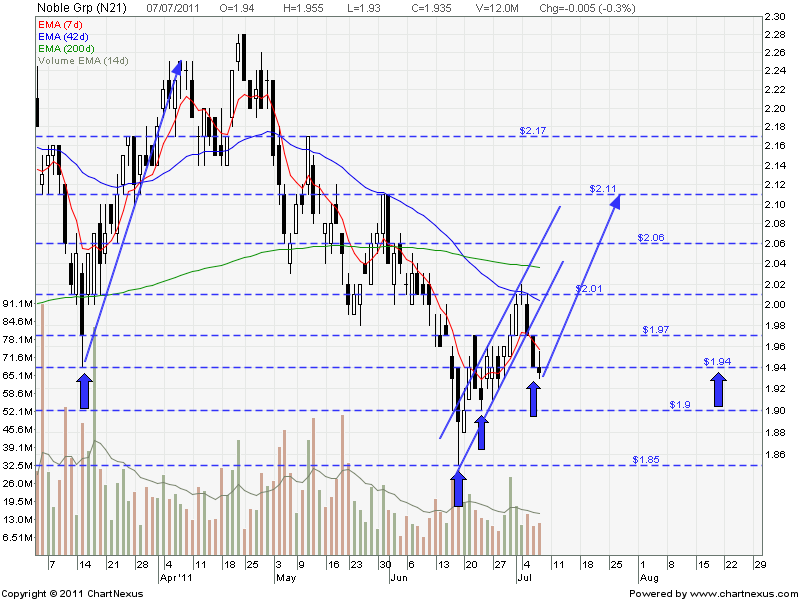
Noble


Now, I know there are a few cyber Noble fans following it. Are you not scare of Noble breaking down?

Simple is not necessarily simplistic

Just For Thinking ...

"If you can't explain it simply, you don't understand it well enough." - Albert Einstein

Read? Investing Made Simple by Uncle8888 (19)

For example:

"Men who can both be right and sit tight are uncommon." - Jessie Livermore


"We don't need to win back in the same manner that we have lost it." - Createwealth8888
 
These are one liner advice. It is simple. Simple is not necessary simplistic.
 
Similarly, Simple chart like this. It is simple and there is no doubt about it.
 
Simple things are not necessarily simplistic. Ask any famous chefs. Simple dishes are the true tests for the cooks.

Sembcorp Marine inks S$600m deal

SINGAPORE - Singapore rig builder Sembcorp Marine said on Thursday its subsidiary has secured close to S$600 million (US$493 million) contract for an integrated processing and living quarter platform. -- REUTERS

Where do you drink your kopi?

Just For Laugh ....

At my office, I realize different colleagues drink their kopi in different ways.

  1. Free kopi at pantry
  2. Kopi at kopithiam (pay)
  3. Kopi at ToastBox (pay more)

S'pore economy contracts by 7.8% in Q2 with slowdown acrss sectors

Singapore: A slowdown across many sectors saw the Singapore economy grow by 0.5 per cent on a year-on-year basis, down from the 9.3 per cent growth seen in the previous quarter.

On a seasonally-adjusted quarter-on-quarter annualised basis, the economy contracted by 7.8 per cent, compared to the 27.2 per cent expansion in the previous quarter.

According to a Trade and Industry ministry release on the advance estimates, the largest contraction was in manufacturing which declined by 5.5 per cent in the second quarter of 2011, after a 16.4 per cent expansion in the previous quarter.

On a sequential basis, the sector contracted by an annualised rate of 22.5 per cent, a sharp reversal from the growth of 96.6 per cent seen in the preceding quarter.

This decline was largely impacted by the biomedical manufacturing cluster as companies switched to producing a different value-mix of active pharmaceutical ingredients during the quarter, as well as the electronics cluster which saw an easing in global demand for semiconductor chips.

Showing some moderation was growth in the services sector, despite healthy growth in the tourism-related sector such as hotels & restaurants due to strong visitor inflows.

The industry grew by 3.3 per cent year-on-year, compared to the 7.6 per cent growth in the preceding quarter.

On a sequential basis, the services producing industries declined by an annualised rate of 2.9 per cent, following the growth of 10.3 per cent in the preceding quarter.

This was largely due to declines in wholesale and retail trade, due to weaker trade flows during the quarter, as well as the financial services sectors which were dragged down by a fall in stock trading activities.

Although not as sterling as the preceding quarter, the construction sector posted 1.6 per cent growth on a year-on-year basis in Q2 2011, after posting 2.4 per cent growth in Q1.

The sector also saw a second consecutive quarter of growth on a sequential basis, at 13.8 per cent, due to increasing construction activities in the industrial building segment.

- CNA

Wednesday, 13 July 2011

DBS unveils new banking account for start-ups

By TEO SI JIA


DBS Bank on Friday introduced a new banking account for business start-ups as it continues in its drive to build a leading regional SME franchise.

The DBS Entrepreneur's Account for Start-ups is expected to provide convenience, access to affordable banking services and other value-added benefits, including the DBS eAdvice service, to over 50,000 companies each year.

Criteria for the new initiative includes application within six months of registration at the Accounting and Corporate Regulatory Authority, and a company that is incorporated in Singapore. The start-up package will also require an initial deposit of S$500.

'We recognise that customers at different stages of their business growth have different banking requirements, said Edwin Khoo DBS Head of Enterprise Banking.

'Start-ups, in particular, are looking for easy and affordable banking solutions. Our aim is to help budding entrepreneurs access support and banking services that are suitable for their needs.'

It plans to mitigate costs of local start-ups by waiving their banking, subscription and set up fees and service charges for a period of time ranging from six months to two years.

Various plans have also been drawn up to aid the company in their cashflow and workforce welfare.

DBS sees SMEs as crucial job creators and sources of innovation which could have the potential to be something bigger in the global region, and thus provides support to them even in hard times.

Investing Made Simple by Uncle8888 (19)

Read? Investing Made Simple by Uncle8888 (18)

In Uncle8888 series (16) - How to invest and make big money in the stock market?

The key learning point is "Men who can both be right and sit tight are uncommon."


Uncle8888 also mentioned "Buy and Hold is Dead".

  1. Men who can both be right and sit tight are uncommon.
  2. Buy and Hold is Dead.
Two questions arise from the above two statements.

  1. Does these two statements contradict each other?
  2. Is statement No 1 useless advice?  (Brolp said: it's useless advice actually - when right sit tight. It's almost like saying when it's raining, bring an umbrella.)
The answers are:
  1. The two statements do not contradict each other.
  2. It is useful advice.
How does Uncle8888 know that when he is right and sit tight?

There are two conditions. Both conditions must be met before he can consider he is right.

Condition No 1: Early Bull in the Bull Market.
Condition No 2: Stock price doesn't look back at his purchase price level during correction.

If stocks are not bought during early bull in the Bull Market, the stocks will be eventually sold at the desired profit goal. In this sense, Buy and Hold is Dead if Condition No 1 is not there.

Even if stocks are bought during early bull in the Bull Market e.g. in early 2009; but subsequently the stock price corrected to near or fall below the original purchase. The stocks will be eventually sold for profits.

Only when both conditions are fully met Uncle8888 will know that he is right and will sit tight.

Do anyone think that the current market is an early bull in the Bull Market?

No. Right? So all stocks bought by Uncle8888 during this period are meant for sale.

Lastly, does anyone else still think that advice from Jessie Livermore is useless actually?

Noble secures record US$3.2b in credit facilities

By ANGELA TAN


Noble Group Limited said on Tuesday that it has secured a record US$3.2 billion in syndicated loans, up from its target of US$2.25 billion.

The facilities comprise a US$1,054.8 million 364-day committed Revolving Credit Facility, a Euro244.4 million 364-day committed Revolving Credit Facility and a US$1,789.2 million three-year committed Revolving Credit Facility.

Noble plans to use the funds to refinance existing debt and for the general corporate purposes of the company and its subsidiaries.

The bookrunner mandated lead arrangers were ABN AMRO Bank NV, Banco do Brasil SA, London Branch, Bank of America, NA, The Bank of Tokyo-Mitsubishi UFJ, Ltd, Citigroup Global Markets Asia Limited, Commerzbank AG, Hong Kong Branch, Cooperatieve Centrale Raiffeisen-Boerenleenbank BA (trading as Rabobank International), DBS Bank Ltd, Goldman Sachs Lending Partners, LLC, The Hongkong and Shanghai Banking Corporation Limited, ING Bank NV, JPMorgan Chase Bank, NA, Hong Kong Branch, Natixis, Hong Kong Branch, The Royal Bank of Scotland plc, Hong Kong Branch, Societe Generale and Standard Chartered Bank (Hong Kong) Limited.

This is Noble's second syndicated Revolving Credit Facilities transaction in less than 12 months.

On 1 December 2010, Noble announced it had completed syndication of US$2.54 billion equivalent of Committed Revolving Credit Facilities.

Noble

Monday, 11 July 2011

DBS SUCCESSFULLY TAPS MAS-PBOC LINE

Continues to be at the forefront of the RMB market in Singapore

SINGAPORE, 11 July 2011 - On 29 June 2011, DBS Bank announced that it had
applied to the Monetary Authority of Singapore (MAS) to tap the bilateral currency swap
agreement established between the central banks of Singapore and China, to provide
financing to a Singapore-based commodities company exporting to China.

DBS is pleased to announce that on 7 July 2011, it had successfully entered into
an agreement with the MAS to tap the facility. The bank will complete drawdown of the
facility today, upon which it will provide RMB financing to the customer.

Said DBS Group Head of Treasury & Markets Andrew Ng, "As a leading Asian
bank, DBS is happy to be an early mover in Singapore to tap the MAS-PBOC bilateral
swap facility to meet client needs.

We are pleased to have been able to execute the
transaction as planned. Over the past week, we have also received many enquiries from
Singapore clients interested to borrow RMB for trade settlement purposes, and we are
confident that this successful transaction will be the first of many more to come."

Sunday, 10 July 2011

In the stock market where does the Money come from?

Just For Thinking ....

A picture is worth a thousand words. When you see a picture, it will strongly embedded in your mind for a long time.


As you can see from the picture. Companies DISTRIBUTE stock dividends and other Investors/Traders in the stock market all together significantly CONTRIBUTE to the capital appreciation of stocks. The amount of money distributed by companies is pale compared to the amount of money contributed by other investors/traders.

So are you contributing to the market or are you taking contributions from the market most of the time?

Trekking along Singapore historical KTM railway tracks - Your last chance to do it!

Have you joined thousands and thousands of Singaporeans and foreigners, and even a few pets to trek down the Singapore historical KTM railway tracks?

I quickly alighted Bus service no 75 after spotting the KTM railway track with some people trekking on it and begin from Holland to Bukit Timah Beauty World centre where I stopped for late lunch. However, after lunch, it was raining and I decided to call it off. Next Sunday, I may continue from Bukit Timah onwards and trek north to Woodlands.

Some info:

The Singapore Land Authority (SLA) has agreed to allow the public to access and trek along the railway tracks between July 1 st and 17.


For two weeks the public will have the opportunity to trek along the entire line of railway tracks except for some localised areas.

After July 17, a three kilometre stretch from Rifle Range Road to the Rail Mall will continue to be open to the public till 31 Jul 2011.

The SLA also advises that members of the public should exercise caution when walking along the tracks as some areas are narrow and rough.

The Tanjong Pagar Railway Station and Bukit Timah Railway Station will be closed temporarily to facilitate the moving out of the furniture and equipment by the KTM and its tenants.

Minor works will also be carried out at the Bukit Timah Railway Station and the railway crossings at Kranji Road, Sungei Kadut Avenue, Choa Chu Kang Road, Stagmont Ring and Gombak Drive. Members of the public should avoid these work areas which will be cordoned off.

Investing Made Simple by Uncle8888 (18)

Read? Investing Made Simple by Uncle8888 (17)

In Investing, Control Risk is NOT a Choice

In investing, control risk is NOT a choice; but a strict requirement to survive in the Law of Jungle in the stock market. You MUST have adequate investing capital to come back when you have fall in the stock market. But, you don't need to win back in the same manner as you have lost it. Uncle8888 has personally tested it in the last Great Bear 2008/09 and it works.

As small retail investors who have limited time and resources to analyze the companies like institutions. You also don't have access to management to have greater insight on their recent business operating environment and challenges. You must never be mistaken on this. When institutions or big boys cut losses and reduce exposures to a stock; they will certainly do it with their eyes wide open. Definitely these institutions are better informed than small retail investors. They know what they are doing. Unfortunately, there will be some retail investors who will think they are actually "bigger" than the Big Boys and "smarter" than the Sharks in the stock market and disgree.

Knowing that control risk is a not choice but a strict requirement for survival in the stock market. We should never allow a single counter to drag us down in our portfolio. It is also not wise to overly expose our portfolio to a single sector.  When a certain market condition happened, no stocks in that sector will be spared. It is only the degree of fall is different.

We should NEVER allow a single loss or a series of losses to wipe off much of our investing capital for our investing mistakes. We will continue to make future investing mistakes no matter how experience we are and regardless of the number of years we have spent in the market. There is no way that we will not lose again! We have to control risk and it is not a choice.

"You don't need to win back in the same manner as you have lost it." - Createwealth8888

Once you have fully understood Uncle8888's quote. Do you still want to average down to 40-60% of your portfolio in a single stock as you can't believe you are wrong?

Saturday, 9 July 2011

Uniquely Singapore. Retirement Age for workers!

Just For Laugh ....

Reaching 55 - Early retirement but lock up your minimum sum in CPF RA account and see it at 65.

Reaching 60 - Optional retirement.

Reaching 62 - Minimum retirement age.

Reaching 65 - Deferred retirement. Thank you for your life time working on your job.

Biosensors Weekly - It is getting better!


It is getting better. Biosensor is now quite near to its 52W High at $1.41; but still some distance away from its All Time High at $1.52.

I have been holding the last batch of biosensors  @ $0.655 since Jan 2008 even though it was a loss making company for years; but I have strong belief that it will one day make it big.

"Men who can both be right and sit tight are uncommon" - Jessie Livermore

Will it then become my next multi-bagger in the portfolio?

Friday, 8 July 2011

How are you measuring up with your investment return? (2)

Read? How are you measuring up with your investment return?


Temasek's Investment Return performance


Over 10 years Temasek's annualized TSR is 9% and Createwealth8888 is 14.2%.  (Too bad, I don't have 20 yrs past investing records to check back)


Keep it up!

Noble Weekly

Thursday, 7 July 2011

Noble - Are most of profit taking completed?

ECB Raises Interest Rate, Brushes Off Debt Worries

By: Peter Guest


Web Producer, CNBC.com

The European Central Bank raised interest rates by 25 basis points to 1.50 percent on Thursday, as it continued to brush off concerns over slow growth and sovereign debt worries in the euro zone periphery. ECB President Jean-Claude Trichet hinted at his press conference that a further rise in August is unlikely.

The ECB also raised its marginal lending rate by 25 basis points to 2.25 percent and its deposit rate to 0.75 percent.

Speaking at a press conference following the decision, Trichet said that the bank will "monitor very closely" inflation in the euro zone. In the ECB's code word system, this generally indicates that the bank will not raise rates at the next meeting, analysts have said.

Trichet said that the bank was concerned about inflation, which currently stands at 2.7 percent, above the target rate of 2 percent.

Claude Trichet told a press conference following the June rate decision that the bank would be "strongly vigilant", code words for a rate hike at the next meeting, so markets had been expecting Thursday's announcement.

The ECB had been holding rates at record lows of 1 percent during the economic crisis, but with growth returning to the euro zone – led by Germany – the bank has gradually been tightening its monetary policy, raising rates by 25 basis points in April.

Saxobank group CIO Steen Jakobsen told CNBC.com that the rate hike was more of a political consideration than an economic one.

"I think the ECB is in a corner, and the only tool left for them to use to create some sort of noise is hiking rates," Jakobsen said.

"I think the gap between what the politicians do and the market is growing, not only in terms of defining a (Greek) default and what needs to be done in terms of the structure," Jakobsen said.

"Trichet, increasingly, at the tail end of his presidency, I think will avoid at all costs losing face, in terms of an actual default, which means that the ECB has to sit and wait, and the only thing they can signal is that they have credibility in terms of fighting inflation."

Trichet's press conference following the rate decision will give markets more indication of where rates are going. Jakobsen expected more talk of fighting inflation, but little else. Trichet has a habit of making hawkish statements one month, before stepping back the next.

"The schism is that he can only talk strong rhetoric about inflation and his credibility on inflation, but at the same time his economic fundamentals are eroding month-by-month, even in Germany," he said. "The spread between his rhetoric and his practical ability to manoeuvre is limited."

"Hiking (rates) now, and indicating another one right away would be giving away his cards. From a game theory point of view, if nothing else, playing into an October hike would be too early," Jakobsen said.

He added that the markets may not be convinced by today's decision.

"If the market calls (Trichet's) bluff, saying, well, you're hiking rates for political reasons only, then the reaction should be that people will start buying bunds and spreads in the periphery will go up," he said.

Jakobsen also noted that the ECB has been "backed into a corner" by its balance sheet, which has seen the bank take a large exposure to peripheral countries' debt.

Research from HSBC showed that the euro system – the ECB and euro zone central banks – could stand to lose 23 billion euros on their bond holdings in peripheral countries, in the event of a 50 percent haircut on Greek, Portuguese and Irish debt.

Wednesday, 6 July 2011

Singapore plans for unforeseen weather conditions

SINGAPORE : Singapore's Environment and Water Resources Minister Vivian Balakrishnan said governments will have to factor in the cost of insurance, infrastructure and technology when planning for unforseen circumstances brought about by unpredictable weather.


Speaking at the closing of the Singapore International Water Week on Wednesday, Dr Balakrishnan said climate change is a "stark reminder" that "so called one in a hundred year events now occur at time intervals considerably less than a hundred".

"The point is whether we like it or not, we are going to get used to a more turbulent ride, a less predictable world, and there is a need therefore for us to insure ourselves wherever possible, and wherever sensible against these events. At some point, the cost is going to be paid either upfront in better preparation or timing, or worst, when the consequences of these unpleasant singular events occur," he said.

Thinking about security and resilience is just one key factor in ensuring the sustainability of Singapore's environment and water resources.

Others the minister highlighted include rational decision-making by politicians and integration of resources to ensure that pricing is right for water.

Dr Balakrishnan said: "We've had that advantage of not having the luxury to procrastinate or to fudge issues, but to make some hardball decisions which we have over the past decade. PUB is an integrated agency that looks after potable water supply, drainage as well as sanitation.

"The advantage of having a well organised system without cross subsidies and with rational decision-making is that we've been able to make sure that the energy and water equation in Singapore continues to be coordinated and delivered in an integrated form."

He also called on the private sector to drive research and development to improve water energy efficiency.

For example, the PUB is working with Keppel Seghers to construct a demonstration plant on Jurong Island to further understand and optimise a new desalination technology called Memstill.

The concept uses low grade waste heat to produce near-distilled water from seawater.

If successful, energy needed for seawater desalination could be reduced by two-thirds.

- CNA /ls

SEMBCORP SIGNS AGREEMENTS TO FURTHER EXPAND ITS WATER

Singapore, July 6, 2011 – Sembcorp is pleased to announce that its wholly-owned subsidiary, Sembcorp Utilities, will be signing three memoranda of understanding (MOU) to explore further expanding its water business in China during the Singapore International Water Week’s (SIWW)

China Business Forum to be held later this afternoon. Earlier in the week on July 3, Sembcorp also signed a MOU with the Xinmin government.

Tuesday, 5 July 2011

Noble

Biosensors - Why sudden bullish today in a down market?


Why can't the Bulls wait in a down market? Some are better informed?

Dividend stocks: quality counts too

Hock Lock Siew
By MICHELLE TAN


THERE has been a big buzz around dividend stocks since the last global financial meltdown as investors and funds start to see the importance of establishing a regular income source, especially when the going gets tough.

Moreover, with Singapore's population demographics reflecting a fast ageing population, dividend stocks also serve as an avenue to generate income to fund retirement especially for investors with weaker saving habits. However, are dividend stocks really such a god-send, or have they been over-hyped by financial media?

In general, analysts and investors ascribe a lower risk and volatility profile to dividend stocks due to their ability to generate regular streams of income that help bolster the ill-effects of a potential downturn.

But does this mean that dividend stocks are less likely than their lesser yielding peers to see price upswings due to their less volatile nature?

As a simple illustration, should one compare the basket of 30 Straits Times Index (STI) constituents with a basket of 30 dividend stocks, findings show that though both portfolios generated positive year-on-year price returns, the former reflected a higher annual return of 13.8 per cent as opposed to the 9.6 per cent registered by the dividend stock portfolio.


As such, based on the findings, it seems that dividend stocks tend to experience lower capital appreciation when compared to index stocks.

Having said that, the STI basket is made up of blue-chip quality counters that tend to be highly favoured by both institutions and layman investors alike.

Perhaps, if the comparison was drawn to a basket of lower cap counters, findings might have shown otherwise.

Now coming from a dividend perspective, dividend stocks triumphed over the STI basket with the former having a forecast consensus dividend yield average of 6.2 per cent in FY11 and 6.5 per cent in FY12 as compared to the latter's 3 per cent and 3.3 per cent for the respective financial years.

The findings are not surprising though investors should bear in mind that the STI portfolio has some dividend stocks, which would have given a slight lift to the basket's average yield.

Should the basket exclude dividend stocks entirely, the average dividend yield would have been even lower.

More pertinently, the dividend stock portfolio, unlike the STI one, is able to outstrip domestic inflation rates, which is cited as a key worry for investors today.

As such, investors who are unable to buy commodities like physical gold or property to hedge against inflation could perhaps turn to dividend stocks as their answer to a cost-efficient inflationary hedge.

But there are no fool-proof investments in this world. Just like any equity, dividend stocks are still susceptible to industry recessions and other sector-specific woes.

In fact, during the last recession, many dividend stocks such as real estate investment trusts (Reits) were not spared from the falling knife.

Admittedly, there was sunlight after the rain for investors that had the financial muscle to tide through the rough patch.

But for investors who were retrenched and needed the funds, liquidating dividend stocks such as Reits - and other non-dividend stocks - back then would have severely decimated their wealth.

All that said, it is an undeniable fact that all boats sink when the tide falls. But one of the better known ways to break the fall is to diversify.

After all, putting all your eggs in one basket is never a wise move, especially from a capital protection standpoint. And this holds true even for stocks with a more conservative risk profile, such as dividend stocks.

The key point to drive home is that whether one is planning for his retirement or is merely seeking extra side income, quality is still of paramount importance.

A high yielding stock does not always mean it is a good stock. Though a stock with sound fundamentals and with attractive yields to boot would be a wise investment option.
Related Posts with Thumbnails