I started serious Investing Journey in Jan 2000 to create wealth through long-term investing and short-term trading; but as from April 2013 my Journey in Investing has changed to create Retirement Income for Life till 85 years old in 2041 for two persons over market cycles of Bull and Bear.

Since 2017 after retiring from full-time job as employee; I am moving towards Investing Nirvana - Freehold Investment Income for Life investing strategy where 100% of investment income from portfolio investment is cashed out to support household expenses i.e. not a single cent of re-investing!

It is 57% (2017 to Aug 2022) to the Land of Investing Nirvana - Freehold Income for Life!


Click to email CW8888 or Email ID : jacobng1@gmail.com


Welcome to Ministry of Wealth!

This blog is authored by an old multi-bagger blue chips stock picker uncle from HDB heartland!

"The market is not your mother. It consists of tough men and women who look for ways to take money away from you instead of pouring milk into your mouth." - Dr. Alexander Elder

"For the things we have to learn before we can do them, we learn by doing them." - Aristotle

It is here where I share with you how I did it! FREE Education in stock market wisdom.

Think Investing as Tug of War - Read more? Click and scroll down


Important Notice and Attention: If you are looking for such ideas; here is the wrong blog to visit.

Value Investing
Dividend/Income Investing
Technical Analysis and Charting
Stock Tips

Showing posts sorted by relevance for query Pareto. Sort by date Show all posts

Sunday, 14 November 2010

Pareto Principle

By Albert Yang


Read? Parkinson's Law

Pareto Principle ~ “20% of the effort generates 80% of the results.”


Background Blurb: (From Wikipedia)

The Pareto principle (also known as the 80-20 rule, the law of the vital few and the principle of factor scarcity) states that, for many events, 80% of the effects come from 20% of the causes.

Business management thinker Joseph M. Juran suggested the principle and named it after Italian economist Vilfredo Pareto, who observed that 80% of income in Italy went to 20% of the population. It is a common rule of thumb in business; e.g., "80% of your sales come from 20% of your clients."

The Pareto principle is only tangentially related to Pareto efficiency, which was also introduced by the same economist, Vilfredo Pareto.

Pareto developed both concepts in the context of the distribution of income and wealth among the population.

Known to most of us as the 80-20 rule, it explains quite a bit about how our world is run. 20% of the clients make up 80% of the sales. 20% of the clients make up 80% of the headaches. 20% of the activities take up 80% of the time.

The list is endless. There are even variations on the 80-20 principle, such as the 90-10, the 95-5, and the 1-99. Of course, if you take a Pareto of a Pareto (Pareto2) you get 80-20 of 80-20, yielding you 64-4 (80% of 80% = 64%; 20% of 20% = 4%).

Like Parkinson's Law, Pareto Principle is another big law that engulfs your work life as well as your personal life. Given that your job is to optimize your life, spotting Parkinson's Law, and applying Pareto Principle to it, is really the basis of the optimization.

Let me try to explain how it applies to most projects in the business world, and in combination with Parkinson's Law, you will begin to see how these two laws all but guarantee that a project will be delayed and over budget (even before you factor in Hofstadter’s Law.)

Let us begin with a project we have been assigned. The project deadline is in two months. Regardless of what needs to be done, because of Parkinson's Law, we already know that we are going to cut it close, and it will fill all two months, regardless if we have ten tasks to accomplish in those two months, or one hundred tasks. Because traditional project management says, we go ahead and list out the tasks we have to do, and begin those which are on the critical path; or more than likely, the project will begin with those items that will take the longest.

Given our timeline, we already know that according to Pareto Principle, the tasks that will take 80% of our time will only yield 20% of the results. But when we apply traditional project management; what tasks do we start off with first??

That's right, those that will take 80% of the total project time to complete. So let's suppose that we have task A, and task B. Task A will take six weeks of our total eight weeks, and task B will take only two weeks. Because we feel that we'd like to have some buffer as a project manager (if you didn't notice it, the creation of a buffer has fallen us victim to Parkinson's Law, even with Hofstadter’s Law), we will start with task A first so that if we don't finish in the six weeks, we still have two weeks left as buffer.

But because of Pareto Principle, we know that task B is: 1) Easier to do 2) Can be completed in two weeks 3) Will account for 80% of the entire project.

But because traditional management says otherwise, we will start with task A, which is: 1) More difficult to do 2) More time consuming than we first estimated, regardless what the estimation is 3) Will take 80% of our time 4)

Will account for probably less than 20% of the project. So by week 6, task A is not completed. “That's ok, because we have an added two weeks buffer!!” You will say to yourself; but Parkinson's Law of course, kicks in, and you will take all eight weeks of your entire project time to finish task A (and of course, task A WILL be finished by the eight weeks because of Parkinson's Law) but when you have finished with task A, you have only finished 20% of the project.

Therefore, by Parkinson's Law, (and lack of Hofstadter’s Law) you will tell your boss that it wasn't your fault, and you need more people, even though you really only have 20% of the tasks left, you will now have more people working on smaller amounts of tasks than you did the previous eight weeks (Cope’s Law).

The lack of understanding of these two rules, Parkinson's Law and Pareto Principle, is pretty much the reason that most projects are delayed and over budget.

If you are a student, in your student life, if you had to clean your room before you did your homework, you will of course spend 80% of your time on cleaning your room to avoid the homework, and in fact, you will take longer than that because of Parkinson's Law. When you are done with cleaning your room, you will have spent 80% of your time, doing less than 20% of what you needed to do.

If you are in sales, you will spend 80% of your time rearranging and alphabetizing your business cards, and only spend 20% of your time making cold calls, which is what yields you clients, not the rearrangement of business cards.

When you understand this however, you will be able to spot it and thus be able to defeat it. I will show you later on, how by reversing the two laws, Parkinson's Law and Pareto Principle, you can do most tasks and do the more efficiently. You can spend as little as 20% of the effort, and 50% of the time, and yield a better
product all at the same time!

-------------------------------------------------

Createwealth8888:

How to spot Parkinson's Law and applying Pareto Principle to our investment strategies?

We should be more productive in our investment and avoid expanding our time and effort for more and more stock/company analysis which may take away too much time from other aspects of life even though we personally may enjoy it; but not sure our other family members can really agree to it.

Over time when we become more skillful and with the right strategies we should be able to spend 20% to get 80% .

Read? My money works harder for me (3)

Read? Is this worth my time and effort to trade? (3)

Monday, 8 May 2017

Do You Diversify Your Stocks Through Many Stocks or ETFs or Concentrate To A Few Better Ones???


Read? Our Desired Investing Outcome: The Pareto Principle (80/20)


Saturday, 21 March 2015

Our Desired Investing Outcome: The Pareto Principle (80/20)

Read? The Pareto Principle (80/20) Investing Strategy


Uncle8888 wrote this in .. 

Sunday, 2 September 2012

Investors. Know at least Pareto's Principle

Pareto Principle ~ “20% of the effort generates 80% of the results.”

Market Timing vs. Time in Market???
Fundamental vs. Technical Analysis?
Short-term Trading vs.  Long-term Investing???

For long-term investors, we should be observing Pareto's Principle.

80% patiently waiting for Market Timing and then spend 80% Time in Market with 20% of our effort will generate 80% of the results. 

And then we spend another 80% market timing for next cycle.


Diversify and then naturally keep the large winners as Concentrate for its liquid cash and cut off the rest of not so good ones. Pareto Principle in action!

The outcome as on 8 May 2017


Monday, 16 November 2009

Pareto's Law In Investing?

Financial & Investment Dictionary: Pareto's Law

Theory that the pattern of income distribution is constant, historically and geographically, regardless of taxation or welfare policies; also called law of the trivial many and the critical few or 80-20 law. Thus, if 80% of a nation's income will benefit only 20% of the population, the only way to improve the economic lot of the poor is to increase overall output and income levels.


Other applications of the law include the idea that in most business activities a small percentage of the work force produces the major portion of output or that 20% of the customers account for 80% of the dollar volume of sales. The law is attributed to Vilfredo Pareto, an Italian-Swiss engineer and economist (1848-1923).

Pareto is also credited with the concept called Paretian optimum (or optimality) that resources are optimally distributed when an individual cannot move into a better position without putting someone else into a worse position.
--------------------------------------------------------------------------
CreateWealth8888:

Pareto's principle can be true in your Portfolio Management. 20% of those stocks (multi-baggers) in your Portfolio are providing 80% of the returns. Likewise, 80% of losses are contributed by 20% of losers.


The rest are small gains and losses here and there; and don't have any serious impact to total or net returns of your Portfolio.

Take note of Pareto Principle and apply them to your Portfolio Management, let the top 20% of winners run; and prevent the top 20% of the losers from creating havoc and cut losses fast.

Saturday, 21 March 2015

Our Desired Investing Outcome: The Pareto Principle (80/20)


Read? The Pareto Principle (80/20) Investing Strategy


Uncle8888 wrote this in ..

Sunday, 2 September 2012

Investors. Know at least Pareto's Principle


Pareto Principle ~ “20% of the effort generates 80% of the results.”

Market Timing vs. Time in Market???
Fundamental vs. Technical Analysis?
Short-term Trading vs.  Long-term Investing???

For long-term investors, we should be observing Pareto's Principle.

80% patiently waiting for Market Timing and then spend 80% Time in Market with 20% of our effort will generate 80% of the results.

And then we spend another 80% market timing for next cycle.

Read?  Laws Applicable To Investing

------------------------------------

Quoting the wisdom from this man, Rolf SueyMarch 20, 2015 at 9:48 AM

@Investment

this principle applies, but it is an outcome. It cannot be use as a strategy.

Since every investment before u press the buy button is ur top priority. If u have 5 stocks, u cannot say my priority is only 1 or 2 out of the rest.

I guess that maybe what B is trying to say is now he is only focusing on few stocks only with higher amt vested in each stock. And this is good enough for him getting good rtn.

but if 20/80 strategy applies... then out of ur 10 stocks, only 2 will give u good money. then how sure are u that it will comes from ur top holdings?


--------------------------------------

Uncle8888 fully agreed. It is an outcome and NOT a strategy.

BUT, this should be our desired investment outcome after XX years of investing in the stock market. We should be proving this principle RIGHT!


How?


Uncle88888 is quite sure that we are going to prove this principle WRONG by selling our winners sooner; but holding on our losers for the longest possible time before we are forced to sell.


Our investing strategy will likely to determine our investment performance outcome after X decades in the stock market. When our strategies are NOT rightly executed; they will NOT lead us to our desired outcome - The Pareto Principle ~ 20% of the effort generates 80% of the results.”


Tuesday, 3 December 2019

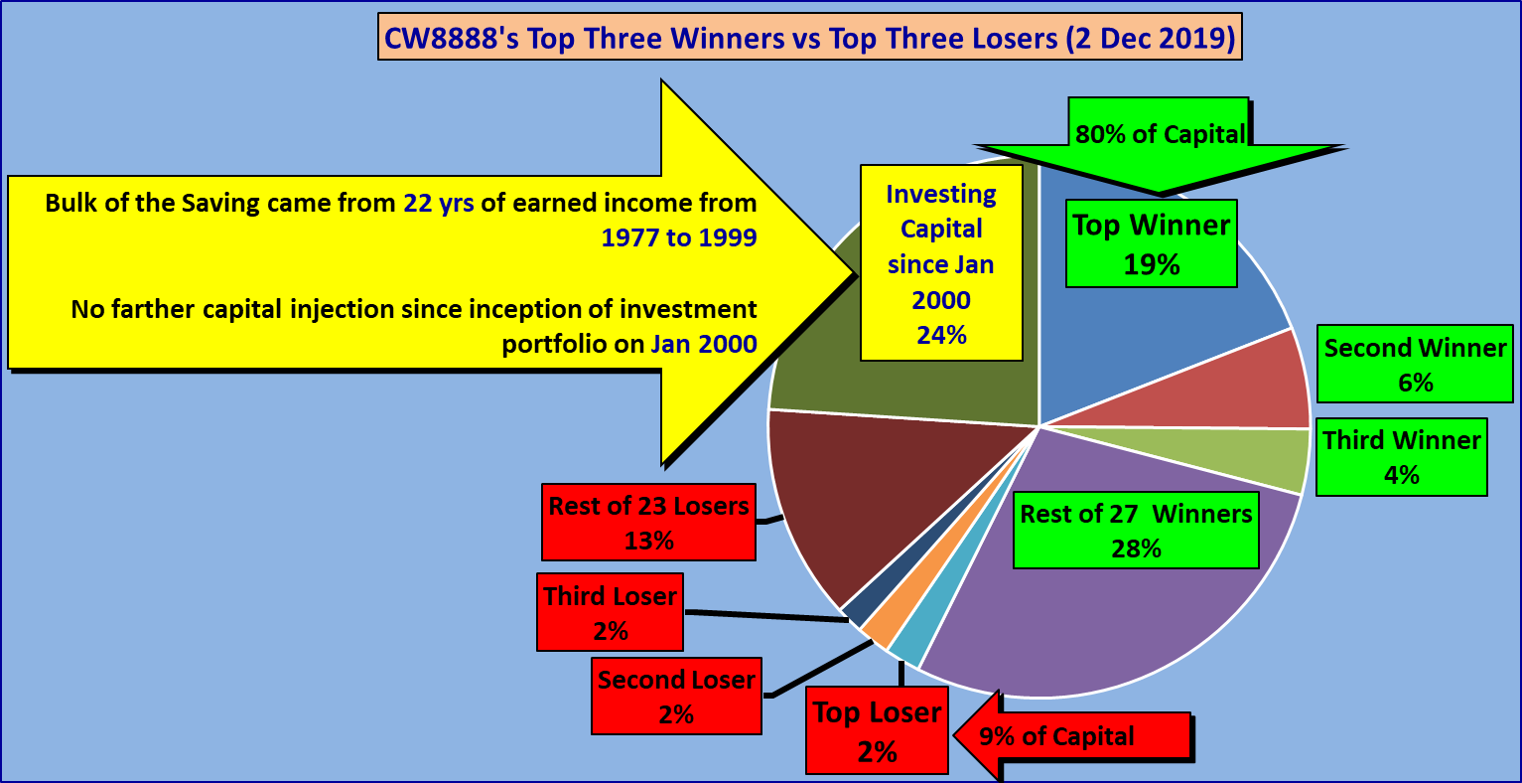
Real Life Example Of The Pareto Principle In Investing


Read? More on Pareto blog posts

The secret to winning in the Pareto principle in investing is .... position sizing and size of war chest during market crashes!

Updated on 2 Dec 2019


Sunday, 2 September 2012

Investors. Know at least Pareto's Principle


Pareto Principle ~ “20% of the effort generates 80% of the results.”

Market Timing vs. Time in Market???

Fundamental vs. Technical Analysis?

Short-term Trading vs.  Long-term Investing???

For long-term investors, we should be observing Pareto's Principle.


80% patiently waiting for Market Timing and then spend 80% Time in Market with 20% of our effort will generate 80% of the results.

And then we spend another 80% market timing for next cycle.


Read? More articles on Laws

Uncle8888 took more than 12 years to finally understand these Laws!!!


Sunday, 14 November 2010

Parkinson's Law

By Albert Yang


Parkinson's Law ~ “Work expands so as to fill the time available for its completion.”

Parkinson's Law of Finance ~ “Expense expands so as to fill available budget.”

Parkinson's Generalized Law ~ “You will always get the lowest item of which you deem acceptable.”

Background Blurb: (From Wikipedia)

“It was first articulated by C. Northcote Parkinson in an article published in The Economist in 1955, later reprinted together with other essays in the book Parkinson's Law: The Pursuit of Progress (London, John Murray, 1958), based on extensive experience in the British Civil Service. The scientific observations which contributed to the law's development included noting that as Britain's overseas empire declined in importance, the number of employees at the Colonial Office increased.”

While I have listed quite a few laws, just as according to Pareto Principle, Parkinson's Law will make up the bulk of this book, and it IS the 20% that will make up 80% of your daily battles. Understanding Parkinson's Law will probably be the single most important knowledge you have in your life. (No, I'm not kidding nor exaggerating). This law and its sole understanding will determine if you have a good marriage, if you have a great retirement, if your country is clean, if your life is happy, if you get a promotion. Singularly, it will so engross and encompass every aspect of your life you won't believe it.

Parkinson's Law, and its subsequent corollaries; are almost magical in its profoundness when you understand them. If you have a project, and you are given a month to complete it, you will complete it in a month. If you have the same project and are given two months to complete it, then you will complete itin two months.

Anybody who has ever been a college student understands this. While a paper is due in two weeks, most of us will do the paper the night before. If the paper were assigned and we were only given one day to finish it, we would all revolt against the professor, yet when you take a look at the reality of the fact, most of us actually do it in less than 24 hours all the time. So Parkinson's Law, as it applies to school and business, is fairly easy to understand and there are dozens of examples that could be sited. These however, are fairly clear and straight forward.

It is however, the subtle underlining forms of Parkinson's Law, those that we don't notice, that really ruin our lives.

Let me give you a few examples. Does your alarm clock have a “snooze” button? If so, and you use it, you are a victim of Parkinson's Law. If your alarm is set at 7:00am, and when it rings, you press the snooze button and “sneak” 10 more minutes of sleep in, you are now a victim of Parkinson's Law. You can almost call it the Parkinson's Law of sleep, “Sleep will expand to fill time available.” So even before you actually get out of bed, you are a victim to Parkinson's Law already, and it goes downhill from there.

Because you woke up 10 minutes later, you try to sooth your nerves by telling yourself that you have plenty of time; which of course according to Parkinson's Law, is another lie in and of itself. You say you have plenty of time, and so you slow down your morning routine, and bam! Parkinson's Law applies again, and your morning routine expands to fill (and then overfill) your available time.

Once you finally get to work, you sit down to answer ONE email, and then one email becomes ten emails, and soon, what you were suppose to do Monday morning is not done. So you say to yourself, “That's ok, I'll just put in a little overtime tonight, no problem.” But what you didn't understand was of course, that Parkinson's Law applies to overtime, and so by giving yourself overtime, Parkinson's Law kicks in once again, and the amount of work you do because you allowed yourself to do overtime is actually the same or LESS than if you didn't have overtime.

This all seems ridiculous, but it's true. If you are the boss of a company, take heed. In a survey of employees who worked 6 hours a day, 8 hours a day, and 10 hours a day. The SAME PERSON, working 6 hours a day, is MORE efficient and got MORE work done than working 8 or 10 hours a day!

How can this be?? It's a mixture of Parkinson's Law and Pareto Principle actually. Even if they had 6 hours of work only, if given 10 hours, they will automagically expand the work to fill 10 hours. So productivity goes down as does efficiency. This is further witnessed by the increased productivity of company CEO's who only go into the office three times a week; or even as little as one time a week compared to those who are at the office all the time.

I will talk more about this when I introduce Pareto Principle, and its combination with Parkinson's Law.

Understand one critical thing though, Parkinson's Law of time, does not shrink, it only grows. That means, when you have a project that is one week long, and later on, you find out you have two weeks instead of one week to finish it, then you will take two weeks. BUT, if you had a project that was two weeks long before, and you then are given only one week to finish it, your project WILL BECOME DELAYED.

So Parkinson's Law only expands, it doesn't shrink. I teach you later on though, how to make it shrink.

Read? Parkinson's Law of Finance

Saturday, 12 May 2018

Dumb Or Patient Investor???


Read? Our Desired Investing Outcome: The Pareto Principle (80/20)


Pareto Law : 80% of the time waiting for 20% of the stocks in the investment portfolio to generate 80% investment return at portfolio level.


Monday, 11 April 2011

Standard Drilling buys Clearwater rigs

Oslo-listed Standard Drilling is pursuing an aggressive fleet expansion plan by offering to buy out two jack-up drilling units being built for New York-based Clearwater Capital Partners and declaring options for four more rigs with Singapore's Keppel Fels.

Tan Hwee Hwee 11 April 2011 01:01 GMT

Standard Drilling has offered $8.5 million in cash and $126 million worth of shares equivalent to 30% of its shareholding to Clearwater for the pair of KFels Mod V B Class jack-ups plus an option for two similar rigs.

Standard Drilling also intends to exercise an option for two rigs attached to its November newbuild contract with Keppel Fels for a pair of jack-up rigs.

All four options have been declared at a total value of $768 million or $192 million per rig.

The transaction is subject to shareholders' approval and will be financed by $330 million of private share placement.

The Clearwater acquisition is expected to be complete by early May and a newbuild contract for the additional rigs will be signed by mid-May, Standard Drilling said in a statement.

The entire transaction when complete, will bring Standard Drilling's fleet up to seven newbuild jack-up rigs, due for delivery from July 2012 through May 2014.

The delivery schedules and the 20:80 payment terms of the newbuild contracts imply the merged fleet will be an attractive acquisition target for any "US driller in a hurry to replace its [older] fleet", according to a Pareto Securities equity research note.

Pareto Securities is the joint lead manager in Standard Drilling's $330 million private equity placement.

Sunday, 18 March 2012

Understanding Asset and Liability (2)

Read? Understanding Asset and Liability

This concept of asset and liability can be extended to stocks investing.

When we invent in stocks without using margins or leverages we are buying assets; but when we are buying stocks on margins or leverages; they will become liabilities whenever we have margin calls from our brokers as cash from our pocket will flow to our brokers.

Good assets

Good assets are those stocks that are paying regular dividends and putting cash into our pocket and at the same time their stock prices are moving up North. Over time, these assets will make us feel richer and richer.

Non-performing assets

These stocks still pay us decent dividends but their stock prices are not moving up North so they may not actually made us feel richer.

Bad assets

Fallen stock prices with no dividends. These stocks are bad assets that we cannot afford to hold too many of them and for too long as rising inflation over long run will eventually kill us.

To become rich in stocks

This is where Pareto's Law will be helpful in our asset management.

80% of our stocks must be of good assets providing cash into our pocket and at the same time they will made us feel richer and richer over long run.


Friday, 29 November 2013

Keppel Fels sets its sights on next frontier


Singapore-based Keppel Fels is upping the ante in its fight against the South Korean yard giants after unveiling a new design for a 20,000 psi blowout preventer drillship at the 2013 Pareto Securities offshore oil and gas conference.


Saturday, 13 February 2016

Less Analyzing. More Investing - CW8888


Read? Uncle8888, how do you find multi-bagger stock? (Re-visit)


With the recent add of GLP, this number has changed from 55 to 56!

In search for the next winning stock .....


No concentration, no deep diving into analysis but let Pareto Principle rules!


Read? Education - Trading - Laws


Thursday, 18 November 2010

Occam's Razor in TA and FA?

Occam's Razor: "one should not increase, beyond what is necessary, the number of entities required to explain anything."

The explanation requiring the fewest assumptions is most likely to be correct.” or "Simply put, the simpler one is generally correct."
 
Yeah. To apply Occam's Razor in my stock analysis:

  • By simplifying my TA, I just look at support, resistance, price-volume actions, and trend lines.

  • By simplifying my FA, I just look at consistency in dividends and low dividend payout ratio. Dividends are real money paying out by a company, and can only be sustainable if company continues to have cold hard cash from its business. Probably, this is the only indicator in FA that really matters; anything else are just guess works by retail investors who have limited resources to do anything substantial.
Read? Fundamental or Technical Analysis? - Revisit 3

Read? Pareto Principle

Sunday, 18 March 2018

How To Become A Better Investor With Ray Dalio’s 5 Investing Principles


Read? How To Become A Better Investor With Ray Dalio’s 5 Investing Principles

Two of the five investing principles listed, Uncle8888 can relate them well. LOL!


3. Constantly compare your outcomes to your goals

Do you diligently compare your investment outcomes to your investment goals? It is common to see investors boasting about their investment goals without having a real measure to evaluate how close they are. Without a clear measure in place, you are unable to receive feedback on whether your investment decisions are right or wrong. This deprives you of the opportunity to improve your investment decision. After all, if you don’t measure your outcome, you are just living in denial that every decision that you make is correct, isn’t it?

CW8888:  Read? Setting Investing Goals and measuring investment outcome and performance


5. Pareto principle: Knowing where the 20% lies

Regardless of how successful you are as an investor, it is unlikely that every stock that you picked will be a winner. Successful investors have recognised that 80% of their portfolio’s return is attributable to 20% of the portfolio. Rather than diversifying their effort to find multiple stocks with mediocre returns, investors like Ray Dalio focus a great deal of time researching for great businesses to become that 20% in their portfolio.

Read? Laws that are applicable to investing


Thursday, 2 December 2010

Two Bank Accounts? No, You may need Four! - (3)

Read? Two Bank Accounts? No, You may need Four! - Part 2

I have four separate bank accounts for different purpose:


1 - For living expenses and GIRO

2 - For Emergency Fund (3 months in conjunction with FD period 6/12 months)

3 - For Investment and Trading

4 - Fixed Deposit (Mid Term Saving)

With the 4 bank accounts, I am absolutely clear on money movement and transactions. It also helps to save time (less than 5 mins) in tracking by just downloading the monthly statement from the each bank.
 
I also simplify it into broad category as follows:


I have another diary to record big ticket items following Pareto Principle - 80% of your expenses are from 20% of big ticket items and don't sweat on the 80% of the items that contribute only 20% of expenses.

Wednesday, 29 May 2013

Money from China? Then "Made in China", shipowners told

By Rujun Shen

SINGAPORE (Reuters) - Chinese banks have sharply increased loans to global shipowners as European lenders retreat from the market but some are driving a hard bargain: the finance often comes with the condition that vessels be built in China.

The financing has given China's shipyards a lifeline after new orders dropped to a seven-year low in 2012. The government wants Chinese yards to move up the value chain by building higher-quality vessels and to become a player in the offshore energy equipment industry, a lucrative sector in the generally depressed shipbuilding market.

The role played by Chinese lenders has drawn the ire of some industry critics, who say an already oversupplied global fleet will only get bigger because shipowners are taking advantage of cheaper quotes from Chinese yards compared to other builders.

Chinese shipyards won new orders of 11.57 million deadweight tonnes in the first four months of the year, up 57 percent from the same period in 2012, data from the China Association of the National Shipbuilding Industry showed.

A key supporter has been the Export-Import Bank of China, a policy bank that provides financing to advance government economic goals.

"China Ex-Im is open to all clients who build vessels in China," said Chen Bin, deputy general manager of the bank's transport finance department.

"In this tough time we want to do as much as we can to help (Chinese) shipyards get orders from shipping companies," Chen told a Sea Asia shipping conference in Singapore in April.

BIG GREEK ORDER

Last month, Greek shipowners ordered 142 vessels, more than 60 percent of their global orderbook, from Chinese yards. Good pricing and Chinese financing were among the reasons, Greek Shipping Minister Kostis Moussouroulis was quoted by China's official Xinhua News Agency as saying at the time.

Among them, Diana Shipping Inc (DSX.N), Angelicoussis Shipping Group Limited and Dynagas Ltd. got loans from the Export-Import Bank of China, the bank said on its website.

The Ex-Im Bank as well as commercial banks such as the International and Commercial Bank of China (1398.HK) and the Bank of China (3988.HK) are some of the most active lenders.

Together they doubled their share of the loan book of the top 40 lenders to the shipping industry in the last two years to 11 percent, or about $46.5 billion in loans, data from Norway's DNB, the world's largest shipping loan provider, shows.

Ex-Im Bank had about $13 billion in outstanding shipping loans in May, up 30 percent from the end of 2011, and planned to offer more, Chen told Reuters. He declined to give a target.

"The enticement to order at particular yards on the basis that you will get financed certainly attracted a lot of non-listed European companies," said Timothy Ross, head of Asia-Pacific transport research at Credit Suisse.

Seadrill Co. Ltd (SDRL.OL), Sevan Drilling ASA (SEVDR.OL) and Singapore-based Frigstad Offshore Ltd, all of which have made orders at Chinese yards within the past two years, did not respond to requests for comment.

But Larry Pupkin, director of Singapore-based Littoral Management, which helps shipowners find yards for construction and arrange financing, said Chinese quotes and financing terms were attractive.

Chinese banks are not alone in helping their shipyards. Bankers and lawyers said policy banks in South Korea were also giving finance to shipowners to place orders at Korean yards, which topped China in the value of orders last year.

In 2012, South Korea won contracts worth nearly $30 billion, while Chinese yards received $18.2 billion in orders, according to the World Shipyard Monitor published by Clarkson Research Services. Global new orders totalled $85.5 billion.

So far this year, Chinese yards have won orders worth $5.4 billion for 184 vessels, compared to $11.5 billion in contracts for 125 new ships at Korean yards. In tonnage terms, China and South Korea were neck-and-neck, the Clarkson data showed.

"The view in the industry right now is, if you need money to buy ships, Chinese and Korean lenders will fund you," said Jon Windham, head of industrial research at Barclays for Asia ex-Japan.

PUSH INTO OFFSHORE EQUIPMENT

The oversupply of vessels, low shipping rates and sluggish demand has drawn concern from some industry officials in China.

"Banks ... shipowners and cargo owners should take an extremely cautious attitude towards shipping investment under this catastrophically oversupplied market," said Zhang Shouguo, executive vice president of China's Shipowners' Association.

In a letter posted on the organisation's website, Zhang estimated that global ship supply exceeded demand by 30 percent.

Beijing has promised to help its vast shipbuilding sector develop as part of a broader effort to upgrade the country's massive manufacturing industry.

In a 2011 document on the strategy to develop the offshore energy equipment industry, China's National Development and Reform Commission urged banks to increase financing to manufacturers.

Industry leaders in that sector are yards in Singapore and South Korea.

But a number of Chinese yards, including Dalian Shipbuilding Industry Co. Ltd, Yantai CIMC Raffles Offshore Ltd and yards under state conglomerates China State Shipbuilding Corporation (CSSC) and China Ocean Shipping (Group) Company (COSCO), have started to challenge in the market for jackup rigs, which drill in water up to a depth of 150 metres (500 feet).

Chinese yards had 35 of the 95 orders for jackups by the end of the first quarter, from fewer than 20 at the start of 2012, Norway-based Pareto Securities said. Singapore had 45.

Seadrill, chaired by shipping tycoon John Frederiksen, placed an order last year for two barges and two jackup rigs at Dalian Shipbuilding, with a syndicated loan of $440 million in which the Ex-Im Bank of China took a sizable chunk, according to the bank.

Even in the offshore equipment field, which has a good outlook thanks to rising expenditure on oil and gas exploration and production, some Chinese bank executives called for prudence.

"Offshore (equipment) is a huge market, but we are concerned about a rush into the market en masse," said Yang Changkun, managing director of shipping at ICBC Financial Leasing Co. Ltd, an arm of ICBC bank.

Nevertheless, Yang told Reuters that ICBC Financial Leasing hoped to bring in 10 billion yuan worth of ship finance deals this year, equivalent to what the company did in the five years since its establishment in 2007.

HEYDAY OVER FOR EUROPEAN BANKS

European banks still dominate lending to the global industry, although their share fell to 75 percent in 2012 from 83 percent in 2010, the DNB data showed.

One major difference in strategy is that Chinese banks are happy to work with new shipowners, while European lenders appear to be working more with existing clients.

"There are European banks that are able to do new business, however, some of the same banks are also spending a lot of time managing their existing book," said Gregg Johnston, partner at law firm Stephenson Harwood LLP in Singapore.

German lender Commerzbank (CBKGk.DE) last year said it would wind up its ship finance unit. France's Societe Generale (SOGN.PA) sold part of its shipping loan portfolio to Citigroup (C.N).

"I don't think European banks will go back to the strength they had before the crisis. Asian banks will very nicely fill the gap," said Mario Behe, co-head of ship finance for Credit Suisse in Singapore.

Related Posts with Thumbnails