I started serious Investing Journey in Jan 2000 to create wealth through long-term investing and short-term trading; but as from April 2013 my Journey in Investing has changed to create Retirement Income for Life till 85 years old in 2041 for two persons over market cycles of Bull and Bear.

Since 2017 after retiring from full-time job as employee; I am moving towards Investing Nirvana - Freehold Investment Income for Life investing strategy where 100% of investment income from portfolio investment is cashed out to support household expenses i.e. not a single cent of re-investing!

It is 57% (2017 to Aug 2022) to the Land of Investing Nirvana - Freehold Income for Life!


Click to email CW8888 or Email ID : jacobng1@gmail.com


Welcome to Ministry of Wealth!

This blog is authored by an old multi-bagger blue chips stock picker uncle from HDB heartland!

"The market is not your mother. It consists of tough men and women who look for ways to take money away from you instead of pouring milk into your mouth." - Dr. Alexander Elder

"For the things we have to learn before we can do them, we learn by doing them." - Aristotle

It is here where I share with you how I did it! FREE Education in stock market wisdom.

Think Investing as Tug of War - Read more? Click and scroll down


Important Notice and Attention: If you are looking for such ideas; here is the wrong blog to visit.

Value Investing
Dividend/Income Investing
Technical Analysis and Charting
Stock Tips

Tuesday, 13 November 2012

Warren Buffett's Timeless Advice: 'Don't Make This Mistake'

By: Alex Crippen

Warren Buffett has some timeless advice for investors that he can't repeat too many times.
At the end of his live, two-hour appearance with Becky Quick on CNBC's "Squawk Box" this morning, she gave him a chance to do a free association reaction to a single word: "buy."
Here's his response:

"I say, basically, 'hold.' The idea that the European news or slowdown in this or that or anything like that, that would not cause you to, if you owned a good farm and had it run by a good tenant, you wouldn't sell it because somebody says, 'Here's a news item,' you know, 'This is happening in Greece' or something of the sort.
 
"If you owned an apartment house and you got to raise the rents a little and it was well located and you had a good manager, you wouldn't dream of selling it.
"If you had a good business personally, a local McDonald's franchise, you wouldn't think of buying or selling it every day.
 
 
"Now, when you own stocks, you own pieces of businesses, and they're wonderful businesses. You can pick the best businesses in the world.
 
"And to buy or sell on current news is just crazy.  You're in a wonderful business. You've got people running it for you. You know you're going to do well over five to ten years. And to think news events should cause you to dance in or out of something that's a wonderful game is a terrible mistake.
 
 
"So, get into a bunch of wonderful businesses and stay with them...
"I've been buying all my life.  I bought my first stock when I was 11-years old and it was about three months after Pearl Harbor, and Corregidor was falling, and they had the Death March at Bataan and all the news was terrible. It was a great time to buy stocks. And I should have held that stock forever, and I've been buying stocks ever since."
 
 
Createwealth8888:
 
 
Did Seller Remorse help to keep Warren Buffet in the long-term investing game?
 
 
  • Uncle8888 sold some Kep Corp at 48% gain. Good!
  • Uncle8888 sold some more Kep Corp at 146% gain. SUPER!!!
 
But .... Seller Remorse when Kep Corp continued to climb even higher to XXX% unrealized gain.
 
Why sell? Fear of losing back? Hope of buying back cheaper?
 
Why not sell? Greed? Never enough?
 
Why not buy some for selling to curse the itch of buying and selling?


Is short-term trading and long-term holding a viable solution to survive in the market emotion of Greed, Fear, and Hope as retail investors?
 
Who can escape from Greed, Fear and Hope when our hard-earned monies are at stake?


Monday, 12 November 2012

Kep Corp: Margin squeeze in 2013? (2)


Read? Kep Corp: Margin squeeze in 2013?

I was curious to find out is there any correlation for net book order, revenue and net profit to guess future earning growth?


MediShield deductibles up from next March

SINGAPORE: Health Minister Gan Kim Yong announced in Parliament Monday that MediShield deductibles for Class B2 and C will be raised to keep premiums affordable and to help MediShield focus on larger bills.

Class B2 and C patients will have to pay MediShield deductibles of S$1,500 and S$2,000 respectively from 1 March 2013.

In the meantime, smaller bills can be covered by Medisave or cash, the minister said.

Mr Gan announced this when Non-Constituency MP Gerald Giam asked if the government could consider providing additional assistance to Class B2 and C patients beyond the S$50 to S$400 one-off Medisave top-ups.

MediShield is a catastrophic insurance scheme designed to cover larger hospitalisation bills. It complements Medisave, which can be used to pay the annual deductible and co-insurance components under MediShield, and any remaining portion of the bill.

"The Medisave top-ups are part of the government's targeted efforts to enhance Singaporeans' Medisave adequacy and help the more vulnerable with their healthcare expenses. Those who still face difficulty managing their healthcare bills can apply for financial assistance from the public healthcare institutions via the Medifund. We have topped up Medifund by S$600 million as announced in this year's budget and this will provide more help for needy patients," Mr Gan said.

MediShield is also set to be enhanced next March and will include an increase of the MediShield policy year claim limit and lifetime claim limit to S$70,000 and S$300,000 respectively.

Mr Gan noted the concerns of the elderly and low-income earners about the higher deductibles but said that besides the one-off Medisave top-up of up to S$400, eligible elderly will also receive annual Medisave top-ups of up to S$450 under the GST Voucher scheme.

He added that low-wage workers who qualify for the Workfare Income Supplement (WIS) Scheme would receive part of their WIS payouts in their Medisave account.

On top of these, Mr Gan said the government provides ad-hoc Medisave top-ups when the budget situation permits, which have totalled S$2.2 billion since 2005.

Retiree inflation rate will be different. Likely to be lower than national average.

Read? Personal Inflation Rate and Market Inflation Rate - Revisit


Most retirees are not affected by inflationary pressure coming coming from housing, children education, children expenses, and etc.

So don't overly scared by your FI using typical 5% inflationary rate. It is too scary!

Uncle8888 used 3% inflation rate for his retirement planning. Reasonable or not???


Saturday, 10 November 2012

Rental yield falls for non-landed private property

SINGAPORE: The rental yield for non-landed private property went down by 0.2 percentage points in the last 10 months, compared to the same period last year.

According to statistics from the Singapore Real Estate Exchange (SRX), this brings the rental yield to 4.03 per cent.

This is even though average rental rose by two per cent in the first 10 months, to reach about S$3.80 per square foot.

In October alone, the average monthly rental was about S$3.89 per square foot.

Analysts said this is due to rental being unable to catch up with rising property prices.

With more private properties expected to be completed next year and the government's tightening of foreign manpower, analysts said rental yield will continue to fall.

This as the economy slows and demand for private property decreases.

The rental yield for October alone was 3.87 per cent and analysts expect it to dip to 3.5 per cent in June next year.

- CNA/ck


Kep Corp: Margin squeeze in 2013?


Kep Corp's Order Book Status at the time of earning report


Look like most of the orders secured in 2008/2009 could have been completed by end of Q3 2012.

Is there going to be more margin squeeze going forward?


Christmas coming. Any Santa Claus party???


Gift or Pain???


Friday, 9 November 2012

DBS - Surprising strong???


Kep Corp: Can buy or not?

Someone asked: "Uncle8888, can buy Kep Corp? Down so much!"


Hmm .... ........            

Hor ..................


Uncle8888 tells you this wisdom again.


The stock market is really weird!!!


One buys, another one sells, someone waits; but all three of them think that they are smart!

One analyst calls for buy, another analyst calls for sell, one  calls for hold; but all three analysts think that they are smart.

When support/resistance level is near, the brokers tell 50% of their clients to sell, the other 50% to buy, and 50% of their clients will think that their brokers are smart.

Since all are so smart, where do the Greater Fools come from?

The stock market is really weird!


SEMBCORP RECORDS NET PROFIT OF S$548.6 MILLION IN 9M2012

 
Utilities business delivers strong profit growth of 36%

Singapore, November 9, 2012 – Sembcorp Industries (Sembcorp) reported a net profit of S$548.6 million in the first nine months of 2012 (9M2012). Group net profit in 9M2011 was S$557.4 million. In 9M2012, turnover increased 8% to S$7.4 billion from S$6.8 billion in 9M2011. Sembcorp’s main profit contributors continued to be its Utilities and Marine businesses, which contributed 52% and 40% of Group net profit respectively.

In 9M2012, the Utilities business delivered strong profit growth with net profit increasing 36%. The business’ 9M2012 net profit grew to S$293.5 million from S$216.2 million, underpinned by robust growth from its Singapore operations. The Marine business contributed S$225.4 million in net profit in 9M2012 compared to S$317.9 million in 9M2011 mainly due to lower margin from new design rigs and resumption of margin recognition on completion and delivery of the
Songa Eclipse semi-submersible rig in 9M2011. The Urban Development business recorded an 8% increase in net profit to S$19.3 million from S$17.9 million over the same period.

For 9M2012, return on equity (annualised) for the Group was 17.0% and earnings per share amounted to 30.7 cents. Economic value added was a positive S$404.1 million while cash and cash equivalents stood at S$1.9 billion.

In the third quarter of 2012 (3Q2012), Group net profit was S$181.2 million compared to S$222.4 million in 3Q2011, while turnover was S$2.3 billion compared to S$2.6 billion.

Tang Kin Fei, Group President & CEO of Sembcorp Industries said, "Backed by strong growth from our Singapore operations and contribution from the newly-completed Salalah Independent Water and Power Plant in Oman, our Utilities business delivered a strong profit growth of 36%. In addition, we achieved a significant milestone in our strategy to grow our renewable energy capabilities with the completion of our acquisition of wind power assets in China. Meanwhile, our Marine business continued to secure significant new orders that have brought its total orderbook to a record S$12.1 billion. Underpinned by sound business fundamentals and a healthy pipeline

of projects and orderbook, Sembcorp is well-positioned to continue to deliver shareholder value and long-term growth."


FY2012 Outlook

Utilities

Our Utilities business is expected to deliver a better performance in FY2012 compared to last year.

With the execution of our pipeline of projects as well as the active pursuit of new growth opportunities, the business continues to be well-positioned to deliver long-term growth.

Marine

Our Marine business secured contract orders worth a total of S$9.1 billion since the start of the year, growing its net orderbook to a record high of S$12.1 billion, with completion and deliveries extending till 2019.

Overall, enquiries continue to be healthy although competition remains keen and affects margin.

Urban Development

While the slowdown in the global economy may affect the pace of land sales, our Urban Development business is expected to deliver a steady performance in 2012.

Group

The Group, underpinned by resilient businesses and a healthy pipeline of projects, will continue to make every effort to position our businesses for sustained growth.


Highlights from Sembcorp’s 9M2012 Financial Results

Turnover at S$7.4 billion, up 8%
 Profit from Operations at S$932.3 million, up 1%

 Net Profit at S$548.6 million, down 2%

 EPS at 30.7 cents

 ROE (annualised) at 17.0%

 Continued strong performance from Utilities, net profit up 36%

*Profit from Operations = Earnings before Interest and Tax + Share of Associates and JVs’ results (net of tax).


View? Presentation slides


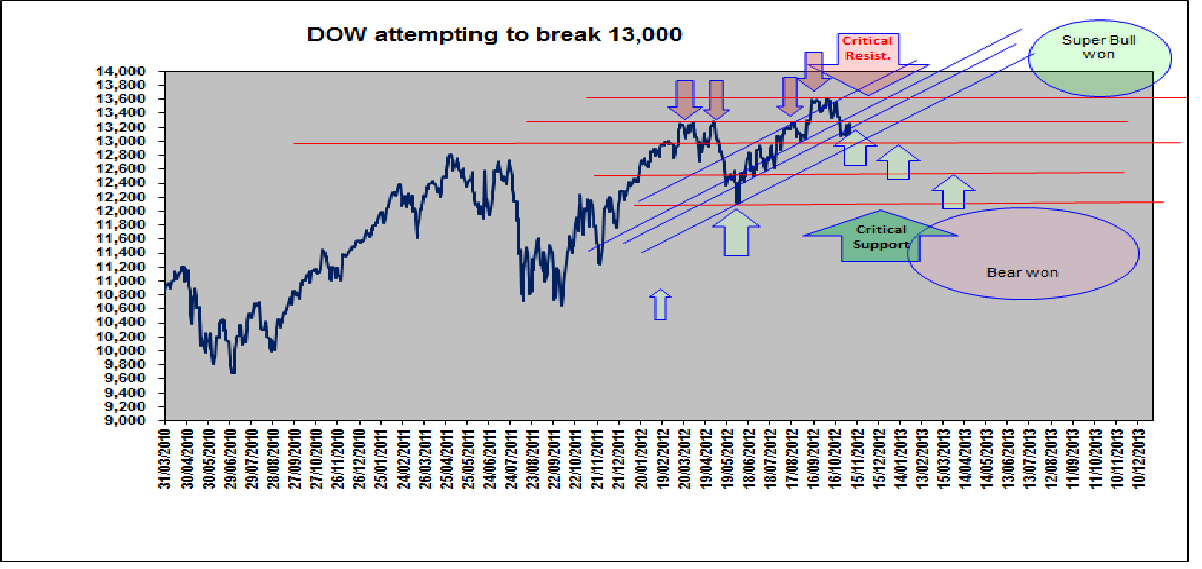
DOW


12,811.32 Down 121.41(0.94%)


NEW YORK (Reuters) - Stocks fell on Thursday and could be in line for more weakness as worries about Washington's ability to find a timely solution to the "fiscal cliff" dominate investor thinking in coming weeks.

The S&P 500 dropped for a second day and closed below its 200-day moving average for the first time in five months.

The moving average is a measure of the market's long-term trend, and a significant break through that level would be seen as a sign of weakness. Just minutes before the closing bell, stocks accelerated their declines and the S&P 500 fell more than 1 percent.

McDonald's Corp (MCD) shares fell 2 percent to $85.13 after the world's largest hamburger chain reported its first monthly drop in global sales since March 2003. The stock's weakness hurt the Dow, which fell through its 200-day moving average on Wednesday.

"Most of the major indices are busting below or challenging those trendlines. Typically those offer pretty strong support, and I would be surprised to see the S&P 500 fall like a knife through here," said Bruce Zaro, chief technical strategist at Delta Global Asset Management, in Boston.

Apple (AAPL) shares sank for a second day. The stock fell 3.6 percent to $537.75 and is down more than 20 percent from its September 21 all-time intraday high of $705.07.

The Dow Jones industrial average (^DJI) lost 121.41 points, or 0.94 percent, to end at 12,811.32. The Standard & Poor's 500 Index (^GSPC) fell 17.02 points, or 1.22 percent, to 1,377.51, ending at its lowest level since August 2. The Nasdaq Composite Index (^IXIC) dropped 41.70 points, or 1.42 percent, to close at 2,895.58.

Since reaching a 52-week closing high of 1,465.77 on September 14, the S&P 500 has dropped 6 percent. On Wednesday, a day after Democratic President Barack Obama defeated Republican Mitt Romney in the U.S. election, the benchmark S&P 500 dropped more than 2 percent for its biggest one-day percentage decline since June 1.

Investors worry that if no deal is reached in Congress over some $600 billion in spending cuts and tax increases due to take effect early next year, the struggling U.S. economy could fall into recession.

While a comprehensive agreement to avoid the automatic spending cuts and tax increases of the "fiscal cliff" was possible, a more likely scenario is for political leaders to find a temporary fix to buy time until the new Congress and Obama are sworn in, which will occur in January.

The prospect of haggling over the budget has deepened the uncertainty for investors, who have sold stocks on the expectation taxes will go up on capital gains and dividends.

"That's really what investors have been reacting to these last two days," said Zaro. "It is this worry about the fiscal cliff and the ability of politicians to come to a solution."

Because of those worries, the market is likely to keep challenging support levels in the coming weeks, he said.

On the data front, the U.S. government reported a better-than-expected drop in weekly first-time claims for unemployment benefits as well as a rise in U.S. exports.

While that news supported stock futures early in the U.S. trading day, it was soon overshadowed by the U.S. fiscal worries.

Qualcomm Inc (QCOM) was a bright spot, with the stock ending up 4.4 percent at $60.67 after the leading supplier of chips for cell phones reported quarterly revenue Wednesday that beat expectations.

Among other earnings reports, Whole Foods Market Inc (WFM) posted earnings that met expectations, but said Hurricane Sandy was a drag on sales this quarter. Its shares slid 5.9 percent to $90.31.

With results in from more than 440 companies, third-quarter S&P 500 earnings are now seen down 0.2 percent from a year ago, which is slightly better than the forecast at the start of the reporting period. Results have been especially weak on the revenue side, however, with just 38 percent of companies beating on sales, Thomson Reuters data showed.

Thursday, 8 November 2012

Noble: Nine months ended 30 September 2012

Record Group operating income from supply chain of US$1,172 million with total operating income, after profit on supply chain assets of US$1,188 million

Record Group volume of 166 million tonnes compared to 158 million tonnes in YTD Sep 2011

Record Group revenue of US$69.8 billion – up 15% from US$60.6 billion in YTD Sep 2011

Agriculture – operating income from supply chain for Q3 showing sequential quarterly growth

Strong liquidity with total committed and uncommitted facilities at US$16.9 billion and liquidity headroom* at US$5.9 billion exceeds total debt outstanding. Strong credit profile with net debt to capital of 46.5%, the lowest since 2008

Conservative approach to risk in the volatile environment. VaR of 0.36% of shareholders’ equity as of end September 2012


DOW: Did Obama crash US market???


12,932.73 Down 312.95(2.36%)


NEW YORK (Reuters) - The Dow industrials lost more than 300 points in a sell-off on Wednesday that drove all major stock indexes down over 2 percent in the wake of the presidential election as investors' focus shifted to the looming "fiscal cliff" debate and Europe's economic troubles.

The Standard & Poor's 500 Index posted its biggest daily percentage drop since June, with all 10 S&P sectors solidly lower and about 80 percent of stocks on both the New York Stock Exchange and the Nasdaq ending in negative territory. Both the Dow and the S&P 500 closed at their lowest levels since early August.

Financial stocks and energy shares, two sectors that could face increased regulation after President Barack Obama's re-election, were the weakest on the day. The S&P financial index (.GSPF) lost 3.5 percent, while the S&P energy index (REU:^GSPEI) fell 3.1 percent. An S&P index of technology shares (.GSPT) slid 2.8 percent as the stock of Apple Inc (AAPL) entered bear market territory.

Obama's victory had been anticipated, though many polls indicated a close race between the president and Mitt Romney, his Republican challenger, going into election day.

The election was considered a major source of uncertainty for the market, but now the focus turns to the fiscal cliff, with investors worrying that if no deal is reached over some $600 billion in spending cuts and tax increases due to kick in early next year, it could derail the economic recovery.

The Republican Party retained control of the U.S. House of Representatives, while the Senate remained under Democratic control.

David Joy, chief market strategist at Ameriprise Financial in Boston, said this kind of divided government was disappointing "since that configuration has resulted in gridlock and there's no clear path towards unlocking that.

"It holds implications for how quickly we resolve the fiscal cliff issue, or whether it gets resolved at all," said Joy, who helps oversee $571 billion in assets.

The market's losses were broad, with pessimism exacerbated by overseas concerns after the European Commission said the region would barely grow next year, dashing hopes for improvement in the short term.

Still, some viewed the day's slide as a buying opportunity, saying it was unlikely that no deal would be reached on the fiscal cliff and arguing that Europe's troubles were already priced into markets.

"There's no question that Europe is lagging the rest of the developed and emerging world, but stocks will find a base soon, when investors start seeing through some of the smoke over the region and cliff," said Richard Weiss, who helps oversee about $120 billion in assets as a senior money manager at American Century Investments in Mountain View, California.

The Dow Jones industrial average (^DJI) slid 312.95 points, or 2.36 percent, to close at 12,932.73. The Standard & Poor's 500 Index (^GSPC) fell 33.86 points, or 2.37 percent, to 1,394.53. The Nasdaq Composite Index (^IXIC) lost 74.64 points, or 2.48 percent, to close at 2,937.29.

The S&P 500 closed below the key 1,400 level for the first time since August 30, while the Dow ended under 13,000 for the first time since August 2.

About 7.81 billion shares traded on the New York Stock Exchange, the American Stock Exchange and Nasdaq, slightly below last year's daily average of 7.84 billion, though Wednesday's volume did surpass that of many recent sessions.

Contributing to the Nasdaq's decline, Apple shares fell 3.8 percent to $558, off 20.8 percent from an all-time intraday high of $705.07 set on September 21. That slump puts the stock of the world's most valuable publicly traded company in bear market territory.

The drop was a reversal from Tuesday's gains when voting was under way. Defense and energy shares were among the market leaders that day, causing speculation that some investors were betting on a Romney win.

On Wednesday, an index of defense shares (.DFX) fell 2.9 percent, its biggest one-day drop in a year. Shares of United Technologies (UTX) dropped 2.9 percent to $77.68 while Lockheed Martin (LMT) sank 3.9 percent to $91.15.

Energy shares fell as investors bet that the industry may see increased regulation in Obama's second term, with less access to federal lands and water. Crude oil shed more than 4 percent while an index of coal companies (.DJUSCL) plunged 8.8 percent. Coal firms Peabody Energy (BTU) lost 9.6 percent to $26.24 and Arch Coal (ACI) sank 12.5 percent to $7.58.

Among financials, JPMorgan Chase & Co (JPM) fell 5.6 percent to $40.46 and Goldman Sachs (GS) dropped 6.6 percent to $117.98.

"The notion that you may have gotten a respite on the financial services side (with regulation) if Romney had been elected is obviously being unwound," said Mike Ryan, chief investment strategist at UBS Wealth Management Americas in New York.

Healthcare stocks were mixed as President Obama's re-election rules out the possibility of a wholesale repeal of his healthcare reform law, though questions remain as to what parts of the domestic policy will be implemented. The S&P health care index (REU:^GSPAI) shed 1.9 percent. In contrast, Tenet Healthcare (THC) was the S&P 500's biggest percentage gainer, up 9.6 percent at $27.34.

In 2008, stocks also rallied on election day, but then fell by the largest margin on record for a day following the vote, with each of the three major U.S. stock indexes posting losses ranging from 5 percent to 5.5 percent.

Wednesday, 7 November 2012

BIOSENSORS REPORTS STRONG SALES AND PROFITABILITY IN THE SECOND QUARTER AND FIRST HALF OF FISCAL YEAR 2013


Q2 FY13 and Recent Highlights:
Total revenue of US$79.8 million, representing 28% year-on-year growth

Interventional Cardiology Products (IVP) sales, largely comprising drug-eluting stent (DES) sales, increased substantially by 61% year-on-year to US$61.9 million

Gross margin on total product sales was 80%, a significant improvement of 9% year-on-year

Operating profit reached US$33.9 million, a 71% year-on-year increase, while net profit excluding exceptional items grew 36% year-on-year to US$29.2 million

A study published in August in the Journal of the American Medical Association (
JAMA) confirms BioMatrix™reduces cardiac events in acute myocardial infarction (AMI) patients more effectively than a bare-metal stent

In October, Biosensors extended its licensing agreement with Terumo for territories outside the United States and Japan and positions itself for more strategic cooperation with Terumo in all sales territories, including Japan

At the Transcatheter Cardiovascular Therapeutics (
TCT) conference in October, the Company released the final 5-year results for its ground-breaking LEADERS trial, demonstrating improved long-term clinical outcomes for BioMatrix Flex as compared to Cypher® Select™


See? Presentation slides


CPL


Past success??? Future Ahead???


Read? How are you measuring up with your investment return? (4)


Past success??? Future Ahead???

You must collect your portfolio performance data on daily basis and be ever ready to plot these data in any other ways to view Past Success of Failure.

Without knowing your past success or failure of your investing skills, how do you revise your investment strategies and uplift your investing skills to meet your investing goal?

Hard. Right???

How about Future Ahead???

Absolutely no one will know how our portfolio will perform in the future.

BUT, it doesn't mean that we are helpless.


” If you have a worry problem, do these three things: 1. Ask yourself: “What is the worst that can possibly happen?” 2. Prepare to accept it if you have to. 3. Then calmly proceed to improve on the worst.” (Carnegie 49)

NO, NO, NO!!!

We can easily STRESS TEST our own  portfolio for the worst case scenario!


DOW


13,245.68 Up 133.24(1.02%)


Tuesday, 6 November 2012

CPL - Breakout today!


Monday, 5 November 2012

Keppel’s overseas yards secure contracts worth S$160 million


Singapore, 5 November 2012 Keppel Offshore & Marine Ltd’s (Keppel O&M) subsidiaries, Keppel Subic Shipyard, Inc. (Keppel Subic Shipyard) in the Philippines and Keppel Verolme BV (Keppel Verolme) in the Netherlands, have secured contracts totalling S$160 million.

Keppel Subic Shipyard has been awarded a contract from Shell Philippines Exploration BV (SPEX) to build a Depletion Compression Platform (DCP) to support the recovery of natural gas from the Malampaya gas field near Palawan Island, in the Philippines.

When completed, the DCP will be deployed next to an existing shallow water production platform. The DCP is designed to maintain the current availability and deliverability of natural gas from the Malampaya field through regulating the gas export pressure and flow rates.

Keppel Subic Shipyard will be responsible for the fabrication of the entire DCP, integration of the topside modules as well as the fabrication of the link bridge connecting the DCP to the shallow water platform. The DCP comprises gas compression facilities mounted on a barge deck, supported by four tubular legs on base footings.

Mr Michael Chia, Managing Director (Marine), Keppel O&M, said, "Over the years, Keppel Subic Shipyard has established a creditable track record in ship repair and major fabrication work. This DCP project is a good platform for us to further enhance our competencies for complex offshore work.

"With a 1,500 tonne gantry crane, various other cranes and worksite facilities which are being set up in conjunction with this project, we are positioning our yard with stronger capabilities to offer better services, take on more onshore and offshore fabrication projects as well as handle conversion work for Floating Production Storage and Offloading (FPSO) vessels, including the fabrication of topside modules.

"Keppel Shipyard in Singapore, which has extensive experience in offshore production modules, is supporting Keppel Subic Shipyard on its work scope. Keppel Subic Shipyard will work closely with all stakeholders to ensure that the project is delivered to the highest quality, in a safe and timely manner."

Mr Sebastian Quiniones, Managing Director of SPEX and Malampaya Asset Manager, said, "Keppel Subic Shipyard has demonstrated that it is one of the most comprehensive yards in the Philippines and a natural choice for us for this project. We are confident that with Keppel’s experience and competencies, the yard will be able to deliver the project to our highest satisfaction and enable us to support the Philippine government’s goal towards energy security."

The development of the DCP forms Phase 3 of the Malampaya Deep Water Gas-to-Power project, which is jointly undertaken by government agencies and private companies. The Philippine Department of Energy leads in this project, and is supported by a consortium comprising the Malampaya project operator, SPEX, and its joint venture partners, Chevron Malampaya LLC and the Philippine National Oil Company-Exploration Corporation (PNOC-EC).

Over in the Netherlands, Keppel Verolme has secured a contract from its repeat customer Heerema Marine Contractors Nederland B.V. (HMC) for the drydocking survey of the deepwater construction vessel (DCV) Balder. One of the largest crane vessels in the world, Balder measures 154 metres (m) in length and 86m in width, and is capable of lifting 6,300 tonnes.

The yard’s work scope for this project includes the painting of the hull, bracings and cranes. It will also undertake steel renewals, as well as the maintenance and repairs to the tanks, including piping and conservation works. The vessel is expected to be delivered in 1Q2013.

This is Balder’s second visit to Keppel Verolme; in 2001, it underwent an extensive conversion programme at the yard. The project work scope included the construction of facilities to receive the 120m-high pipe-laying tower and accompanying components.

Another project recently completed by Keppel Verolme for HMC was the life extension of the DCV Thialf, HMC’s largest such unit. Over the years, Keppel Verolme has undertaken several major projects for HMC.

Mr Harold Linssen, Managing Director of Keppel Verolme, said, "Keppel Verolme is pleased to be of service to our repeat customer Heerema Marine Contractors again and look forward to delivering yet another high quality project to them safely, on time and within budget. We pride ourselves on our ability to respond swiftly to our customer’s needs with innovative and cost-effective solutions."

The above contracts are not expected to have a material impact on the net tangible assets or earnings per share of Keppel Corporation Limited for the current financial year.

-The End-

Why Are Investors Fleeing Equities? Hint: It's Not the Computers

By ANDREW ROSS SORKIN | New York Times

Let's stop with the excuses.

You've no doubt been reading a lot about a "crisis of confidence" on Wall Street in recent days after software problems at a big trading firm sent the stock market, briefly, into a tizzy.

Everyone is hyperventilating at the errant trades at the Knight Capital Group - suggesting, in the words of Arthur Levitt, that these malfunctions "have scared the hell out of investors." The problems at the firm were immediately lumped together with Facebook's glitch-filled initial public offering, the flash crash of 2010 and the rescinded public offering of BATS Global Markets, among others.

Apparently - if the experts are to be believed - these computer errors are the reason "investors are fleeing the markets like never before," Dennis Kelleher, president of Better Markets, told The Los Angeles Times. Dozens of articles about the trading blunder included some form of that contention, using statistics showing that $130 billion or more had been withdrawn from mutual funds over the last year or so.

Let me offer a more straightforward explanation of why investors have left the stock market: it has been a losing proposition. An entire generation of investors hasn't made a buck.

"The cult of equity is dying," Bill Gross, the founder of Pimco, wrote in his monthly letter last week.

"Like a once bright green aspen turning to subtle shades of yellow then red in the Colorado fall, investors' impressions of 'stocks for the long run' or any run have mellowed as well," Mr. Gross wrote. His letter came after he had sent a Twitter post that read: "Boomers can't take risk. Gen X and Y believe in Facebook but not its stock. Gen Z has no money."

(Mr. Gross, who manages the largest bond fund in the world, started a stock fund several years ago, too, so he has a vested interest in seeing stocks succeed for his clients.)
This is not to say that Knight Capital's software debacle is helping instill confidence in investors. But it's doubtful it would make a Top 10 list of reasons for investors to flee.

So why are so many investors sitting on their hands? The unemployment crisis, the European debt crisis and the looming fiscal-cliff crisis, to name just a few reasons. Economic growth is slowing, not just in the United States but in China, too.

Those are the same reasons that chief executives and boards of American companies are sitting on $2 trillion in cash and not investing in their own businesses. They are scared, rightly or wrongly, about the future. (It should be noted that some of the most skilled investors, including Warren Buffett, contend that when everyone's scared, that's usually a good time to invest. Mr. Buffett famously advised that investors "should try to be fearful when others are greedy and greedy only when others are fearful." But it doesn't seem like that advice is being followed.)

Even the hedge fund titan Louis M. Bacon has been so humbled by the stock market that he returned $2 billion to his investors last week rather than risk losing it.

None of these fundamental issues have anything to do with a computer that ran amok or a trade order mistakenly entered by a fat finger.

Blaming computers is not a new phenomenon. In 1988, months after the 1987 crash, The New York Times explained that small investors shared a "fear of being whip-sawed by program trading."

"I think everybody is concerned about the flight of the small investor - the S.E.C., the exchanges, everyone," Howard L. Kramer, assistant director of the Securities and Exchange Commission's division of market regulation, said in another article, also in 1988.

Here are the numbers today: About $171 billion has flowed out of mutual funds over the last year, according to the Investment Company Institute, which tracks mutual fund data. Where has all that money gone?

Bonds. About $208 billion has flowed into the bond market over the same period, according to numbers from the I.C.I.

The fact that so few long-term investors are in the stock market has only worsened the volatility, since it often seems as if the only people who are trading stocks are the professionals.

Which brings us back to the "crisis of confidence." This does exist among investors, but they are not focused on how computers are making the markets go haywire. Rather, they are concerned about the future of the economy and, yes, trust.

Individuals are worried that it's hard to make the right bet and worried that the market is rigged against them. Much of this is an outgrowth of woes of Wall Street's own making, like insider trading cases or market manipulation scandals. Those situations are partly why individual investors don't believe they stand a chance against the professionals.

Consider this: Of 878 students at 18 high schools across 11 different states surveyed by the Financial Literacy Group, three-quarters of them said they agreed with this statement: "The stock market is rigged mostly to benefit greedy Wall Street bankers."

So for now, it seems, trading firms don't just need to throw out their electronic trading systems or bring in more regulators to oversee their stock executions. They need the country to get a shot in the arm to address its economic problems, and they need the public to have faith in the long term.

Instead of pointing the blame at one incident or another, look at the fundamentals.


Createwealth8888:

In Singapore, what is the money flowing to?

S-REITs???


Sunday, 4 November 2012

G20 flags U.S. fiscal cliff, Europe's debt woes

MEXICO CITY (Reuters) - Finance chiefs of the world's 20 leading economies are ringing alarm bells over the U.S. fiscal cliff and Europe's debt woes at a meeting in Mexico this weekend as they look to push back deficit reduction targets to help boost growth.
 
Unless a fractious U.S. Congress can reach a deal, about $600 billion in government spending cuts and higher taxes are set to kick in on January 1, threatening to push the American economy back into recession and hit world growth.
 
But with the U.S. presidential election looming on Tuesday, dealing with the fiscal cliff has been delayed.
 
"The Americans themselves acknowledge that this is a problem," a G20 official said on condition of anonymity. "The U.S. administration says it doesn't want to fall off the fiscal cliff, but right now it can't tell us how exactly it will address it because that issue is on ice ahead of the election."
 
Tax cuts enacted under President George W. Bush are set to expire in January, when automatic spending cuts designed to put pressure on lawmakers to strike a long-term budget deal are also set to kick in.
 
"What remains a sort of key aspect is that the United States is not respecting the current commitments (to reduce its deficits) and does not have a credible fiscal consolidation plan," one European official said.
 
The U.S. Congress will also soon have to raise the nation's debt limit to avoid a default.
An initial consensus around the need for urgent action to prevent a new depression has given way to deep differences over issues such as spending to boost growth and the right pace of belt-tightening to tackle high debt levels.
 
Jose Angel Gurria, head of the Organization for Economic Co-operation and Development, said on Saturday the G20 should appeal to the United States to avoid the fiscal cliff, but added he was optimistic that Congress would strike a deal.
 
"I still believe it is not going to be applied," Gurria said in an interview before the meeting of G20 finance chiefs, which formally starts on Sunday.
 
Officials are also concerned about Japan's own fiscal cliff, and recognize that previous commitments made by developed countries to cut their budget deficits in half by 2013 and to stabilize their debt load by 2015 look unfeasible.
 
U.S. and European officials are also likely to come under pressure from G20 peers for dragging their feet on implementing the so-called Basel III accords on financial regulations, the world's response to the 2007-09 financial crisis.
 
Despite the issue's prominence, a G20 source said Russia wants to keep financial regulation discussions at a more technical level when it takes over the presidency of the group from Mexico after this meeting, which ends on Monday.
 
Spain's reluctance to seek financial aid is stoking worries that Europe's debt crisis could further hurt world growth. The government is under pressure to seek a bailout as it struggles to cope with high public debt and the cost of recapitalizing its banks. Euro zone sources say they expect Spain to seek financial aid from the euro zone in November.
 
A government source told Reuters on Wednesday that Prime Minister Mariano Rajoy had not ruled out applying for a rescue, but Rajoy has signaled he will not rush unless market conditions deteriorate significantly.
 
(Reporting by Alonso Soto, Alexandra Alper, Tetsushi Kajimoto, Lesley Wroughton, Julien Toyer, Jan Strupczewski, Gernot Heller, Louise Egan, Krista Hughes, Dave Graham and Michael O'Boyle; Writing by Simon Gardner; Editing by Doina Chiacu)
 

Retirement Income for Life??? (3)


Read? Retirement Income for Life??? (2)


Investing income for life

How do you view the money coming from the stock market?
 
Money as chunks of wealth???

Money as streams of income???


Money as streams of income???

You are income investors. You are also likely to be interested in S-REITs as possible sources of streams of income.

Come Monday, you can easily join them if you are interested too.

Joining them?


Read? S-REITs;

Read? REITData

Hey! Wait a minute. I am lagging in this knowledge and want to learn more!

No problem!!!

Plenty of S-REIT or income investing bloggers here. 

Visit? The Finance

Visit? Investment Bloggers based in Singapore.

Money as chunks of wealth???


Sorry! Come Monday. You don't even have slight chance of smelling it.

That is the way mother nature of stock market works for chunks of wealth. It is only available to growth dividend investors who have these two great attributes in long-term investing for wealth:

GUT and PATIENCE.

Delay gratification is a must!


Bad news!!!

Come Monday. You can't possibly be one of them. You can't even find enough blogs to read and learn more.

When Uncle8888 combs Singapore finance and investment blogs daily and sometime even hourly; the number of bloggers advocating stock market as chunks of wealth is becoming endangered species like Singapore babies.


The greatest investment reward comes to those who by good luck or good sense find the occasional company that over the years can grow in sales and profits far more than industry as a whole.
 
- Phillip A Fisher
 
I don't want a lot of good investments; I want a few outstanding ones.
 
- Phillip A Fisher

Read more? How to become Rich in Stocks?


Saturday, 3 November 2012

A few good stocks in sufficient large quantity???


The greatest investment reward comes to those who by good luck or good sense find the occasional company that over the years can grow in sales and profits far more than industry as a whole.
  - Phillip A Fisher


I don't want a lot of good investments; I want a few outstanding ones.
  - Phillip A Fisher


Is life sometime cruel to the innocent (naive, kiasi) when come to investment? (3)


Read? Is life sometime cruel to the innocent (naive, kiasi) when come to investment? (2)


Uncle8888 is right!


It is more like the founders smelling the blood of more and more naive and kiasu investors seeing how earlier investors boosting of their high return from their investment.

Late comers become kiasu and jump in???

This investment scheme then evolves into Ponzi???

Then blame who???

Uncle8888 read this somewhere:

A late entrant to the Gold bar scheme


Mr. Chan (not his real name) advised his wife to stay way from the Genneva Gold scheme. She did.
 
After a year, the wife got angry with Mr. Chan because her friends invested in Genneva Gold and received their monthly payout and also the buyback payments. They were making a good return.

The wife decided to ignore Mr. Chan. Her family joined her to put in all of their savings into the scheme, and to make up for the lost time. Genneva Gold was raided by by authority six months later, and all their savings got stuck. Mrs. Chan and her family do not know if they will get back their investments and gold bars.


Barbell strategy (2)


Read? Barbell strategy


Nassim Nicholas Taleb (pictured), principal of Universa Investments and famed author of “The Black Swan”, delivered a keynote speech on some useful properties of barbells at Gaim International 2012. Noting that the opposite of fragile is “antifragile”, Taleb explained that barbells – a type of investment strategy that sits on both ends of the yield curve for example in bonds – possess this antifragile characteristic, enabling them to benefit from crises.

Barbells, then, have the capacity to turn something that’s robust into something antifragile.

If you have a lot of upside and a lot of downside in a portfolio (left tail distribution) it’s still fragile said Taleb, noting that antifragility has a big right tail distribution with big upside and little downside. Constructing a barbell, said Taleb, involves “clipping the left tail”.

In terms of strategy, said Taleb, instead of investing in medium-risk securities you invest 80 per cent of money in zero risk securities (left side of the barbell) and 20 per cent in maximum risk securities (right side of the barbell). “The linear correlation is vastly superior to medium-risk securities,” said Taleb. “Barbells put you in a situation where error and uncertainty help.”

The reason barbells are important is because today we’re building systems that are vulnerable to model errors. After all, small changes in the standard deviation of tails can blow things up. You want to be protected from any concentration of risk in the left tail and replace that with barbells said Taleb.

“Anything that has a right tail increases with variance and these portfolios gain from variance: we call that the barbell theory,” said Taleb. He said that uncertainty should be welcomed because that’s what nature itself is built on. Evolution is based on things failing and being replaced by stronger equivalents.


DOW


13,093.16 Down 139.46(1.05%)


Stocks finished down 1 percent Friday, wiping out the previous session's gains, despite a better-than-expected government jobs report and amid nervousness ahead of next week's presidential election.
The Dow and Nasdaq finished in the red for the week, while the S&P 500 squeezed out a small gain.

Friday, 2 November 2012

Time Deposit – Upfront Interest???

Just For Thinking ....


Receive upfront interest one calendar day after placement.


Are you excited to receive this upfront interest?


Good deal???


What do you think?


Is life sometime cruel to the innocent (naive, kiasi) when come to investment? (2)

Just For Thinking ...

Read? Is life sometime cruel to the innocent (naive, kiasi) when come to investment?


Did these investment idea or scheme started off by the founders as Ponzi???


Don't think so.

It is more like the founders smelling the blood of more and more naive and kiasu investors seeing how earlier investors boosting of their high return from their investment.

Late comers become kiasu and jump in???

This investment scheme then evolves into Ponzi???

Then blame who???


Conversion of a FLNG for Golar by Kep Corp


LONDON, Nov 1 (Reuters) - Norwegian shipper Golar LNG made big waves on Thursday by ordering its first floating liquefied natural gas (LNG) plant, an innovation that analysts said could loosen the grip on LNG production enjoyed by oil majors.

The announcement set Golar's stock soaring as analysts recommended shares in the Norwegian shipper, calling the move a big game changer. Its share price rose more than 10 percent to $43.14.

Golar agreed to convert one of its old LNG tankers into a floating LNG vessel (FLNGV), or production plant, and is eyeing African flared gas and pipeline systems as a source of supply, it said.

Singapore's Keppel Shipyard will start drawing up designs with vessel conversion due to start around mid-2013, Golar said, in a deal analysts say may cost $600 million.

It will produce around 2 million tonnes of LNG annually.

Golar's billionaire chairman John Fredriksen said the company retains the right to convert another two tankers.

Fredriksen said FLNGV will open new markets for LNG as well as boost production capacity at a time of bottlenecks with "massive opportunities for growth in the next five to 10 years."

"If successful, a massive value transfer from oil companies to Golar LNG could emerge as the current LNG production cartel could be broken," RS Platou Markets said in a client note.

"A successful FLNG conversion will be a big game changer for GLNG as it can offer a full infrastructure solution between gas markets," it added.

The global LNG market is controlled by a handful of state and private companies, like Shell and BG Group, as the high cost of developing plants has prohibited the entry of independent players.

The move also underscores the growing attraction of LNG, with demand due to grow rapidly over the next decade as countries move away from coal-fired power plants towards cleaner burning gas.

It also paves the way for Golar LNG to leapfrog rivals by entering the upstream arm of the business long denied to shipping companies.

"This gives Golar the chance to enter the upstream segment, for example, by partnering with companies to monetize gas in west Africa that would otherwise be flared," Arctic Securities analyst Erik Stavseth said.

Oil drillers produce gas as a byproduct which is often flared, or burnt, on-site given its low value compared with crude oil.

Stavseth said Golar's ability to liquefy and sell stranded gas purchased at a discount will keep its shipments of LNG comparatively cheap at a time of rising global demand.

Unlike Shell's Prelude floating LNG project, the plant envisaged by Golar will be moored close to shore and supplied largely by pipelines, not distant offshore gas fields.

"The floating solution gives customers increased flexibility, quicker development times and the unique ability to develop reserves that are currently uneconomic," Golar said in a statement.

"It further gives them an opportunity to capitalize on the large global gas spreads and the attractive economics associated with gas as an energy resource," it added.

U.S. gas prices have bounced off 20-year lows to about $3 a million British thermal units (mmBtu), compared with $9/mmBtu in Europe and $13.50/mmBtu in Asia.

Golar's floating LNG plant will have maximum capacity of 2 million tonnes/year.

The first conversion will be ready by the first-quarter 2015, it added.


Golar’s Chairman John Fredriksen said, “Golar helped to open up the LNG market through the introduction of floating receiving terminals which have opened a lot of new markets for LNG. Our FLNGV’s will be able to provide a fast-track, cost effective solution for developing new LNG production capacity. We believe this technology will be extremely attractive to companies looking to develop their natural gas assets and we are actively pursuing multiple opportunities. It is Golar’s intention to market the solution for field developments as well as for direct production from existing pipeline infrastructure. The Board sees particular opportunities in the African region, where gas prices remain low. Significantly, large quantities of gas are currently being flared and the infrastructure doesn’t naturally support large land based LNG investments. The Board is excited about the new business line and sees massive opportunities for growth in the next five to ten years”.

Here's more from DBS:

Golar LNG is one of the world's largest independent owners and operators of LNG carriers, and where John Fredriksen is Chairman.

KEP will undertake the engineering and conversion work. Under the agreement, Keppel Shipyard will firstly undertake a front-end engineering and design (FEED) study, expected to commence in November 2012.

Vessel conversion is expected to start around mid-2013 following the conclusion of the detailed design and engineering work scope. To accommodate customer requirements, the first unit will be developed through several stages, and is expected to be ready for production in 1Q2015.

Contract to be firmed once FEED study concludes. The proposed unit will have a capacity of up to 2m tonnes per annum (tpa) and will have 125,000 cubic meters of LNG storage capacity.

Earlier FLNG projects by Shell and Petronas were valued at US$3bn and US$2bn respectively, with production capacity of 3.6m tpa/1.2m tpa. While we understand that the conversion contract and project value will be firmed up only when the FEED study confirms the engineering and work scope, we believe the project value to KEP will be significant.

Significant breakthrough for KEP; a potentially new growth driver. We see this project as a breakthrough for KEP, underscoring its capability and execution track record, with FLNGV projects and having been awarded to Korean yards to date.

We believe this could represent a new growth driver for the group, with Golar noting opportunities in the African region where large quantities of gas are currently being flared and the infrastructure does not support large onshore LNG investments.


DMG & Partners Securities
 

Golar signed agreement with Keppel for conversion of FLNG vessel. News reports highlighted that Golar LNG has reached an agreement with Keppel Shipyard for the conversion of its first floating liquefied natural gas vessel (FLNGV). The FLNGV will have a capacity of up to 2m tonnes per annum and 125,000 cubic meters of LNG storage. Golar will convert one of its existing Moss LNG carriers and has options for two similar conversions at Keppel Shipyard. Upstream reported that Keppel will start Front End Engineering and Design (FEED) this month and physical work on the vessel is expected to start in mid-2013. The conversion is expected to complete in 1Q2015. We maintain BUY with a TP of S$13.80. Stock is now trading at 12.6x FY13F P/E with 4% yield.
Positive on the news.
We view the move positively and the award highlights the strength of Keppel in the conversion space. In the past, Golar awarded three FSRU conversions to Keppel (two projects) and Sembcorp Marine (one project) and we believe a successful conversion of a FLNGV could potentially lead to a more such projects. No contract value was reported in the news but we believe the shipyard value for the FLNGV could be as much as US$500m, depending on the scope of work, especially the procurement portion. For comparison, Shell’s Prelude FLNG project has a capacity of 5.3m tonnes per annum and the shipyard value with Samsung Heavy Industries is reported to be around US$3b.
 
Related Posts with Thumbnails